Exploring Alternatives for the Chatbot Metaphor
1 Introduction
With the growing popularity of generative AI applications based on large language models (LLMs), such as ChatGPT, Claude, Copilot, Gemini, and Vibe, we increasingly take for granted the user interface or interaction metaphor of the chatbot. You type. It types back. You ask questions. It gives answers. It is as if there were someone behind the screen of your laptop, a conversation partner who reads your questions and responds (see Figure 1).
Figure 1: AI as a Conversation Partner: As if There Is Somebody Behind the Screen
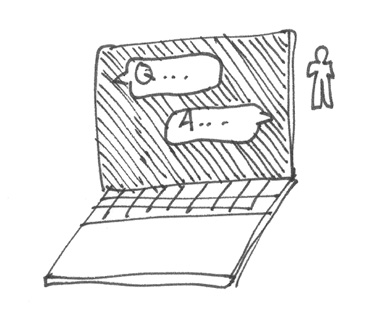
In the 1960s, Joseph Weizenbaum observed how easily people are influenced into thinking that a chatbot has intelligence, empathy, creativity, and other humanlike traits (Berry, 2023; Floyd, 2023). People need only very small hints to make them project such traits onto a chatbot; for example, representing the user’s input and the system’s output in the form of a dialogue, with separate paragraphs (e.g., in desktop or laptop-based apps) or with speech bubbles (e.g., in mobile phone-based apps). Weizenbaum warned of what has since become known as the ELIZA effect; we tend to project all sorts of human qualities onto the system that we are interacting with, as if it were a human conversation partner.
The metaphor of the chatbot as conversation partner is promoted by big tech companies, presumably because it promotes adoption; it makes people trust and use these applications. Uncritical use of such chatbots can, however, have serious drawbacks, such as eroding users’ cognitive skills (Kosmyna et al., 2025). Moreover, LLMs can be weaponized to spread disinformation, polarize societies, and undermine democracies (Maurya et al., 2025), similar to how social media started out as seemingly nice, but have increasingly been weaponized. Furthermore, people can develop relationships with chatbots that appear friendly and helpful and place too much trust in them and disclose personal information to them, which could then be used to manipulate users (Cheng et al., 2026), or they can develop an overly intimate relationship with these systems and become overly reliant on them (Namvarpour et al., 2026; Rani et al., 2026).
2 Metaphors in Human–Computer Interaction
In human–computer interaction (HCI), metaphors are often used to present systems in ways that shape how people experience them. Typically, such metaphors involve using images of well-known objects to represent underlying qualities of the system, to help people to learn, understand, and use an unfamiliar system (Carroll et al., 1988): “metaphors allow the transference or mapping of knowledge from a source domain (familiar area of knowledge) to a target domain (unfamiliar area or situation), enabling humans to use specific prior knowledge and experience for understanding and behaving in situations that are novel or unfamiliar” (Neale & Carroll, 1997, p. 441). The images that are meant to elicit and convey certain metaphors can be used in visuals in the user interface, but also, e.g., in the images or words that companies use to market their systems or in the words that people use to talk about these. OpenAI, e.g., chose the word ChatGPT to convey the metaphor of conversation partner, and people colloquially say things like “I asked ChatGPT this morning …” to describe using it.
Below, we will explore several alternative metaphors for LLM-based systems. A well-known alternative is, for example, the “stochastic parrot” (Bender et al., 2021), which critiques the parroting behavior of such systems.
We can turn to phenomenology to start exploring alternative metaphors. In the terminology of Ihde (1990) and Verbeek (2006, 2015), a chatbot exemplifies an alterity relation, as if interacting with another entity. Other forms of interaction include embodiment or cyborg relations, as with eyeglasses experienced as transparent extensions of the body; hermeneutic or augmentation, like a thermometer that you look at to learn something about the world; immersion or background, like a smart home system that controls air flow and light automatically. Perhaps one of these other metaphors is more appropriate than the default chatbot metaphor. Some software developers also critique the chatbot metaphor, arguing that typing or speaking may not always be efficient ways to instruct a computer (Julian, 2025; Ma, 2025).
The following alternative metaphors may better reflect the underlying technology (Steen et al., 2025) or the effects on society and the environment (Bender et al., 2021; Crawford, 2021), or encourage more virtuous uses of LLMs. The following alternative metaphors are discussed: a mirror (Vallor, 2024); a calculator and multiplier; a frame; and direct manipulation. The first three are meant as cautionary tales; they point to various shortcomings or risks. The fourth (direct manipulation) is used to discuss how AI systems can be designed and used in ways that can help people cultivate relevant virtues (Vallor, 2016).
3 Mirror
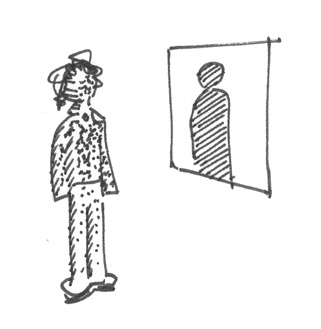
Shannon Vallor uses the metaphor of a mirror in her recent book, The AI mirror: How to reclaim our humanity in an age of machine thinking (2024). This metaphor aims to convey the warning that AI systems provide distorted and partial reflections. They reflect what we put before them. If the training data contain biases, those biases appear in the reflections. Moreover, the AI mirrors’ reflections are very often deformed and always only partial. If you look in an AI-mirror, the reflected image does not have any volume, weight, texture, or temperature. It is only a visual, deformed, and partial reflection (see Figure 2). Critically, AI systems function as rearview mirrors because they are based on data from the past, even though their outputs pretend to be predictive. Moreover, looking at reflections of ourselves can remind us of the myth of Narcissus and warn us about the risks and costs of looking into AI mirrors too often.
Figure 2: AI as a Mirror: Giving a Flat, Distorted, and Partial Image, Based on Past Data
4 Calculator and Multiplier
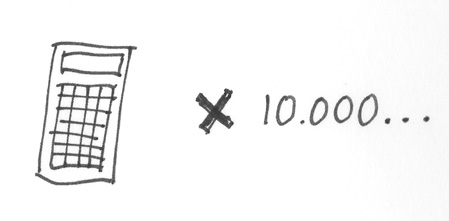
Regarding the technology underlying LLM-based systems, one can argue that they are only very big calculators: very big and very expensive machines that calculate the likelihood of words occurring in a particular sequence and that generate nicely flowing texts that look convincingly real. This can give some relief; these machines are only calculators, without any bad intentions. Yet this description is incomplete, because LLM-based systems are also multipliers of human capabilities (Ashby, 1957). Their effects on the world can be enormous. People who want to do good can use these machines to do x times more good. Indeed, people who want to do evil can use these machines to do x times more evil (see Figure 3). This does not, however, suggest that technology is neutral. It’s also neither inherently good nor inherently bad. Much depends on the objectives for which it is deployed and on path dependencies that are created over time.
Figure 3: AI as a Calculator: Its Effects Can Be Multiplied Enormously
5 Frame
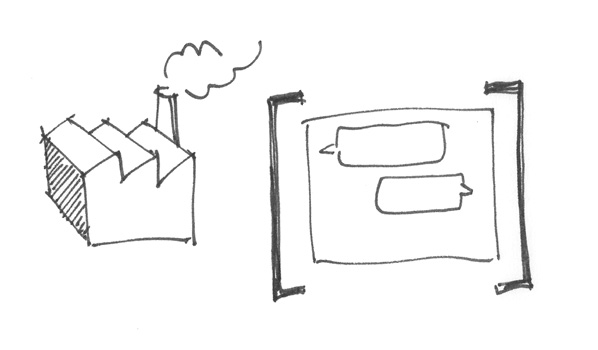
The chatbot metaphor suggests that somebody is on the other side of the screen, reading your words and typing words in response. Nonetheless, there is no little person inside your laptop or phone. The screen of your laptop or phone creates a frame. Outside of that frame is a gigantic system that makes the LLM and the chatbot work. What happens outside the frame is invisible to you (see Figure 4). As early as 2021, researchers such as Crawford (2021) and Bender et al. (2021) drew attention to what happens outside our view, such as the large amounts of energy and water that are used in the training of LLMs and the human labor that is deployed in curating the data, providing feedback to the LLM, and fine-tuning the chatbot (Guzman et al., 2023; Miceli et al., 2024). Generative AI applications involving images or video can require even more energy and water (Casey, 2025).
Figure 4: AI as a Frame: Concealing What Lies Outside It
6 Direct Manipulation
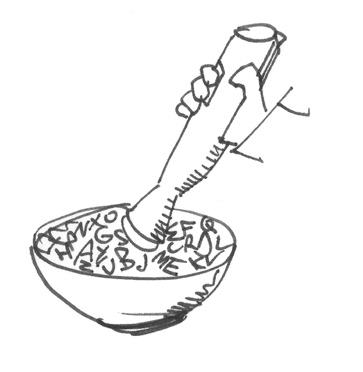
After three metaphors highlighting the limitations, costs, and risks of LLMs, we turn to a more constructive metaphor: direct manipulation. This is a classic metaphor in HCI, in which digital objects and the interactions one has with these digital objects resemble physical objects and the interactions one has with these physical objects (Shneiderman, 1982, 1983). In MS Paint, you can pick and manipulate a brush to apply paint on a white canvas. Applied to LLMs, the metaphor might work as follows: Imagine picking up a handheld blender, placing it in a bowl of words, to transform the words: the words begin in Portuguese and become English as you blend them. This is the metaphor of using a tool (Schuler & Namioka, 1993): pick the tool, use it to translate words from Portuguese to English, and then put it back. You do the work. You pick up and manipulate the blender. Not some imagined little person behind the screen (see Figure 5).
Figure 5: Using an LLM Like You Use a Handheld Tool: Pick It Up, Use It, and Put It Back
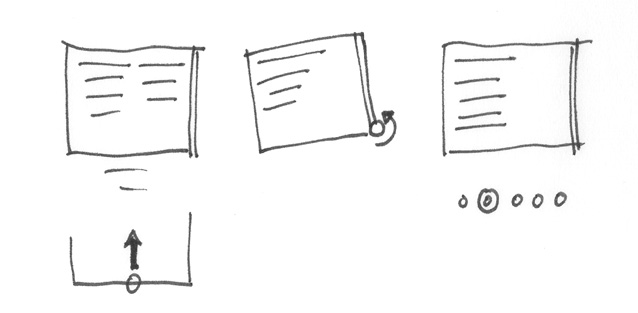
We can further explore the metaphor of direct manipulation: suppose you need a summary of a text of 5,000. You copy and paste the 5,000 words into a text box. Then you manipulate the edges of the box to make it smaller; voila, the text is now a 200-word summary. Or suppose you have written a 200-word advertisement and need different versions for different styles and audiences. You paste the text into the text box. Then you tilt it to the right to make the text more formal or tilt it to the left to make it less formal. Or you can manipulate a slider through different text styles (narrative, descriptive, persuasive, technical, or epic), like manipulating a slider through different filter settings in an image editing program (vivid warm, vivid cool, dramatic warm, dramatic cool, or monochrome; see Figure 6).
Figure 6: Examples of Direct Manipulation: Reduce Text Length or Change Text Style
Interestingly, an early interface for OpenAI’s GPT-2 model did not use a chatbot format. Instead, users had a single text box. They entered the beginning of a sentence or story and clicked the “Complete text” button. The model then generated text. 1
7 Reversing Roles and Cultivating Virtues
The examples of direct manipulation (above) are associated with manipulating texts: summarizing, translating, rephrasing, etc. These are not the only tasks for which people use generative AI (GenAI). Often people want to use GenAI as a conversation partner. Indeed, “therapy/companionship” is the number one application of GenAI (Zao-Sanders, 2025). Moreover, the conversation partner metaphor is very powerful and cannot easily be replaced.
It can therefore be worthwhile to explore ways to use this chatbot metaphor more deliberately so that it can help people to cultivate relevant virtues. Typically, one interacts with a chatbot by asking questions and receiving back answers. We can also note that the conversation partner metaphor can carry troubling connotations, such as a hierarchy between master (who gives orders) and enslaved person (who obeys), or a hierarchy between male (user) and female (stereotypical assistant).
We can, however, reverse these roles to counter the ELIZA effect: the chatbot asks questions, and you provide answers. Moreover, we can think of technologies—in this case LLM-based chatbots—as tools that people can use to cultivate relevant virtues (Vallor, 2016).
This requires examining how applications are designed and used in practice. Social media platforms, for example, are often designed to benefit providers rather than users. They can undermine virtues like self-control and civility, and encourage prolonged use and the spread of outrage and polarization. Conversely, it is possible to design and use such applications differently, so that a person can, for example, choose to set a time-limit, to help cultivate self-control, with user interface features that require some pause before posting, to help cultivate civility. If we imagine a reversal of roles in the chatbot metaphor, you would be doing most of the cognitive work, rather than staring at the screen and waiting for answers. That makes sense for anybody who’s ever been to a fitness studio to stay fit. The machines are there to help you to work out. You lift the dumbbells. It would be silly to let the machines lift the dumbbells for you.
With these reversed roles, you can use a chatbot, for example, as an artificial tutor or coach (Mollick, 2024, pp. 159–192). Suppose your task is to write an essay on medieval castles, with a focus on their social and economic functions. The tutor chatbot would then provide prompts that are meant to start your research process. What interests you most about castles? (to cultivate curiosity). How would you find reliable information about that? (to cultivate carefulness). Or suppose your task is to write a research grant proposal. The coach chatbot would then provide prompts that are meant to start your creative process. If you think about this research project, what would be a great outcome? (to cultivate courage). And how would the research findings help to make the world a better place? (to cultivate justice).
This essay has explored alternatives to the chatbot metaphor for interacting with LLMs. With alternative metaphors, it would be possible to design and use such systems differently; potentially in ways that can help people to cultivate relevant virtues, like courage, justice, creativity, and carefulness. Could AI systems enhance our human capabilities (High-Level Expert Group on Artificial Intelligence, 2019), rather than erode them? Let’s close with an invitation by Weizenbaum to cultivate the virtue of wisdom: the wisdom to distinguish between tasks that you can delegate to computers and tasks that you better do yourself: “What human objectives and purposes may not be appropriately delegated to computers?” (1976, p. 207).
References
Ashby, W. R. (1957). An introduction to cybernetics. Chapman & Hall.
Bender, E. M., Gebru, T., McMillan-Major, A., & Shmitchell, S. (2021). On the dangers of stochastic parrots: Can language models be too big? In Proceedings of the 2021 ACM Conference on Fairness, Accountability, and Transparency (pp. 610–623). ACM Press. https://doi.org/10.1145/3442188.3445922
Berry, D. M. (2023). The limits of computation: Joseph Weizenbaum and the ELIZA chatbot. Weizenbaum Journal of the Digital Society, 3(3). https://doi.org/10.34669/WI.WJDS/3.3.2
Carroll, J. M., Mack, R. L., & Kellogg, W. A. (1988). Interface Metaphors and User Interface Design. In M. Helander (Ed.), Handbook of Human-Computer Interaction (pp. 67–85). North-Holland. https://doi.org/10.1016/B978-0-444-70536-5.50008-7
Casey, C. (2025). Three takeaways about AI’s energy use and climate impacts. MIT Technology Review. https://www.technologyreview.com/2025/05/22/1117277/ai-energy-three-takeaways/
Cheng, M., Lee, C., Khadpe, P., Yu, S., Han, D., & Jurafsky, D. (2026). Sycophantic AI decreases prosocial intentions and promotes dependence. Science, 391(6792). https://doi.org/10.1126/science.aec8352
Crawford, K. (2021). The Atlas of AI: Power, politics, and the planetary costs of Artificial Intelligence. Yale University Press.
Floyd, C. (2023). From Joseph Weizenbaum to ChatGPT: Critical encounters with dazzling AI technology. Weizenbaum Journal of the Digital Society, 3(3). https://doi.org/10.34669/WI.WJDS/3.3.3
Guzman, A., McEwen, R., Jones, S., & Posada, J. (2023). Labor, Automation, and Human–Machine Communication. In The Sage Handbook of Human–Machine Communication (pp. 384–391).
High-Level Expert Group on Artificial Intelligence. (2019). Ethics guidelines for trustworthy AI. European Commission. https://digital-strategy.ec.europa.eu/en/library/ethics-guidelines-trustworthy-ai
Ihde, D. (1990). Technology and the lifeworld: From garden to earth. Indiana University Press.
Julian. (2025). The case against conversational interfaces. https://julian.digital/2025/03/27/the-case-against-conversational-interfaces/
Kosmyna, N., Hauptmann, E., Yuan, Y. T., Situ, J., Liao, X.-H., Beresnitzky, A. V., Braunstein, I., & Maes, P. (2025). Your brain on ChatGPT: Accumulation of cognitive debt when using an AI assistant for essay writing task. https://arxiv.org/abs/2506.08872
Ma, E. J. (2025). Rethinking LLM interfaces, from chatbots to contextual applications. https://ericmjl.github.io/blog/2025/6/14/rethinking-llm-interfaces-from-chatbots-to-contextual-applications/
Maurya, R. G., Shukla, V., Dandekar, R. A., Dandekar, R., & Panat, S. (2025). Simulating misinformation propagation in social networks using Large Language Models. https://arxiv.org/abs/2511.10384
Miceli, M., Tubaro, P., Casilli, A. A., Le Bonniec, T., Wagner, C. S., & Sachenbacher, L. (2024). Who Trains the Data for European Artificial Intelligence? European Parliament. https://hal.science/hal-04662589v1
Mollick, E. (2024). Co-intelligence: Living and working with AI. WH Allen.
Namvarpour, M., Brofsky, B., Medina, J. Y., Akter, M., & Razi, A. (2026). Understanding Teen Overreliance on AI Companion Chatbots Through Self-Reported Reddit Narratives. Proceedings of the 2026 CHI Conference on Human Factors in Computing Systems, CHI ’26. https://doi.org/10.1145/3772318.3790597
Neale, D. C., & Carroll, J. M. (1997). The Role of Metaphors in User Interface Design. In M. G. Helander, T. K. Landauer, & P. V. Prabhu (Eds.), Handbook of Human-Computer Interaction (Second Edition) (pp. 441–462). North-Holland. https://doi.org/10.1016/B978-044481862-1.50086-8
Rani, A., Danry, V., Liang, P. P., Lippman, A., & Maes, P. (2026). Dialogues with AI Reduce Beliefs in Misinformation but Build No Lasting Discernment Skills. Proceedings of the 2026 CHI Conference on Human Factors in Computing Systems, CHI ’26. https://doi.org/10.1145/3772318.3790656
Schuler, D., & Namioka, A. (1993). Participatory design: Principles and practices. Lawrence Erlbaum Associates.
Shneiderman, B. (1982). The future of interactive systems and the emergence of direct manipulation†. Behaviour & Information Technology, 1(3), 237–256. https://doi.org/10.1080/01449298208914450
Shneiderman, B. (1983). Direct Manipulation: A Step Beyond Programming Languages. Computer, 16(8), 57–69. https://doi.org/10.1109/MC.1983.1654471
Steen, M., Timan, T., Van Diggelen, J., & Vethman, S. (2025). We need better images of AI and better conversations about AI. AI & Society, 40(5), 3615–3626. https://doi.org/10.1007/s00146-024-02101-z
Vallor, S. (2016). Technology and the virtues: A philosophical guide to a future worth wanting. Oxford University Press.
Vallor, S. (2024). The AI mirror: How to reclaim our humanity in an age of machine thinking. Oxford University Press.
Verbeek, P. P. (2006). Materializing morality: Design ethics and technological mediation. Science, Technology, & Human Values, 31(3), 361–380. https://doi.org/10.1177/0162243905285847
Verbeek, P. P. (2015). Beyond interaction: A short introduction to mediation theory (Pt. 26-31). Interactions, 22(3). https://doi.org/10.1145/2751314
Weizenbaum, J. (1976). Computer power and human reason: From judgment to calculation. W.H. Freeman and Company.
Zao-Sanders, M. (2025). How people are really using gen AI in 2025. Harvard Business Review. https://hbr.org/2025/04/how-people-are-really-using-gen-ai-in-2025
Date accepted: 6 October 2026
1 This refers to OpenAI’s GPT-2, of 2019; see https://en.wikipedia.org/wiki/GPT-2. It was made accessible, e.g., through TalkToTransformer; see https://youtu.be/hhutHdDRb74.