Between Policy and Market: The Role of China’s Alliance of Industrial Internet in Industrial Digitalization
A Connector, Guide, and Marketplace
1 Introduction
The transformation represented by production digitalization and intelligent manufacturing has given rise to extensive research across interdisciplinary fields (Butollo et al., 2022). The transition toward smart manufacturing signifies a substantial enhancement in national industrial competitiveness. As a result, countries such as the United States, Germany, Japan, the United Kingdom, and China have introduced high-profile industrial policies in recent years, aiming to lead the new technological revolution (Kuo et al., 2019).
China is one of the world’s largest economies, and its modernization, characterized by remarkable economic growth, has garnered considerable research attention. Existing research has documented in detail the central state’s role in driving China’s economic growth and industrial upgrading (Kenderdine, 2017; Lin, 2017; Lin & Wang, 2008; Naughton, 2021), mapped China’s industrial policy toolkit (Naughton et al., 2024), and analyzed its sectoral variations (Feng & Jiang, 2024; Gomes et al., 2023; Naughton, 2024). Other studies examine private-sector influence on policymaking, such as that of companies or industrial associations (Deng & Kennedy, 2010; Huang & Zhang, 2018; Ji, 2015; Kennedy, 2005). These studies suggest that China’s economic development has long combined state-led planning with private-sector entrepreneurship (McNally, 2012, 2019; Ten Brink, 2019), a hybrid logic that also applies to industrial digitalization, where the industrial Internet reflects similar state–market interplay (Zheng & Huang, 2018).
While the literature has extensively explored China’s digital manufacturing transformation from different angles, with some studies focusing on e-commerce platform-driven production digitalization and its social and economic implications (Gereffi et al., 2022; Luethje, 2019, 2022; Schneidemesser & Butollo, 2022) and others assessing the current state of China’s industrial digitalization from a policy (Li, Y., 2019; Li, X. H., 2020; Shang & Song, 2023) or local perspective (Lei, 2021 ), few have adopted a multi-actor perspective that integrates the central government, market participants, and industry associations to systematically examine this transformation.
This paper examines how the state-backed Alliance of Industrial Internet (AII), a pivotal industry association in China’s industrial digitalization landscape, bridges government and market to advance the digitalization of production in line with the national strategy of building a manufacturing powerhouse through the industrial Internet. Specifically, it addresses two questions: (i) What are the motivations and strategies of the central government in establishing the AII?; and (ii) How has the association facilitated the digitalization and intelligent transition of the manufacturing sector in its interactions with the private sector, and with what actual effect?
I argue that the AII has a dual identity: politically, it serves as an essential assistant for the central government in implementing national strategy; economically, it functions as a commercial industry association. Its specific role can be summarized in three functions: as a connector between the public and private sectors, as a guide to educate market players and navigate market transformation, and as a self-evolving marketplace that discovers high-quality suppliers among its members and facilitates demand–supply matching. In brief, the AII resembles the baton in the hand of a conductor, linking the central government (the conductor) and enterprises (the musicians) within the market, directing all instruments to play the appropriate melody at the right time, and choreographing the entire performance. However, although the AII’s role as a connector, guide, and marketplace is irreplaceable, it is far from being a pure industry association. Confronted with domestic and international headwinds, and with its primary mission being to serve national objectives, the AII lacks the ability to incentivize less motivated enterprises to accelerate their digital transformation, a clear indication of the inherent limits of its capacity.
The structure of this paper is as follows. Section 2 outlines the current state of research by examining data-driven intelligent manufacturing, the role of industrial policy in China’s economic success and industrial upgrading, and the progress of China’s industrial digital transformation, thereby clarifying the positioning of this study. Section 3 introduces the research methods, data sources, and analytical approaches employed. Section 4 reviews the macro-level background and organizational structure of the AII, defines its institutional identity and essential characteristics, and briefly compares it with similar industry associations of other countries. Section 5 focuses on the AII’s operational mechanisms and examines its three primary functions. Section 6 discusses the limitations of the AII in light of the domestic and international challenges it faces. Section 7 concludes the paper.
2 The State of the Research
This section reviews four bodies of literature that are directly relevant to the research questions and the empirical analysis that follows. These debates were selected not to provide a comprehensive overview of the field, but to build the conceptual toolkit necessary for examining the AII’s intermediary role. Specifically, I draw on the literature on technological drivers of manufacturing digitalization to establish the substantive context of the AII’s work; on China’s state–market hybridity to explain the institutional environment that enables and constrains its actions; on industry associations to theorize the organizational form through which such intermediation operates; and on industrial Internet pathways to delineate the boundaries between the state-led model that this study examines and the e-commerce-driven model that lies outside its scope. Together, these four thematic discussions provide the conceptual foundation for the empirical analysis of the AII’s work.
2.1 Advanced Technology-Based Digitalization of Manufacturing
Emerging technologies such as the industrial Internet and AI have been key to upgrading domestic manufacturing structures and enhancing industrial strength. Data flow enables the creation, provision, and capture of value, significantly impacting business models in Industry 4.0 and the market success of industry players (Veile et al., 2022). In the data-oriented commercial world, industrial digital platforms or B2B platform-dominated business networks have become the core of smart manufacturing.
Unlike B2C platforms, industrial B2B platforms are less prone to monopolization and tend to develop symbiotic, interdependent relationships with manufacturers. Yet despite this, such platforms face significant challenges in achieving success due to manufacturers’ reluctance to share data and concerns over security (Butollo & Schneidemesser, 2022). This is a common issue confronting the industrial Internet platform sector globally. Nevertheless, data, digital technology, and infrastructure remain fundamental drivers of digital power for countries worldwide (Kemmerling & Trampusch, 2023).
Given that the status and future position of various economies in global production scenarios depend partly on the relationship between domestic and foreign firms (Lechowski & Krzywdzinski, 2022), the role of industrial policy and the state in promoting economic growth and industry competitiveness has accordingly received sustained scholarly attention (Aiginger & Rodrik, 2020; Bulfone, 2023; Lin & Monga, 2010). To understand how such state-led efforts unfold in the Chinese context, it is necessary to examine the institutional arrangements that underpin China’s industrial transformation.
2.2 Industrial Development in the Context of China’s State–Market Hybridity
The industrial development trajectory in China cannot be understood without examining the country’s distinctive approach to industrial policy. Industrial policy is not a single policy but a combination of interactive measures requiring strategic coordination due to complex conflicts of interest and structural interdependencies (Andreoni & Chang, 2019). East Asia’s developmental states have successfully transformed their industries through strategic initiatives (Evans et al., 2018; Juhasz et al., 2023). As one example, China’s economic reform within its party-state system has charted a unique path to national prosperity (Gomes et al., 2023; Ten Brink, 2019). Over the past two decades, the central government has institutionalized an innovation policy framework that combines market-based learning with strategic guidance (Lin & Wang, 2008), endorsing direct intervention in science and technology innovation and the cultivation of core industries (Ling & Naughton, 2016; Naughton, 2021; Naughton et al., 2023). Central to this framework is the emphasis on advanced manufacturing, known as Industry 4.0, which refers to the application of new technologies to key sectors (Naughton, 2021, pp. 74–75).
What underpins this policy approach, however, is a deeper institutional logic: a hybrid form of state–market interplay that has long characterized China’s economic trajectory. The literature has explained that in China, economic development and modernity have been driven by both the party-state’s political incentives for development and the private sector’s economic entrepreneurship (e.g., Lei, 2023; McNally, 2012, 2019; Ten Brink, 2019). Over the decades, we have witnessed the prosperity of the Chinese-style market economy, in which an adaptive state-permeation economy and variegated public–private networks emerged to promote market development (Ten Brink, 2019). As Christopher McNally has summarized, China employs “a state-centric development planning with local initiatives and policy experiments,” which at the same time interacts with “bottom-up networks of entrepreneurs, market competition, and global economic integration” (2019, p. 315). During this process, the bulk of the domestic information economy has been embedded within the Chinese “market-in-state” architecture (Zheng & Huang, 2018), in which the proactive government serves as both a supporter and a shaper of a niche market. The development of the Internet industry is no exception to this “state-guided capitalism” and “state-led development” pattern (McNally, 2012) in industrial digitalization and techno-upgrading.
In this institutional context, the state often relies on intermediary organizations to bridge its strategic ambitions with market realities. One such intermediary is the industry association, an actor that operates at the intersection of public policy and private interests.
2.3 Industry Associations in China’s Political Economy
Central state-led industrial policies alone cannot fully determine industrial development outcomes, as other critical factors come into play. Private-sector actors, such as firms and business associations, actively influence both policy formation and industrial outcomes (Barbieri et al., 2012; Deng & Kennedy, 2010; Kennedy, 2005). Tian et al. (2019) further show that proactive government–business relations benefit manufacturing innovation during technological transitions. The policy influence of industry associations depends on multiple factors. Associations relying solely on internal resources and membership fees maintain limited influence; both state support and market relevance are essential for meaningful policy engagement (Huang & Zhang, 2018). The level of association also matters: provincial-level associations enjoy greater policymaking access than their municipal or county-level counterparts, as higher-tier bureaucracies are more receptive to their input (Ji, 2015). Moreover, influential associations often extend beyond traditional advocacy to perform local governance functions (Ji, 2022).
In the Chinese context, such associations occupy an intermediate space between state and market, serving as both policy implementers and interest articulators. This dual positioning makes them crucial for understanding the dynamics of China’s political economy, and particularly so in the context of industrial upgrading and transformation.
2.4 Industrial Internet-Driven Manufacturing Upgrading
China’s industrial Internet transformation follows multiple pathways. In terms of platform typology, Schneidemesser and Butollo (2022, p. 62) have distinguished between production-driven and distribution-driven industrial Internet platforms. The former optimize manufacturing processes based on data, while the latter connect producers with business buyers along the supply chain. Among distribution-driven platforms, particular attention has been paid to the manufacturing digitalization models derived from Alibaba’s Taobao and Tmall platforms, such as Taobao factories and Taobao villages (Schneidemesser & Butollo, 2022; Chu et al., 2023; Luethje, 2022; Wu & Gereffi, 2019).
Numerous studies have analyzed the factors shaping China’s industrial upgrading through smart manufacturing, covering both top-down central government policies and bottom-up forces such as enterprises, domestic markets, and foreign direct investment (FDI) (Gereffi et al., 2022). Other studies have explored the negative impact of e-commerce platform-based manufacturing (PBM) (Luethje, 2022, p. 37) on labor and society, as well as its role in value chain restructuring (Schneidemesser & Butollo, 2022; Luethje, 2019, 2022). This PBM form relies on industrial Internet technologies to connect many Small and Medium-sized Enterprises (SMEs), constituting an important part of China’s production digitalization landscape. However, the PBM model, bottom-up and market-driven in contrast to the top-down, state-led “manufacturing powerhouse” strategy, focuses primarily on improving circulation efficiency and market responsiveness in consumer goods such as apparel and toys, rather than on the core sectors of advanced industrial goods targeted by the national “manufacturing powerhouse” strategy. As such, the PBM literature sits outside the central question of how the government implements its core industrial upgrading agenda.
To understand this strategic transformation, it is necessary to examine the organizational mechanisms through which the central government operates its industrial digitalization agenda.
Studies from a local perspective reveal implementation misalignment in the “robot substitution” policy in electronics manufacturing, exposing a disconnect between the overemphasis on techno-developmentalism and the neglect of social equity under weak regulatory oversight (Lei, 2021). Lei (2021) further notes that “state policy does not change how manufacturers evaluate the productive efficacy of robots” (p. 1093), as some manufacturers may see the government’s techno-development initiatives as a window of opportunity for digital upgrades, while others view them as a way to manage their firms’ high-tech image, build closer connections with local officials, or secure subsidies (pp. 1087–1090). Yet this perspective overlooks the systematic efforts made by the central government to promote industrial upgrading. In fact, rather than blindly pursuing automation targets, the national authorities have long promoted best practices and established talent training bases nationwide. In contrast to this, the existing literature on the central government’s role tends to focus narrowly on policy instruments or its general constraints (Li, X. H., 2020; Shang & Song, 2023; Li, Y. 2019). What is missing from both strands of research is a dynamic, multi-actor perspective that considers how the state coordinates with market players, industry associations, and enterprises in manufacturing digitalization.
2.5 The AII as an Intermediary between Policy and Market
Overall, though studies on this topic have generated rich discussions, several limitations remain. Accordingly, this study aims to address the above shortcomings, and its contributions are threefold. First, it focuses on smart manufacturing transformation at the national strategic level, directly engaging with the core agenda of building a manufacturing powerhouse. Second, by taking the AII as its object of analysis, it reveals how the central government, through the establishment of an industry association with designated functions and authority, coordinates and guides industrial upgrading in an institutionalized manner. Third, by examining how the AII achieves national objectives, serves ministerial mandates, connects enterprises, and channels their knowledge to guide market transformation, it presents a comprehensive picture of the interactions among the state, the market, and the industry association. The next section introduces the research methods, data sources, and analytical approach adopted in this study.
3 Methods and Data Analysis
To explore the identity and function of the AII and evaluate its contributions, this study primarily employs qualitative thematic analysis (Braun & Clarke, 2006), document analysis (Bowen, 2009), and semi-structured interviews (Kvale & Brinkmann, 2009).
In terms of data collection, the study draws on multiple sources to explore the role of the AII. The first source comprises publicly available materials from the official AII website, including news releases since the organization’s establishment, a large number of research reports, the organization’s charter and specific management regulations, and basic statistical data such as membership numbers and composition. These are the core materials that shape our understanding of the AII’s nature, strategy, and operations. The second source consists of policy documents and news releases from the State Council and the official website of the Ministry of Industry and Information Technology (MIIT). These documents help to elucidate how the AII is closely aligned with government goals and strategies, thereby deepening our grasp of the association’s identity and nature. The third source is relevant news reports and industry research reports, which provide a third-party perspective to supplement our knowledge of the AII’s actual role in China’s transformation of production automation. Finally, primary data obtained from semi-structured interviews serve as the core of this study. These insights from industry representatives not only deepen our comprehension of how internal players view the AII’s role and the current state of China’s industrial digital transformation, but also help to triangulate the findings derived from policies and documents.
Specifically, these semi-structured interviews were conducted between December 2023 and March 2025, involving 17 participants from various sectors and companies, totaling 19 interviews that lasted 60 to 120 minutes each. Most interviews were conducted offline in Beijing, Shenzhen, and Guangzhou, with a few conducted online. Participants were labeled N1 to N17 in chronological order. To follow up on specific points from the initial interviews, two respondents (N9 and N11) were invited to a second interview, with their first interviews labeled N9.1 and N11.1 respectively, and the second ones N9.2 and N11.2 respectively. At the request of the interviewees, no audio recordings or transcriptions were made. Only key information was documented through notes to protect participant privacy and ensure confidentiality, as shown in Table 1. Further details are provided in the appendix.
Therefore, as indicated above, publicly available materials from the official AII website and semi-structured interview data constitute the central materials for delineating the AII’s functions and assessing its role in this study, while government policy documents and third-party news reports serve as important supplementary materials.
Table 1: Research Methods and Data Collection
|
Methods |
Source |
Details |
|
1) Qualitative thematic analysis |
• Homepage of the Alliance of Industrial Internet (AII) • Homepage of the Ministry of Industry, Information and Technology (MIIT) • Homepage of the State Council • Interview data |
• Press releases • Speech texts • Foundational documents and membership data • Research reports and white papers • Policy documents |
|
2) Document analysis |
• Policy documents and press releases from the website of AII, MIIT and the State Council • Research reports and white papers of the AII • Third-party industry reports and news coverages |
Industrial Internet or manufacturing automation related to governmental policy documents, white papers, research reports, and news reports, including those from the AII, MIIT, the State Council, as well as third-party news sources, industry associations, and consulting firms. |
|
3) Semi-structured interviews |
• 19 interviews with 17 respondents, each with a duration of 60–120 minutes, from December 2023 to March 2025 • The interviewees are leaders or professors in the fields of senior management, technology, marketing, sales, engineering, venture capital, and sectors including industrial software, programmable logic controller (PLC), AI, cloud or platform infrastructure, advanced manufacturing, aerospace, ICT, and industry studies, as well as industry association management |
Interview outline: • Perception of the dual identity of the AII • Perception of the specific role of the AII • Evaluation of the status quo of digital transformation in domestic advanced manufacturing • Assessment of the actual functions of the AII • Perception of the prospect of China’s intelligent production transition in the global and domestic context |
Source: Created by the author.
The data were analyzed manually using qualitative thematic analysis, without the use of software. Two main categories of data were analyzed: the first consists of official documents of the AII, including a comprehensive collection and reading of its news updates (nearly 2,000 items), the Alliance charter, membership data, key publications, and approximately 700 working group research reports. The second category comprises primary interview data obtained from 19 semi-structured interviews, with interviewees including association staff; representatives of state-owned enterprises and foreign and private companies; and technical experts.
The analysis followed a three-step procedure. First, all documentary materials and interview notes were reviewed to ensure data familiarization. Second, inductive coding was conducted: news updates were categorized by content; hundreds of working group research reports were classified by thematic areas such as architectural design, standardization, technical certification, and market supply–demand matching, and the frequency of each theme was tallied; and the interview notes were coded independently to extract respondents’ views on the AII’s operational mechanisms, actual outcomes, and existing challenges. Finally, the coding results from the two data sources were compared and integrated. Through this analysis, three core themes emerged that capture the AII’s primary functions: that of a connector, bridging the government with a large number of enterprises; that of a navigator, acquiring knowledge from leading firms and disseminating it to the market to educate and guide transformation; and that of a self-evolving market, facilitating transactions among enterprises through its various activities.
In the integrative analysis, official documents were used primarily to identify the AII’s functions and outcomes, while interview data explained the underlying operational mechanisms, the perceptions of different participants, and the challenges facing industrial digital transformation, allowing for cross-validation between the two datasets. To assess the relative salience of each function, the frequency of documents referring to each theme was tallied, complemented by the frequency of mentions in interviews, providing quasi-statistical support for the qualitative findings.
4 The Alliance of Industrial Internet (AII): A Politically Top-Down Industry Organization
4.1 Becoming a Manufacturing Powerhouse through Industrial Digitalization
As a global manufacturing hub, China has achieved high-speed economic growth through the impressive export performance of its industrial sector over the past decades. However, this economic prosperity, which relies heavily on the consumption of natural resources and quantity rather than quality, is not a sustainable long-term solution. Despite its remarkable success, China faces the challenge of being large yet not strong. Compared to advanced industrial states, there is a significant gap in innovation capabilities, resource utilization efficiency, and industrial structure (Kuo et al., 2019, p. 7). Since 2013, China has transitioned from high-speed growth to a new normal (新常态) period characterized by stable low-to-medium-speed growth. On the one hand, the demographic dividend is diminishing, and rising labor costs have led to the relocation of manufacturing industries to Southeast Asia, where production and labor costs are lower. On the other hand, major industrial powers such as the United States, Germany, and Japan have increasingly prioritized enhancing industrial competence and advancing intelligent manufacturing. As a result, China faces dual competitive pressures: developed countries continue to expand their technological superiority and dominate the high-end segments of the industrial chain, while emerging countries may take over production capacities relocated from China, leveraging latecomer advantages and achieving intelligent manufacturing through foreign investment (Gao & Zhu, 2020, p. 30).
Amid these pressures, China’s goal for the next stage is to achieve industrial upgrading and become a global manufacturing power (制造强国) (MIIT, 2015). Specifically, China aims to pursue a path of high-quality development focused on innovation, advanced technology, and sustainability in the coming decades (Qstheory, 2023). After this, Beijing has identified the Internet and advanced manufacturing as critical to enhancing national capabilities and securing future success (State Council, 2017). This is evidenced by the issuing of numerous key policy documents, including Made in China 2025, the Guiding Opinions on Deepening the Development of the Industrial Internet in Internet + Advanced Manufacturing and the Industrial Internet Development Action Plan (2018–2020), among others. Table 2 shows the selected key national policy documents.
Table 2: Selected National Policy Documents on Industrial Internet & Advanced Manufacturing
|
Date |
Issuing Authority |
Policy Document |
|
May 8, 2015 |
State Council |
Made in China 2025 |
|
May 20, 2016 |
State Council |
Guiding Opinions of the State Council on Deepening the Integration of Manufacturing and the Internet |
|
November 27, 2017 |
State Council |
Guiding Opinions on Deepening the Development of the Industrial Internet in Internet + Advanced Manufacturing |
|
April 27, 2018 |
MIIT |
Industrial Internet Development Action Plan (2018–2020) |
|
May 31, 2018 |
MIIT |
Action Plan for the Development of the Industrial Internet (2018–2020) |
|
May 31, 2018 |
MIIT |
2018 Work Plan of the Industrial Internet Special Task Group |
|
December 29, 2018 |
MIIT |
Guidelines for the Construction and Promotion of Industrial Internet Networks |
|
April 28, 2020 |
MIIT |
Guiding Opinions on the Development of Industrial Big Data |
|
July 26, 2018 |
MIIT |
Guiding Opinions on Strengthening Industrial Internet Security Work |
|
January 3, 2017 |
MIIT |
Management Measures for National New Industrialization Industry Demonstration Bases |
|
December 2019 |
MIIT |
Notice on the Establishment of National Internet Standards Coordination and Promotion Groups, Overall Groups, and Expert Advisory Groups |
|
October 12, 2020 |
MIIT |
Notice on Organizing the Application for the 2020 Manufacturing and Internet Integration Development Pilot Demonstration Projects |
|
February 27, 2020 |
MIIT |
Guidelines for the Classification and Grading of Industrial Data (Trial) |
|
March 20, 2020 |
MIIT |
Notice on Promoting the Accelerated Development of the Industrial Internet |
|
June 30, 2020 |
MIIT |
2020 Work Plan of the Industrial Internet Special Task Group |
|
December 22, 2020 |
MIIT |
Industrial Internet Innovation and Development Action Plan (2021–2023) |
|
November 17, 2021 |
MIIT |
14th Five-Year Plan for Deep Integration of Informatization and Industrialization |
|
December 21, 2021 |
MIIT |
Notice on Issuing the 14th Five-Year Plan for the Development of Intelligent Manufacturing |
|
April 13, 2022 |
MIIT |
2022 Work Plan of the Industrial Internet Special Task Group |
|
August 25, 2022 |
MIIT |
5G Fully Connected Factory Construction Guidelines |
|
September 30, 2024 |
State Council |
Regulations on Network Data Security Management |
|
August 27, 2025 |
State Council |
Opinions of the State Council on Deeply Implementing the “Artificial Intelligence+” Action |
|
December 30, 2025 |
MIIT |
Action Plan for Empowering Integration of Industrial Internet and Artificial Intelligence |
Source: Created by the author.
The overall transition to digital manufacturing requires not only end-to-end data connectivity between equipment and across factories within an enterprise, but also horizontal integration between upstream and downstream enterprises in the industrial chain. Technically, this involves creating a nationwide network of connections that encompasses industries, enterprises, and industrial equipment. Despite the emergence of leading platforms such as COSMOPlat, Inspur, Rootcloud, Hanyun, and Casicloud as dominant players in the market (MIIT, 2025a),1 most private-sector players, especially SMEs, lack a clear understanding of digital transformation, including what it entails and how to implement it (AII, 2023b, p. 66). Furthermore, due to pronounced sectoral disparities, the requirements for intelligent manufacturing in terms of technology, applications, platforms, and solutions vary widely. There is no one-size-fits-all solution for digitalizing businesses and factories. If enterprises pursue platform construction or digitalization in isolation, the resulting incompatibility and lack of interoperability can lead to market fragmentation—an outcome contrary to the public sector’s expectations.
In this context, proactive industrial policies from the central government are strategically important. Nevertheless, while national authorities possess power, resources, and authority, they lack the most critical element: know-how. This expertise can only come from private enterprises, particularly market leaders in smart manufacturing and industrial digital platforms. To implement the transition effectively, national decision-makers must establish connections with pioneers, that is, experienced enterprises, acquire knowledge and expertise from them, and then bridge the gap with followers, typically SMEs, guiding their upgrading based on lessons learned from market leaders. In this way, two-way communication can be established and maintained between the public sector and enterprises, as well as between pioneering and late-adopting enterprises. This ensures that the entire industry moves forward in a unified manner, aligned with the central government’s expectations.
4.2 The Alliance of Industrial Internet (AII): Establishment and Organizational Structure
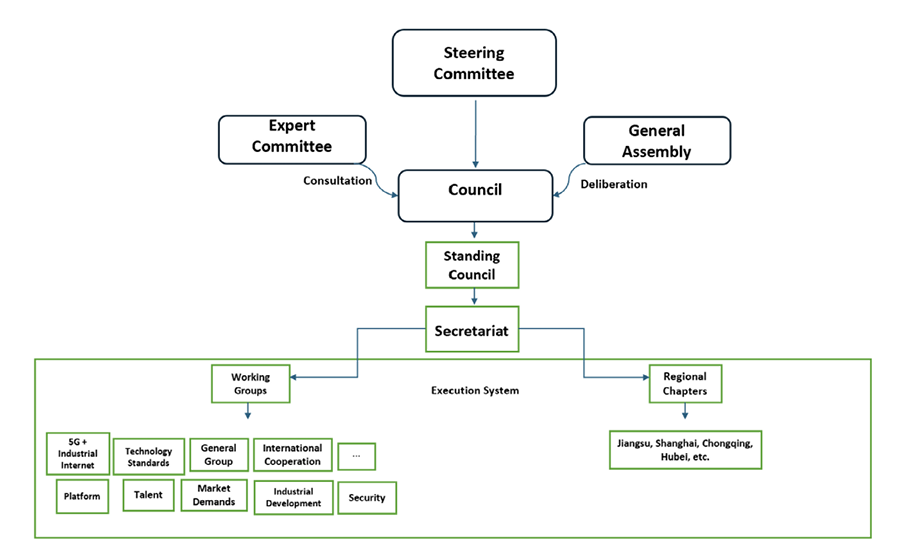
This brings us to the research object of this article: the Alliance of Industrial Internet (AII), established in February 2016 with the endorsement of the central government. The AII is steered by the Ministry of Industry and Information Technology (MIIT), which determines its strategy and targets. The Expert Committee, composed of renowned academicians and heads of national research institutions, provides advisory suggestions for the AII’s decision-making. The executive body, the Council, consists of company representatives and research institute members appointed by the government rather than the Alliance. As the core decision-making and executive body, its chair position is held by the president of the China Academy of Information and Communications Technology (CAICT), a key think tank directly under the MIIT. Vice-chair positions are held by leading enterprises in industries such as manufacturing, telecommunications, and the internet. The current Council is predominantly composed of experts from the CAICT, along with some renowned entrepreneurs appointed by the government. The Standing Council, led by the CAICT, handles the AII’s daily administrative functions. The General Assembly, composed of all members, while defined in the charter as the supreme authority, primarily functions to deliberate and vote on existing resolutions rather than to initiate agendas. Thus, the CAICT is the actual management institution of the AII. Since the AII’s operations are closely intertwined with the CAICT and the MIIT, the Alliance can be defined as a public-sector-dominated institution. Its organizational structure is illustrated in Figure 1.
Figure 1: Organizational Structure of the AII
Source: Created by the author based on the AII website.
The AII’s counterparts in the US2 and Germany are the Industrial Internet Consortium (IIC) in the US and Platform Industrie 4.0 in Germany.3 The three associations were established around the same time and play a similar role in their respective countries as key drivers of smart manufacturing transformation. However, they differ significantly in their initiators and governance models. The AII exhibits a stronger public-sector-driven approach, whereas in Platform Industrie 4.0, there is a co-leadership between the federal government and industry stakeholders, including enterprises, industry associations, and research institutions. In contrast, the IIC is evidently private-sector-driven (see Table 3). In contrast to its international counterparts, the AII is characterized by limited autonomy due to its affiliation with the central state, a characteristic shared by most national industry associations or commerce chambers (Deng & Kennedy, 2010, p. 119).
Table 3: Comparison between Platform Industrie 4.0, the IIC, and the AII
|
Aspect |
Platform Industrie 4.0 |
IIC |
AII |
|
Founding Date |
2013 |
2014 |
2016 |
|
Initiating Actor |
Federal government (BMWi, BMBF) |
Big companies(GE, IBM, Cisco, AT&T, Intel) |
Government (MIIT) |
|
Management Institutions |
Industry associations (Bitkom, VDMA, ZVEI) |
Industry consortium/companies (managed by Object Management Group, OMG, since 2018) |
Government think tank (CAICT, under MIIT) |
|
Governing Form |
Public and private co-led |
Private-sector-led |
Public-sector-led |
|
Goal |
Strengthen Germany’s manufacturing leadership through digitalization (Industry 4.0) |
Accelerate Industrial Internet of Things (IIoT) adoption in the US and push industrial progress |
Support China’s Made in China 2025 strategy |
|
Functions |
• Develop standards (e.g., RAMI 4.0) • Promote the application and development of smart factories |
• Create frameworks (e.g., IIRA) • Test beds for cross-sector IIoT solutions • Advocate interoperability |
• Unify the architecture and standards of the industrial Internet in China, among other objectives. |
|
Major Contributions |
• Globalized Industry 4.0 concept • RAMI 4.0 reference model |
• Industrial Internet Reference Architecture (IIRA) • Cross-industry IIoT test beds • Bridged IT/OT sectors |
• Promoted national industry strategy by connecting companies and navigating the market’s movement |
Source: Created by the author.
According to its charter, the purpose of the AII is:
to promote research regarding the architecture and technology associated with the industrial Internet, unify standards, test and verify technologies and solutions, and select pilot demonstration enterprises, solutions, and platforms. (AII, 2024a)
To fulfill these tasks, the AII has established approximately 30 working groups covering areas such as reference architecture, standards, technologies, networks, security, international cooperation, and talent training. The chairpersons or co-chairs of these working groups are primarily representatives of the CAICT, state-owned enterprises (SOEs), or leading private enterprises. In rare cases, senior managers of foreign companies such as Schneider, Siemens, IBM, and PTC also hold high-level positions. Several sub-alliances have also been established nationwide and have collaborated closely with the national leadership. However, the local branches are governed by local authorities and serve the needs of the local government. A review of the Alliance’s official website reveals that policy guidance from the public sector, particularly from the State Council and the MIIT, is essential for the association’s operations, implying that its projects and activities closely align with the evolving national strategy.4 The relationship with the public sector underscores the AII’s political identity and its fundamental objective of serving the public sector’s transformation strategy.
In addition, the AII’s behavior is apparently characterized by significant market player attributes. As an industry association with around 150 initial members, it has grown to include more than 2,800 members after numerous rounds of expansion as of March 14, 2026. The vast majority of these members are enterprises, comprising over 73% private enterprises, 15.75% SOEs, 4% foreign enterprises, and approximately 7% research institutions, universities, and other industry associations (AII, 2026a). Moreover, the AII’s activities are heavily reliant on member support and involvement, including co-authored industry guidelines, national industrial Internet conferences, enterprise roadshows, and supply–demand matching events.
In short, as an industry association established in a top-down manner, the AII is a policy-driven initiative mandated to advance the national industrial strategy, operating as a commercial association.
5 A Connector, Guide, and Marketplace
5.1 A Connector: Connecting the Public Sector with Enterprises and Facilitating Enterprise-to-Enterprise Connections
How does the AII fulfill the mission assigned by national authorities? As previously mentioned, its work heavily relies on its extensive membership. It can be affirmed that the AII would not have made significant contributions without the participation and support of its members, including private and foreign enterprises, SOEs, research institutions, and universities. The Alliance has initiated a significant expansion of its membership, aiming to connect with numerous valuable private players and establish strong ties between the public and private sectors.
In China, numerous industry associations related to the industrial Internet, communication standards, intelligent manufacturing, and the Internet of Things (IoT) have emerged in recent years. Examples include the Internet + Development Association of China (IDAC), the China Integration and Innovation Alliance of Internet and Industry (CIIAII), the Technology Innovation Strategic Alliance of Internet of Things Industry (TISAITI), the Sino-German Intelligent Manufacturing Alliance (SGIMA), and regional associations such as the Zhongguancun Internet of Things Industry Alliance in Beijing (Z-Park IoT Alliance) and the Shenzhen Industrial Internet Industry Association. These associations were initiated either by central or local governments or leading enterprises. Nevertheless, the key difference lies in their membership criteria: while these associations also operate on a membership basis, they maintain specific eligibility requirements that limit access to a targeted group of organizations, making them largely inaccessible to the majority of SMEs.5 This does not imply that other industry associations failed to establish connections with the market in the past. Rather, they lacked the inclusiveness to engage with most market participants.
Given the above, the AII’s first distinctive feature is its role as a connector. Connecting with enterprises and markets is a prerequisite for its operation, and expanding membership is the principal means to achieve this objective. Furthermore, the direct nexus between the association and its members implies a multidimensional connection between the public sector and the market, as well as a linkage between enterprises in the market. The connection with many market actors possessing experience and expertise is significant for government decision-making. In other words, “the connection itself is not the goal of the Alliance but the essential approach to achieving its target” (Interview N17, March 2025).
As a respondent from one member company stated,
The government’s objective is to mobilize society and businesses to collaborate on this initiative through the AII. The Alliance serves as a window between policy and enterprises, acting as a channel for the top-down dissemination of policies. This helps to assess the effectiveness of government policies. Certainly, the government requires contributions from businesses. (Interview N11.2, March 2025)
Specifically, although other associations have included important public sectors, leading enterprises, and R&D institutions, which could support decision-making for government departments, their membership is primarily concentrated in a small number of leading companies, excluding many SMEs with rich potential for application and practical experience from engagement. According to a tech expert specializing in intelligent manufacturing, “China’s manufacturing sector advantage lies in the wealth of application scenarios offered by millions of SMEs” (Interview N6, October 2024). This makes it hard for the public sector to grasp the current comprehensive national panorama.6
Moreover, the rich practices and application scenarios from the AII’s extensive membership enable government decision-makers to follow industry trends almost in real time, facilitating pragmatic and effective decision-making and better coordination of market actions. For example, as of September 2024, the association has reviewed 146 industrial Internet cases reported by corporate members, encompassing five major systems of the industrial Internet: network, data, platform, application, and security (AII, 2024b). These selected application scenarios have proven highly valuable for governmental departments, the industrial sector, and enterprises, and they have been promoted at national industrial Internet conferences and summarized in the AII’s white papers.7
Additionally, the association frequently hosts large-scale public events, such as national and international conferences and competitions, which break down information barriers among enterprises and facilitate potential connections between them. Meanwhile, the AII also provides tangible support to its members on a regular basis. For example, the AII has initiated online surveys involving over 1,600 SMEs, organized offline client–supplier matching events to facilitate enterprise financing, and dispatched personnel to provide on-site assistance (AII, 2024c).
In brief, members are crucial to fulfilling the Alliance’s fundamental role. Without its large number of members, the AII cannot pool the collective wisdom of the industry. From the perspective of enterprises, market players value the association’s political clout, believing its connections offer benefits. As summarized by a member respondent,
The primary focus of the AII is its role as a connector. The Alliance does not develop its own core business knowledge itself but continuously collects case studies and experiences from everyone. Most of us choose to join it for individual reasons. (Interview N9.2, March 2025)
5.2 A Guide: Educating and Navigating the Market
After establishing connections between the public sector and the market, as well as among enterprises, the second role of the AII is to act as a guide or navigator, cultivating the market and navigating its transformation.
First, the AII educates the market. In its early years, the CAICT, as the de facto governing body, partnered with its enterprise members to create industry-leading publications, defining and shaping the architecture, standards, and systems of the industrial Internet to educate market participants and cultivate the market.
The Alliance proposed many new concepts in its early stages. Its efforts have popularized the concept of the industrial Internet in China, helping people understand what it is, how to implement it, and what capabilities are needed to do it well. (Interview N9.2, March 2025)
For example, the publication Industrial Internet Standard System (《工业互联网标准体系》) (AII, 2021a) has been updated from its first to its third version, covering six key areas: basic definitions, network, edge computing, platform, security, and applications. The MIIT has also adopted it as a reference for national standard-setting. Additionally, the AII not only releases numerous standards but also actively participates in the National Industrial Internet Standard General Group, one of the country’s most significant standard-setting bodies, thereby becoming an influential player in national standardization efforts. Moreover, from its inception, the Alliance has placed great emphasis on maintaining dialogue in accordance with international standards, particularly those of the US and Europe. While referring to advanced international standards, the primary objective is not to replicate Western systems but to ensure alignment with global best practices (Interview N6, December 2024; Interview 11.2, March 2025).
Due to its significant influence, the AII’s research publications have become a trusted reference for industry stakeholders, actively guiding the digital transformation of China’s manufacturing sector. A survey of 2,000 enterprises indicated that the issue of early understanding prevented 60% of small and micro-enterprises from undergoing digitalization (AII, 2023b, pp. 66). This scenario demonstrates that the AII’s conceptual publications are at least necessary for market followers to update their understanding and obtain accurate industry information. Moreover, these publications are comprehensible, featuring clear explanations of technical terms. These resources offer a unified introduction for enterprises unfamiliar with smart manufacturing, providing a clear, referable template for those who are just getting started or are already engaged in this process. Many large private enterprises have also referred to the Alliance’s product design standards (Interviews N9 & N12, December 2024).
In addition, the Alliance systematically promotes market education and capacity-building to guide the industrial digital transformation through organizing seminars and training programs. Regarding seminars, each working group of the Alliance holds at least 2–3 meetings annually (AII, 2019).8 Working groups may also organize thematic seminars on specific technical or industrial topics independently. For example, in September 2022, the Alliance cohosted the “Information Model Partnership Program-Industrial Internet Interoperability Seminar,” inviting representatives from enterprises such as Huawei Cloud, RootCloud, Mitsubishi Electric, SF Technology, and Alibaba Cloud to discuss topics including standard mutual recognition, product testing, and data sharing (AII, 2022b). According to statistics, since its establishment in 2016, the Alliance and its working groups have organized nearly a hundred seminars. Participants are primarily various enterprises and member units, with topics covering cutting-edge fields such as 5G+TSN, pre-trained large industrial intelligence models, Industrial Software as a Service (Industrial SaaS), and security assessment.9
In terms of training programs, the Alliance launched the “Industrial Internet Training Base Project,” collaborating with various institutions including enterprises, universities, and research institutes to build talent-cultivation platforms. Specifically, the Alliance formulates management measures to uniformly select, assess, and guide the training bases, while partner units are responsible for the specific teaching implementation to increase the reserve of industrial Internet talent in the market (AII, 2026b). Currently, through the Training Base Program, the Alliance has established over 20 training bases, offering more than 300 courses and training nearly one million participants cumulatively (AII, 2024d). Furthermore, the AII regularly publishes popular science articles through its dedicated online platform and co-organizes science lectures with external institutions, disseminating cutting-edge knowledge and practical insights on the industrial Internet to industry professionals.
Second, based on its function of educating the market, the AII also guides the transformation of the private sector. With its extensive portfolio of key publications, it serves as a beacon for the intelligent national transformation of manufacturing, guiding the transition’s method and style.
The activities and publications of the AII have a considerable influence over a broad audience, largely due to its political identity and extensive membership base. This substantial foundation enables the Alliance to fulfill its role as a navigator effectively. Unlike other similar organizations, the AII operates a website and public WeChat account, which has garnered many followers since its establishment, maintaining a high update frequency and achieving extensive popularity. By early 2026, the AII’s working groups had jointly published approximately 700 publications in collaboration with members, covering all aspects of industrial Internet transformation, including architecture, network, platform, data, security, applications, technical standards, test beds, and application cases. Among them, about 500 are themed around application cases. In addition to its industrial publications, the AII regularly showcases the best cases from its diverse corporate members on its official website, thereby assisting both member and non-member companies in identifying suitable business partners or solution providers.
5.3 A Marketplace: A Self-Evolving Market Through Discovering High-Quality Players
In contrast to its functions as a connector and guide, the AII’s third role is not readily discernible, but cannot be dismissed: that of a marketplace.
China’s industrial digital transformation, despite strong government support, ultimately relies on the active engagement of market players. This frequently occurs within the scope of the AII’s duties, typically accomplished in two ways: through corporate initiative or intentional institutional direction.
On the one hand, as a connector for all members, the AII enables companies to become acquainted with each other’s businesses through diverse offline and online activities. Through the frequent dissemination of information on the Internet and social media, non-member companies can also interact with key players from various sub-industries. The association’s contribution lies in establishing a platform for companies to familiarize themselves with one another, exchange ideas, and even conduct business. Companies can independently select partners for business exchanges and cooperation in this marketplace.
Take the Edge Computing Developer Competition (边缘计算开发者大赛), co-organized by the AII, the CAICT, and the Edge Computing Consortium (ECC), as an example. Held alongside the annual “Global Edge Computing Development Summit,” the award ceremony featured officials from the MIIT and academicians, and was livestreamed across multiple platforms, attracting approximately 200,000 real-time viewers (AII, 2022a, 2023a). While winning teams receive additional business opportunities, all participants benefit from increased visibility and authoritative endorsement. Corporate spectators can also use this to identify suitable partners. Through this mechanism, the AII signals “high-quality teams” to the market, reducing information asymmetry and creating matchmaking opportunities. Whether actual transactions occur remains unobservable.
On the other hand, the Alliance’s frequent selection and promotion programs for the best platforms, suppliers, and solutions also guide the matching of supply and demand in the market. For example, the “Hundreds of Cities, Thousands of Parks” project(百城千园行)10 announced the project’s list of inaugural star-rated industrial Internet parks at the China 5G+ Industrial Internet Conference, co-hosted by the MIIT and Hubei Provincial Government and co-organized by the AII. This premier industry event drew significant attention to selected parks and firms, effectively providing authoritative, government-endorsed guidance on “quality providers/parks” for demand-side entities seeking reliable partners (AII, 2023c).
Many enterprise members strongly desire to earn recognition or awards from the association. Furthermore, for private companies, passing the AII’s product tests, which serve as a benchmark of public authority, is crucial not only for market entry but also, as one interviewee stated, for securing relevant governmental policy or resource support (Interview N17, March 2025).11 For example, the “5G+ Industrial Internet” Chain-Building Initiative (5G+工业互联网铸链计划) recommends quality suppliers to the market through authoritative testing and public promotion. The initiative publicly solicits products, which undergo rigorous testing by the CAICT’s national laboratories. Successful products receive certification and are promoted on multiple channels, including the official website (AII, 2025a). The CAICT is a nationally authorized testing body, and validation through its labs is essential for enterprises seeking market entry, as such certification is required for MIIT network access licenses and other market access credentials (CAICT, 2026).
While recognition from public institutions can enhance a company’s profile, it does not guarantee direct access to new business opportunities.
We view this as an honor bestowed by the government, which is used for marketing and advertising purposes. Of course, this honor from the industry association cannot immediately translate into business. In our sector, securing business primarily depends on professional competence and sustained engagement with key accounts. (Interview N 9.2, March 2025)
The Alliance, backed by the support of governmental departments, will prioritize the awarded suppliers by matching them with internal projects12 as incentives. For instance, when enterprises pass the association’s testing projects with specific themes, such as new industrial control testing, edge computing standard parts, time-sensitive network evaluation, or trusted data space applications, they will have a chance to participate in governmental business-matching programs. Furthermore, the association also facilitates connections between investment institutions and enterprises,13 organizing corporate financing roadshows and providing opportunities for enterprises to engage with venture capitalists. Companies actively participate in the programs, recognizing it as a strategic move to elevate their industry profile. In this way, the Alliance facilitates business transactions, both directly and indirectly, thereby underscoring its role as a dynamic marketplace.
In conclusion, the AII’s work is rooted in close engagement with market participants, especially its members. Its white papers rely heavily on member expertise. Without it, such work would be difficult to accomplish. In short, the AII operates on the principle of “from the market, for the market” (取之于市场、用之于市场). This makes the AII distinct. It serves as an intermediary bridging the public and private sectors, linking stakeholders and coordinating processes. Yet its role remains auxiliary under the MIIT, with limited authority and resources. China’s industrial digital transformation is shaped by broader forces, which constrain what the AII can achieve. This will be discussed in detail in the next section.
6 The Limitations of the AII’s Role and Capability
6.1 The Current Status of Industrial Digital Transformation
Despite the Alliance’s constant efforts, the market still faces practical challenges in implementing digital transformation. Currently, China’s industrial digitalization transition is characterized by inconsistent progress, uneven resource allocation, and regional disparities (AII, 2021b, pp. 37–45). The immaturity of the technological foundation, lack of business innovation, and tepid market response suggest that the transformation is still in its early stage. In addition, the smart manufacturing strategy remains largely driven by the public sector. Despite government mobilization, policy support, and public investment, the market has yet to achieve a decisive breakthrough in industrial digitalization (Interviews N9.1, N10, N11.1, N12, N13, December 2024). Furthermore, market enthusiasm has cooled as industry leaders, such as General Electric Company (GE) and Siemens, have underperformed, and domestic giants have faced initial public offering (IPO)setbacks (Interviews N11.2, N17, December 2024; The Paper, 2023).
First, consider the case of platform enterprises that are facing multidimensional challenges in business development:
Everyone who launched an industrial digital platform originally intended to serve all machinery industries, but it did not work out as planned. It is challenging within the machinery industry because peers are reluctant to share their data. So, they can only focus on peripheral industries. It can be done, but it is insufficient to support their going public, and it is also challenging to provide services across various industries. (Interview N11.2, March 2025)
Currently, very few are making money from industrial Internet initiatives, you could say. Before 2022, everyone was focused on building platforms; however, the focus has now shifted to industrial applications, as they are perceived as something that business users truly desire. (Interview N12, December 2024)
The challenges confronting platform enterprises, ranging from data-sharing reluctance among industry peers to the difficulty of establishing profitable business models, have contributed to the limited market success of industrial Internet transformation, which has become a significant factor hindering digitalization progress for private-sector companies. For small and medium-sized manufacturing firms, a different but equally complex set of considerations comes into play.
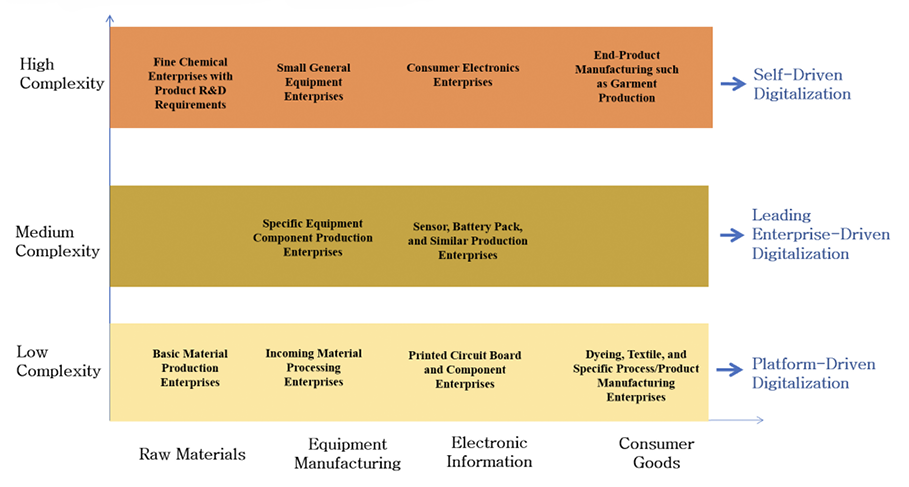
Second, market followers, particularly SMEs, are motivated to pursue digitalization through four distinct pathways. In the anchor-driven model, leading firms equip supply-chain SMEs with digital tools, gaining supply-chain data for coordinated monitoring in return. In the park-driven model, industrial clusters or parks build shared digital infrastructure, enabling collective SME transformation while lowering individual investment costs. In the platform-driven model, digital platforms match external orders with SME capacity via free industrial SaaS, exchanging production data for stable order flows. In the technology-driven model, SMEs independently adopt lightweight, targeted digital solutions (e.g., industrial SaaS) to enhance core business capabilities (AII, 2023b, pp. 37–45). As for the specific upgrading approaches, enterprises producing more complex products face greater competitive pressure, increasing the urgency of upgrading and the likelihood of spontaneous initiatives. Conversely, manufacturers of less complex products are more likely to be motivated and pushed by industrial digital platforms or clusters (see Figure 2).
Certainly, there are successful examples of platforms that connect SMEs. One type is the e-commerce-driven platform, exemplified by Alibaba’s manufacturing-focused ecosystem. Leveraging shopping festivals such as Singles’ Day (双十一), which started in 2012 and achieved huge success, these platforms have enabled numerous small-scale manufacturing enterprises in villages and towns to participate from the bottom up, primarily in sectors like apparel, toys, furniture, and other daily consumer goods. They have significantly improved circulation efficiency and flexible manufacturing capabilities. However, such platforms are not central to China’s strategy of becoming a manufacturing powerhouse, nor are they highlighted as a key focus in the AII’s work. The second type consists of cross-industry and cross-domain industrial Internet platforms selected by the MIIT, such as Haier COSMOPlat, which has been recognized for several consecutive years. These platforms have connected a large number of SMEs, with case studies documented in AII white papers, yet these remain the exception, not the rule.
Figure 2: Transformation Paths of SMEs
Source: AII (2023b, p. 32).
In contrast to the struggles of platform enterprises, SMEs face a different set of challenges. The prevailing narrative on SMEs’ digital transformation in manufacturing tends to oversimplify the barriers, focusing predominantly on financial constraints, talent shortages, and limited awareness. One survey reveals a nuanced picture: while 53% of SMEs lack understanding of digital transformation, 43% report knowing the concept but lacking viable solutions, 32% cite insufficient funding, and 31% point to talent shortages as primary obstacles (AII, 2023b, p. 66). However, in SMEs’ view, the core impediment is more fundamental: a perceived lack of tangible benefits from such investments. SMEs, due to their limited capital and human resources, as well as high sensitivity to the return on investment, are extremely cautious about digitalization investments. As one interviewee noted, SMEs operate with limited capital and must calculate every investment. “If they cannot see a way to recoup their investment, they will not proceed” (Interview N17, March 2025). Another elaborated on this cost–benefit calculus:
The fundamental reason for the investment reluctance is that they are concerned about spending money without creating tangible value. Therefore, whether it is millions, hundreds of thousands, or even just a few thousand Yuan, they are less willing to invest. (Interview N9.2, March 2025)
This cautiousness is particularly pronounced in manufacturing, where inherently low profit margins make SMEs highly sensitive to any expenditure. Unless they can clearly foresee benefits such as reduced production costs, improved efficiency, or enhanced product quality (降本、增效、提质), they tend to approach digital upgrading with far greater caution than larger enterprises.
Such financial and capability constraints manifest in various ways. For example, despite receiving advanced equipment through government subsidies, professionals in some small and micro-enterprises often utilize only the most basic functions of such machinery, abandoning more complex features due to coordination and management challenges (AII, 2023b, p. 26). Some smaller enterprises take an even more extreme approach: “Some of them do not make any move to carry out upgrades, even with subsidies” (Interview N14, December 2024).
Furthermore, China’s SMEs are highly diverse, with significant variations in production models, capability levels, and industry types. Currently, there is a lack of clear and mature guidance on transformation paths, and the short-term economic benefits of transformation have yet to materialize. As a result, followers and laggards are not highly motivated to pursue digitalization or cloud-based adaptation. Only when profitable products are developed and monetized will market enthusiasm be truly ignited. To date, the turning point for transformation has not yet arrived.
However, neither public-sector support nor the efforts of the AII alone are sufficient to drive rapid market adoption. In the end, it is the market that will determine which solutions succeed. Such deep-seated structural challenges, rooted in the basic economics of small manufacturing firms, are far beyond what a single industrial organization like the AII can address on its own.
As one respondent from the industrial software sector noted:
Our company is capable of collecting industrial data, but we do not pursue this business because the methods to realize economic value from data are not yet clear, and we cannot make money from it. (Interview N9.1, December 2024)
Similarly, a representative from a regional industrial association observed, further confirming that the AII itself cannot alter the willingness or motivation of the broader market toward digitalization:
Although the AII has published many industrial guidelines on how to conduct digitalization and improve production efficiency, the standards are too high and difficult for most small companies to meet. After all, the association itself cannot improve the capabilities of industrial enterprises. (Interview N10, December 2024)
6.2 The Limits of the AII’s Capacity and Role
Beyond the structural barriers rooted in domestic market fragmentation and hesitant enterprise adoption, the AII’s work and influence have been further constrained by intensifying geopolitical tensions, diminished Sino-Western exchanges, and the shrinking role of foreign players in both the Chinese market and the Alliance itself. In recent years, the systemic rivalry between the East and the West has nearly halted the AII’s communication and cooperation with international counterparts. Especially since 2018, China–U.S. geopolitical friction and high-tech competition have led to a near standstill in the Alliance’s international exchanges, particularly bilateral dialogue with the United States (Interview N11.1, December 2024).
This decoupling has had unintended consequences for all parties involved. For Western companies, high-tech isolation has deprived them of access to the vast Chinese market, crucial for testing products and improving competitiveness. For China, reduced information exchange with international market leaders may hinder the full realization of technological potential and limit opportunities for shared progress, potentially constraining broader innovation outcomes (Naughton et al., 2023, p. 29). For the AII specifically, these tensions have directly constrained its institutional evolution, limiting its ability to facilitate cross-border learning and collaboration.
These broader tensions are reflected in the AII’s membership composition. Foreign enterprises and joint ventures account for less than 5% of the total membership. Only a few foreign companies—particularly from Germany (e.g., Siemens, SAP, Bosch), France (e.g., Schneider), and the U.S. (e.g., PTC)—remain active in coauthoring white papers, organizing national events, and initiating research projects. Siemens and Schneider have frequently been highlighted as model companies on the AII’s homepage, with Schneider contributing to at least eight white papers.14 SAP is the only foreign enterprise serving as a vice-chairperson member. To some extent, the role of foreign members within the Alliance remains underutilized.
This marks a sharp departure from an earlier period of Sino-European cooperation, in which China’s leading industrial digital platforms heavily relied on foreign technologies, including SaaS, Platform as a Service (PaaS), sensors, and connectivity solutions (Arcesati et al., 2020, p. 12). Domestic industrial Internet platforms, such as COSMOPlat and Casicloud, were built on German technologies and products (Arcesati et al., 2020, p. 11). The success of these collaborations was driven by mutual benefits: German companies sought access to the Chinese market, while Chinese partners sought advanced technology (Fuchs & Eaton, 2022, p. 966; Interview N6, December 2024). Today, however, foreign enterprises face a markedly different landscape. As domestic firms rise to capture market share, foreign companies face mounting competitive pressure, prompting tactical responses such as establishing local branches, reducing prices, and partnering with Chinese firms for technology transfers (Interview N16, March 2025). Meanwhile, they perceive fewer opportunities to participate in key national innovation projects. Among the 52 industrial-Internet-related standards published by the MIIT in 2022, 12 were led by AII members, yet the leading institutions were predominantly SOEs, research institutes, and top universities, with no foreign representation (MIIT, 2022). As one senior manager noted:
While our firm has a positive relationship with the public sector and government officials, we have rarely been awarded national or Beijing-level projects, though local projects may offer more opportunities. (Interview N7, December 2024)
The cumulative effect of these geopolitical shifts has been a visible decline in the AII’s output and relevance. As one member representative shared: “The Alliance has slowed down continuously proposing new concepts as it did initially, nor does it provide many exchanges centered on industrial enterprises” (Interview N9.1, December 2024).
Compounding this, the sluggish adoption of digital transformation and the flagging enthusiasm of market players have further contributed to a perceived decline in the AII’s role and influence among its members. In the past, member companies competed for speaking slots at working group meetings (Interview N17, March 2025). After 2023, however, members have become less proactive in attending events, perceiving limited lucrative value or new business opportunities (Interviews N9.2 & N11.2, March 2025).
In sum, China’s industrial digital transformation remains at an early stage. Platform enterprises are constrained by data-sharing barriers and a lack of viable business models, leading to waning market enthusiasm. While some SMEs have achieved successful digitalization, they remain the exception rather than the rule; SMEs’ reluctance to invest stems largely from unclear returns, compounded by shortages of capital, talent, and management capacity. Meanwhile, geopolitical tensions have curtailed international exchanges and reduced the role of foreign actors. The AII itself has seen its output and influence diminish, with member engagement notably cooling. As a subsidiary body under the MIIT, the AII has limited authority and autonomy. Given the external structural challenges at play, its capacity to effect meaningful change is inherently constrained. The Alliance has accomplished much, yet its role is ultimately circumscribed by these fundamental limitations.
7 Conclusion
This paper investigates how the Chinese government, together with market and enterprise actors, promotes industrial digital transformation in pursuit of the goal of becoming a manufacturing powerhouse, by examining the role and function of a government-established industry association, the Alliance of Industrial Internet (AII).
Specifically, the AII possesses a dual identity: it has a political orientation serving the central government, and an active economic presence in the market. It plays a crucial role in connecting a wide range of market participants, educating and guiding the market, and functioning as a marketplace. Its driving force derives both from the public-sector influence granted by the government and from the knowledge and expertise accumulated from enterprises. Navigating between policy and market, the AII’s significance lies in shaping a common understanding among enterprises, aligning their pace and actions, framing technology and industry standards, and reducing market fragmentation, thereby accelerating the transition toward the national goal of manufacturing upgrading.
However, intensifying domestic competition has led to a notable decline in profits, which may prompt manufacturers to further reduce their digitalization investments. Challenges such as fierce market rivalry, an unfavorable international environment, weak corporate motivation, and power imbalances between state-owned and private enterprises all lie beyond the scope of the AII’s influence. To address these issues, the central government promulgated the Regulation on Fair Competition Review in August 2024 (State Council, 2024). More recently, the Central Economic Work Conference in December 2025 emphasized the need to “address involutionary competition”(“整治内卷式竞争”) to enhance market vitality and efficiency (Xinhua News, 2025; Qstheory, 2025). Despite these efforts and sustained state support, the deeper task of industrial upgrading and the transformation of advanced manufacturing networks ultimately depends on proactive engagement from market participants. There is still a long way to go. In this context, the public and private sectors need to define clear roles, with the former fostering an innovation-friendly environment and the latter driving research and development and value creation. Only then can the potential of smart manufacturing be unleashed and the value of the transition be realized.
As for the Alliance, despite its limited authority and capacity, discussed earlier, it has adapted to the AI era by adjusting its strategic focus. The year 2025 marked a pivotal shift in China’s smart manufacturing strategy toward artificial intelligence, underscored by key policies including the State Council’s Opinions on Deeply Implementing the “AI+” Action, the Action Plan for Empowering Integration of Industrial Internet and AI (MIIT, 2025b), and the Notice on Issuing Implementation Opinions on the “AI+ Manufacturing” Special Action (MIIT et al., 2025). In response to these top-down directives, the AII accordingly shifted its focus toward AI. Since 2025, it has advanced AI integration with smart manufacturing across four dimensions, data, models, standards, and applications, by releasing an industrial embodied AI robot-training dataset, launching a security agent platform, soliciting large language model application cases, initiating standards development through the Blue Paper on Classification and Grading of Artificial Intelligence Applications in Manufacturing Scenarios (AII, 2025b), and promoting technology adoption via case collection and smart pilot lines. Following its established logic, the AII leverages close ties with market players and the expertise of leading firms to distill scattered practices into replicable paradigms through a “solicit, select, publish, promote” mechanism.
In sum, by analyzing the role and function of the AII in China’s industrial digital transformation, this paper reveals the mechanisms of interaction among multiple actors, including the state, industry associations, the market, and enterprises, thereby offering a clear picture of the underlying logic. Future research could explore the political logic, economic effects, and social implications of China’s industrial digitalization, including tensions between national strategies and local practices, the reshaping of industrial structures and employment patterns by digital technologies, and comparative analyses of industry associations across sectors and regions.
Acknowledgement
This paper is an output of the Shenzhen Key Research Base for Humanities and Social Sciences — the Research Center of German Industrial Culture, Shenzhen Technology University.
References
Aiginger, K., & Rodrik, D. (2020). Rebirth of industrial policy and an agenda for the twenty-first century. Journal of Industry, Competition and Trade, 20, 189–207. https://doi.org/10.1007/s10842-019-00322-3
AII. (2019). Industrial Internet industry alliance working group management measures. (工业互联网产业联盟:《工业互联网产业联盟工作组管理办法》,2019年).
AII. (2021a). Industrial Internet standard system (Version 3.0). (工业互联网产业联盟:《工业互联网标准体系》版本3.0,2021年).
AII. (2021b). China industrial Internet development effectiveness evaluation report. December 2021. (工业互联网产业联盟:《中国工业互联网发展成效评估报告》,2021年).
AII. (2022a). The 2nd Edge Computing Developer Competition launched! https://www.aii-alliance.org/index/c190/n3326.html (工业互联网产业联盟:《第二届边缘计算开发者大赛正式启动!》,2022年9月8日).
AII. (2022b). Information model partnership program—industrial Internet interoperability seminar successfully held. https://www.aii-alliance.org/index/c189/n3349.html (工业互联网产业联盟:《信息模型伙伴计划-工业互联网互操作研讨会成功举行》,2022年9月22日).
AII. (2023a). Edge Computing Development Summit & 2nd Edge Computing Developer Competition Award Ceremony successfully held. https://www.aii-alliance.org/index/c189/n3805.html (工业互联网产业联盟:《边缘计算发展高峰论坛暨第二届边缘计算开发者大赛颁奖仪式成功举办》,2023年4月3日).
AII. (2023b). Report on the digitalization transformation of SME in China. (工业互联网产业联盟:《中小企业数字化转型研究报告》,2023年).
AII. (2023c). 2023 China 5G+ Industrial Internet Conference—Parallel Session on Industrial Internet Identity and “Hundreds of Cities, Thousands of Parks” Initiative held in Wuhan. https://www.aii-alliance.org/index/c189/n5032.html (工业互联网产业联盟:《2023中国5G+工业互联网大会——工业互联网标识暨“百城千园行”平行会议在武汉举办》,2023年11月22日).
AII. (2024a). Alliance Charter. https://www.aii-alliance.org/index/c12.html (工业互联网产业联盟:《联盟章程》,2024年).
AII. (2024b). Notice on the collection of AII industrial Internet application cases in 2024. https://www.aii-alliance.org/index/c189/n5189.html (工业互联网产业联盟:《关于2024年AII工业互联网应用案例征集的通知》,2024年).
AII. (2024c). You have a need, I will help! “I do practical things for enterprises” survey questionnaire. https://www.aii-alliance.org/index/c189/n4980.html (工业互联网产业联盟:《您有需求 我来帮忙!“我为企业办实事”调研问卷》,2024年).
AII. (2024d). Jianxin Zhongyuan Industrial Internet Security Training Base. https://www.aii-alliance.org/index/c189/n5015.html (工业互联网产业联盟:《AII实训基地丨健信中原工业互联网安全实训基地》,2024年4月29日).
AII. (2025a). Chain-Building Initiative | Guangzhou Guanghang Communication’s 5G smart helmet empowers safety upgrade in high-risk industries. https://www.aii-alliance.org/index/c189/n5947.html (工业互联网产业联盟:《铸链计划 | 广州广哈通信5G智能安全帽助力高危行业安全生产升级》,2025年8月20日).
AII. (2025b). Blue paper on classification and grading of artificial intelligence applications in manufacturing scenarios (工业互联网产业联盟:《制造业场景人工智能应用分类分级蓝皮书》,2025年11月).
AII. (2026a). Alliance membership composition. https://www.aii-alliance.org/index/c10.html (工业互联网产业联盟:《成员构成》).
AII. (2026b). Industrial Internet Industry Alliance training base management measures (trial). March 2026. (工业互联网产业联盟:《工业互联网产业联盟实训基地管理办法》(试行),2026年3月).
Andreoni, A., & Chang, H.-J. (2019). The political economy of industrial policy: Structural interdependencies, policy alignment and conflict management. Structural Change and Economic Dynamics, 48, 136–150. https://doi.org/10.1016/j.strueco.2018.10.007
Andreoni, A., and Roberts, S. (2022). Governing digital platform power for industrial development: Towards an entrepreneurial-regulatory state. Cambridge Journal of Economics, 46(6), 1431–1454. https://doi.org/10.1093/cje/beac055
Arcesati, R., et al. (2020). China’s digital platform economy: Assessing developments towards Industry 4.0. Challenges and opportunities for German actors. MERICS Report.
Barbieri, E., Di Tommaso, M. R., & Bonnini, S. (2012). Industrial development policies and performances in southern China: Beyond the specialized industrial cluster program. China Economic Review, 23, 613–625. https://doi.org/10.1016/j.chieco.2010.12.005
Bowen, G. A. (2009). Document analysis as a qualitative research method. Qualitative Research Journal 9(2), 27–40. https://doi.org/10.3316/QRJ0902027
Braun, V., & Clarke, V. (2006). Using thematic analysis in psychology. Qualitative Research in Psychology, 3(2), 77–101. http://dx.doi.org/10.1191/1478088706qp063oa
Bulfone, F. (2023). Industrial policy and comparative political economy: A literature review and research agenda. Competition & Change, 27(1), 22–43. https://doi.org/10.1177/10245294221076225
Butollo, F., Gereffi, G., Yang, C., & Krzywdzinski, M. (2022). Digital transformation and value chains: Introduction. Global Networks, 22(4), 585–594. https://doi.org/10.1111/glob.12388
Butollo, F., & Schneidemesser, L. (2022). Who runs the show in digitalized manufacturing? Data, digital platforms and the restructuring of global value chains. Global Networks, 22(4), 595–614. https://doi.org/10.1111/glob.12366
CAICT. (2026). CTTL. https://www.caict.ac.cn/wygk/zzjg/201804/t20180428_161091.htm (中国信息通信研究院:《泰尔系统实验室》).
Chu, H., Hassink, R., Xie, D., & Hu, X. (2023). Placing the platform economy: The emerging, developing and upgrading of Taobao villages as a platform-based place making phenomenon in China. Cambridge Journal of Regions, Economy and Society, 16(2), 319–334. https://doi.org/10.1093/cjres/rsad004
Deng, G. S., & Kennedy, S. (2010). Big business and industry association lobbying in China: The paradox of contrasting styles. China Journal, 63, 101–125. https://doi.org/10.1086/tcj.63.20749196
Evans, P., & Heller, P. (2018). The state and development. WIDER Working Paper 2018/112. https://www.wider.unu.edu/sites/default/files/Publications/Working-paper/PDF/wp2018-112.pdf
Feng, K. D., & Jiang, Z. Y. (2024). Centralized regime gaining information capacity: Can China approach innovation frontiers? Journal of Contemporary China, 33(147), 392–416. https://doi.org/10.1080/10670564.2023.2233477
Fuchs, D., & Eaton, S. (2022). Diffusion of practice: The curious case of the Sino-German technical standardisation partnership. New Political Economy, 27(6), 958–971. https://doi.org/10.1080/13563467.2021.1961221
Gao, B., & Zhu, L. (2020). From the “world factory” to an industrial Internet powerhouse: Creating competitive advantages in the era of intelligent manufacturing. Reform, 316(6), 30–43. (高柏、朱兰:《从“世界工厂”到工业互联网强国:打造智能制造时代的竞争优势》,载《改’革》,2020年第6期,第30-43页。).
Gereffi, G., Bamber, P., & Fernandez-Stark, K. (2022). China’s new development strategies: Upgrading from above and from below in global value chains. Palgrave Macmillan.
Gomes, A. D. P., Pauls, R., and Ten Brink, T. (2023). Industrial policy and the creation of the electric vehicles market in China: Demand structure, sectoral complementarities and policy coordination. Cambridge Journal of Economics, 47(1), 45–66. https://doi.org/10.1093/cje/beac056
Huang, D. Y., & Zhang, H. (2018). How to organize private entrepreneurs? Based on the analysis of the Chamber of Commerce of Guangdong Federation of Industry and Commerce. Sociological Research, 4, 28–55. (黄冬娅、张华:《民营企业家如何组织起来?——基于广东工商联系统商会组织的分析》,载《社会学研究》,2018年第4期,第28-55页。).
Ji, Y. Y. (2015). The policy influence of contemporary Chinese industry associations and chambers of commerce: Institutional environment and hierarchical differentiation. Nanjing Social Sciences, 9, 65–72. (纪莺莺:《当代中国行业协会商会的政策影响力:制度环境与层级分化》,载《南京社会科学》,2015年第9期,第65-72页。).
Ji, Y. Y. (2022). Social organization and the reproduction of local society: A case study of an industry association. Guangdong Social Sciences, 4, 195–208. (纪莺莺:《社会组织与地方社会的再生产:以一个行业协会为例》,载《广东社会科学》,2022年第4期,第195-208页。).
Juhasz, R., Lane, N. J., & Rodrik, D. (2023). The new economics of industrial policy. NBER Working Paper Series, working paper 31538, August 2023.
Kemmerling, M., & Trampusch, C. (2023). Digital power resources (DPR): The political economy of structural and infrastructural business power in digital(ized) capitalism. Socio-Economic Review, 21(4), 1851–1876. https://doi.org/10.1093/ser/mwac059
Kenderdine, T. (2017). China’s industrial policy, strategic emerging industries and space law. Asia & the Pacific Policy Studies, 4(2), 325–342. https://doi.org/10.1002/app5.177
Kennedy, S. (2005). The business of lobbying in China. Harvard University Press.
Kuo, C. C., Shyu, J. Z., and Ding, K. (2019). Industrial revitalization via Industry 4.0: A comparative policy analysis among China, Germany and the USA. Global Transitions, 1, 3–14. https://doi.org/10.1016/j.glt.2018.12.001
Kvale, S., & Brinkmann, S. (2009). InterViews: Learning the craft of qualitative research interviewing (2nd ed.). Sage Publications.
Lechowski, G., & Krzywdzinski, M. (2022). Emerging positions of German firms in the industrial internet of things: A global technological ecosystem perspective. Global Networks, 22(4), 666–683. https://doi.org/10.1111/glob.12380
Lei, Y. W. (2021). Upgrading China through automation: Manufacturers, workers and the techno-developmental state. Work, Employment and Society, 36(6), 1078–1096. https://doi.org/10.1177/0950017021999198
Lei, Y. W. (2023). The gilded cage: Technology, development, and state capitalism in China. Princeton University Press.
Li, Y. (2019). Restrictive factors and promotion strategies for the development of industrial internet platforms. Reform, 2019(3), 35–44. (李燕:《工业互联网平台发展的制约因素与推进策略》,载《改革》,2019年第3期,第35-44页。).
Li, X. H. (2020). A comparative study on the development of global industrial internet. Gansu Social Sciences, 6, 187–196. (李晓华:《全球工业互联网发展比较》,载《甘肃社会科学》,2020年第6期,第187-196页。).
Lin, J. Y. F., & Wang, Y. (2008). China’s integration with the world: Development as a process of learning and industrial upgrading. Policy Research Working Paper 4799.
Lin, J. Y. F., & Monga, C. (2010). Growth identification and facilitation: The role of the state in the dynamics of structural change. Policy Research Working Paper 5313.
Lin, J. Y. F. (2017). Industrial policy and the development of my country’s economy: From the perspective of new structural economics. Journal of Fudan University, 59(2), 148–153. (林毅夫:《产业政策与我国经济的发展:新结构经济学的视角》,载《复旦学报》,2017年第2期,第148-153页。).
Ling, C., and Naughton, B. (2016). An institutionalized policy-making mechanism: China’s return to techno-industrial policy. Research Policy, 45(10), 2138–2152. https://doi.org/10.1016/j.respol.2016.09.014
Luethje, B. (2019). Platform capitalism “made in China”? Intelligent manufacturing, Taobao villages and the restructuring of work. Science, Technology and Society, 24(2), 199–217. https://doi.org/10.1177/0971721819841985
Luethje, B. (2022). China’s industrial Internet: Platform-based manufacturing and restricting of value chains. In G. Gereffi et al. (Eds.), China’s new development strategies: Upgrading from above and from below in global value chains (pp. 33–59). Palgrave Macmillan.
McNally, C. A. (2012). Sino-capitalism: China’s reemergence and the international political economy. World Politics, 64, 741–776. https://doi.org/10.1017/S0043887112000202
McNally, C. A. (2019). Theorizing Sino-capitalism: Implications for the study of comparative capitalisms. Contemporary Politics, 25, 313–333. https://doi.org/10.1080/13569775.2018.1553125
MIIT. (2015). Made in China 2025. https://wap.miit.gov.cn/ztzl/lszt/zgzz2025/index.html (中国工信部:《中国制造2025》,2015年).
MIIT. (2022). 2022 Third batch of industry standard formulation and revision and foreign language version project plans. November 2022. https://ythxxfb.miit.gov.cn/cms_files/filemanager/431831678/attach/202212/afab148a553a47ac827ab78787f85b6c.pdf (工业和信息化部:《2022年第三批行业标准制修订和外文版项目计划》,2022年11月).
MIIT. (2025a). 2025 list of cross-industry & cross-field industrial Internet platforms. http://gxt.shandong.gov.cn/module/download/downfile.jsp?classid=0&filename=3a03beaed924423c88e4d5f2d8b1da85.pdf (中国工信部:《2025年跨行业跨领域工业互联网平台名单》,2025年).
MIIT. (2025b). Action plan for empowering integration of industrial Internet and artificial intelligence. December 30, 2025. (工业和信息化部:《工业互联网和人工智能融合赋能行动方 案》,2025年12月30日).
MIIT, et al. (2025). Notice on issuing the implementation opinions on the “AI+ manufacturing” special action. December 25, 2025. ((工业和信息化部等八部门:《工业和信息化部等八部门关 于印发〈“人工智能+制造”专项行动实施意见〉的通知》,2025年12月25日).
Naughton, B. (2021). The rise of China’s industrial policy 1978 to 2020. Universidad Nacional Autónoma de México. https://www.ucigcc.org/wp-content/uploads/2023/12/Naughton2021_Industrial_Policy_in_China_CECHIMEX-All.pdf
Naughton, B. (2024). Re-engineering the innovation chain: How a new phase of government intervention is transforming China’s industrial economy. IGCC, MERICS.
Naughton, B., Xiao, S. W., & Xu, Y. S. (2023). The trajectory of China’s industrial policies. IGCC working paper no. 6.
Naughton, B., Xiao, S. W., & Xu, Y. S. (2024). Decoding China’s technology and industrial policy: Seven terms you need to know. IGCC Policy Brief, March 2024.
Qstheory. (2023). The development process and practical significance of General Secretary Xi Jinping’s important exposition on China’s high-quality economic development. http://www.qstheory.cn/2023-09/19/c_1129870825.htm (求是网:《习近平总书记关于中国经济高质量发展重要论述的发展历程与实践意义》,2023年).
Qstheory. (2025). In-depth rectification of “involutionary competition”. https://www.qstheory.cn/20251215/751a868db026484894e7eabb2dbc5e23/c.html (求是网:《深入整治“内卷式”竞争》,2025年).
Schneidemesser, L., & Butollo, F. (2022). Alibaba’s distribution-centered approach towards the industrial Internet: A Chinese version of Industry 4.0? In G. Gereffi, P. Bamber, & K. Fernandez-Stark (Eds.), China’s new development strategies: Upgrading from above and from below in global value chains (pp. 61–83). Palgrave Macmillan.
Shang, H. T., & Song, A. L. (2023). Does industrial Internet industrial policy promote enterprise digital transformation? Studies in Science of Science, 41(11), 1991–2000. (尚洪涛、宋岸玲:《工业互联网产业政策促进了企业数字化转型吗?》,载《科学学研究》,2023年第41卷第11期,第1991-2000页。).
State Council. (2017). Guiding opinions of the state council on deepening the development of industrial Internet through “Internet + Advanced Manufacturing”. https://www.gov.cn/zhengce/content/2017-11/27/content_5242582.htm (国务院:《国务院关于深化“互联网+先进制造业”发展工业互联网的指导意见》,2017年).
State Council. (2024). Regulations on fair competition review. https://www.gov.cn/zhengce/content/202406/content_6957049.htm (国务院:《公平竞争审查条例》,2024年).
State Council. (2025). Opinions on deeply implementing the “Artificial Intelligence+” action. August 21, 2025. (国务院:《国务院关于深入实施“人工智能+”行动的意见》,2025年8月21日).
Ten Brink, T. (2019). China’s capitalism: A paradoxical route to economic prosperity. University of Pennsylvania Press.
The Paper. (2023). Three years of losses totaling 1.3 billion, IPO suspended—can this track still work? https://www.thepaper.cn/newsDetail_forward_22477886 (澎湃新闻:《三年亏损13亿,上市中止,这个赛道到底行不行?》,2023年3月29日).
Tian Y., et al. (2019). The impact of business-government relations on firms’ innovation: Evidence from Chinese manufacturing industry. Technological Forecasting & Social Change, 143, 1–8. https://doi.org/10.1016/j.techfore.2019.02.007
Veile, J. W., Schmidt, M. C., & Voigt, K. I. (2022). Toward a new era of cooperation: How industrial digital platforms transform business models in Industry 4.0. Journal of Business Research, 143(C), 387–405. https://doi.org/10.1016/j.jbusres.2021.11.062
Wu, X., & Gereffi, G. (2019). Amazon and Alibaba: Internet governance, business models, and internationalization strategies. In R. van Tulder, A. Verbeke, & L. Piscitello (Eds.), International business in the information and digital age (pp. 227–252). Emerald Publishing.
Xinhua News. (2025). At the Central Economic Work Conference held in Beijing, Xi Jinping delivered important speech. https://www.gov.cn/yaowen/liebiao/202512/content_7050963.htm (新华社:《中央经济工作会议在北京举行 习近平发表重要讲话》,2025年12月11日).
Zheng, Y., & Huang, Y. (2018). Market in state: The political economy of dominance in China. Cambridge University Press.
Appendix
|
The Interviews on the Role of AII in China’s Intelligent Manufacturing Transformation |
|||||
|
No. |
Interviewee |
Workplace |
Position |
Date |
On-/Offline |
|
No. 1 |
N1 |
State-owned venture capital institution |
Venture capitalist |
December, 2023 |
Beijing |
|
No. 2 |
N2 |
State-owned enterprise |
Senior management |
December, 2023 |
Beijing |
|
No. 3 |
N3 |
Private venture capital institution |
Venture capitalist |
December, 2023 |
Beijing |
|
No. 4 |
N4 |
State-owned venture capital institution |
Venture capitalist |
December, 2023 |
Beijing |
|
No. 5 |
N5 |
University |
University professor |
December, 2023 |
Beijing |
|
No. 6 |
N6 |
University |
University professor |
December, 2024 |
Shenzhen |
|
No. 7 |
N7 |
Foreign enterprise |
Technical lead |
December, 2024 |
Guangzhou |
|
No. 8 |
N8 |
University |
University professor |
December, 2024 |
Shenzhen |
|
No. 9 |
N9.1 |
Private enterprise (AII member) |
Senior management |
December, 2024 |
Shenzhen |
|
No. 10 |
N9.2 |
Private enterprise (AII member) |
Senior management |
March, 2025 |
online |
|
No. 11 |
N10 |
Regional industrial association |
Association Representative |
December, 2024 |
Shenzhen |
|
No. 12 |
N11.1 |
Private enterprise (AII member) |
Project lead |
December, 2024 |
Shenzhen |
|
No. 13 |
N11.2 |
Private enterprise (AII member) |
Project lead |
March, 2025 |
online |
|
No. 14 |
N12 |
Private enterprise (AII member) |
Technical lead |
December, 2024 |
Shenzhen |
|
No. 15 |
N13 |
Regional industrial association |
Association representative |
December, 2024 |
Shenzhen |
|
No. 16 |
N14 |
Governmental think tank |
Project lead |
December, 2024 |
Shenzhen |
|
No. 17 |
N15 |
Private enterprise |
Marketing lead |
December, 2024 |
Shenzhen |
|
No. 18 |
N16 |
Private enterprise |
Technical lead |
December, 2024 |
Shenzhen |
|
No. 19 |
N17 |
Private enterprise (AII member) |
Senior management |
March, 2025 |
online |
Date received: 2 April 2025
Date accepted: 2 April 2026
1 The MIIT has, over the years, maintained a regular selection of benchmark industrial Internet platforms. The platforms mentioned here, such as COSMOPlat, HanYun (XCMG), INDICS (CASIC), and Inspur, are consistently listed among the prestigious cross-industry and cross-field platforms (referred to as “dual-cross” platforms, 双跨平台).
2 See the IIC website, https://www.iiconsortium.org/.
3 See the Platform Industrie 4.0. website, https://www.plattform-i40.de/IP/Navigation/EN/Home/home.html.
4 Almost every news release on the AII website starts with a new policy from a central government department (mainly the MIIT or the State Council).
5 The CIIAII and SGIMA are elite clubs with high barriers to entry and no independent websites. The Z-Park IoT Alliance is broader and more open, but enterprise-initiated with weak government ties. The TISAITI and IDAC appear only in news releases with no public documentation. The Shenzhen Industrial Internet Industry Association, supported by local government, focuses on leading regional enterprises.
6 Many companies in the Chinese market have rich possibilities for application, which is also an advantage for China in developing the industrial Internet compared with other countries. Most interviewees also confirmed this view.
7 As of November 2024, the official AII website has released more than 470 industrial Internet-related application cases based on application cases collected from enterprises, covering industrial intelligence, industrial application (APP), blockchain, industrial data centers, etc.
8 The author also verified through official news releases that working groups indeed hold 2–3 seminars annually.
9 Data on seminars are derived from the author’s search and review of the official AII website.
10 The “Hundreds of Cities, Thousands of Parks” initiative, launched by the MIIT, aims to accelerate industrial Internet adoption by channeling policies, infrastructure, and resources into industrial parks to support digital enterprise transformation.
11 According to the Announcement on Publishing the First Batch of Institutions Undertaking Security Certification and Testing Tasks for Key Network Equipment and Special Cybersecurity Products issued by the Certification and Accreditation Administration, the Ministry of Industry and Information Technology, the Ministry of Public Security, and the Cyberspace Administration of China on June 20, 2018, laboratories affiliated with the CAICT are qualified institutions for the testing and certification of key network equipment and cybersecurity products.
12 Regarding the specific meaning of “internal projects,” publicly available information is limited. According to Article 12 of the AII Charter, only “board member units”(理事单位), as opposed to “regular member units”(普通会员单位), are eligible to undertake cooperative projects entrusted to the Alliance by enterprises or institutions. Given that the AII is effectively managed by the CAICT, a think tank directly under the central government, it is reasonable to infer that the “internal projects” or matchmaking activities prioritized for award-winning enterprises most likely refer to such entrusted projects.
13 The original Chinese name of this project is “I Deliver for Enterprises”(我为企业办实事).
14 For example, Schneider participated in the writing of the following publications: Industrial Internet Platform Standard System Framework (Version 1.0) [《工业互联网平台标准体系框架(版本1.0)》], Industrial Internet System Architecture (Version 1.0) [《工业互联网体系架构(版本1.0)》], Industrial Internet Maturity Assessment White Paper (Version 1.0) [《工业互联网成熟度评估白皮书 (1.0版)》], Industrial Network 3.0 White Paper (2022) [《工业网络3.0白皮书 (2022年)》], Industrial Internet Park Guide [《工业互联网园区指南》], and Industrial Internet Platform White Paper (2017) [《工业互联网平台白皮书(2017)》].