Untangling the Future of Diamond Access
Discussing Quality Standards for the Re-communalization of Scholarly Publishing
1 Introduction
The “future of academic publishing” is a recurring concern in the history of science, which has recently re-emerged to the beat of the major shifts introduced by digitalization and followed with the expansion of Open Access (OA) during the COVID-19 pandemic (Scheufen, 2015; Ahmed et al., 2023). The proliferation of paid OA and hybrid journals is one such relevant change, and one that has generated significant global asymmetry. Researchers affiliated with rich institutions that have signed transformative agreements can make use of “open access,” while others are forced to cover these charges with personal funds or are strongly driven to publish in traditional subscription journals. Academic institutions are investing millions of euros in disseminating research that has already been publicly funded, with consequent and well-documented detrimental effects (Simard et al., 2024; Frank et al., 2022; Steinhart et al., 2024). Scholarly communication has, therefore, become increasingly commodified. However, it remains highly diversified, comprising a wide array of publishing circuits and business models: from journals published by major commercial publishers, the one-size-fits-all mega-journals, to those managed by university publishers or small, specialized publishing houses. Eventually, the “gold” route initially imagined by the OA movement has become corrupted by diverse forms of paywalls (Chan et al., 2020; Pinfield, 2025).
In this context, however, there are thousands of journals directly edited by university portals, independent research institutes, or learned societies, fed by non-commercial publishing platforms, such as the Red de Revistas de América Latina y del Caribe (RedALyC), the African Journals Online (AJOL), or the Scientific Electronic Library Online (Scielo) (Nazarovets & Taşkın, 2025). It is likely that the extensive use of the Open Journal Systems (OJS) explains the resilience and continuous expansion of nonprofit, community-led journals free to read and without publishing fees. These types of OA journals have been termed “diamond,” with the implication being that they are more valuable than “gold.” Moreover, Diamondalization, as a neologism, was coined in due course (Mounier & Rooryck, 2023) and has become an increasingly shared value, understood not only as a form of access to scholarly publishing, or merely as a journal business model, but as a struggle against marketization.
Chan et al. 2020 intervened with a cautionary note on this new denomination, as it is used in the same neoliberal framework that turned gold OA into a revenue stream for publishers. Besides, the fact that this mineral embodies the very nature of colonial extraction is indeed a good reason to review its very definition or even abandon its use. Beyond the labels, academic autonomy is at stake in the face of the growing intrusions of the publishing industry. Accordingly, it seems both relevant and urgent for researchers, editors, funders, and librarians to advance a consensual definition of Diamond Open Access (DOA) publishing. This article aims to discuss the current state of this debate and straighten the redefinition of “diamondalization” toward the re-communalization of the journals.
To do so, a crafted overview of the recent initiatives and DOA reports is provided, elaborating on the tension between academic autonomy and commercial heteronomy. Drawing on social theory and the political dimension of scholarly publishing, this paper highlights the critical issue of reputation and legitimacy in the transformation process in favor of community-led journals. Overall, the attempt is to participate in the call for quality (rather than quantity) in scholarly publishing and research evaluation, presenting sustainable publishing practices – particularly from Latin America – and identifying tools to increase their perceived value. The research questions that organize this paper are: (1) What quality criteria are formulated in the discussion about Diamond Open Access? (2) To what extent are these quality criteria implemented by the existing indexation systems when including journals in the curated collections?
To address them, the article is divided into three sections. Firstly, it delves into the state of affairs in the debate on DOA in terms of academic autonomy, sustainability, visibility, and legitimacy. It discusses several definitions of Diamond journals by focusing on the communitarian feature of these venues. The second section describes the diverse DOA quality standards that are under discussion in the various active initiatives in Europe and Latin America to consider academic autonomy from more nuanced perspectives. Section 3 attempts to bring the issue of “indexation” back to the fore, stressing the relevance of the collections and curated lists of journals with entrance criteria. It examines the differences between indexing databases and national classification systems, presenting the Latin American case of quality indexation at journal level. By examining the future of DOA, this research seeks to contribute to reinforcing autonomy, multilingualism, and bibliodiversity amid an ongoing global reform of research assessment publication practices.
1.1 Methods
This paper examines Diamond scholarly publishing from a social science perspective by revising the available literature on the definition of Diamond journals and its existing opacities. Through textual analysis of policy papers and DOA reports, it seeks to broaden the conceptualization that describes these journals, discussing the experience and practices observed in diverse publishing circuits. The point of departure for the textual analysis is the DIAMAS set of seven standards for Diamond journals: 1) funding, 2) ownership, 3) open science, 4) editorial quality, 5) technical efficiency, 6) visibility, and 7) equity, diversity, inclusion, and belonging (EDIB). A database was completed with documents crafted by other initiatives that discuss DOA standards to determine whether they add new insights. The complete list of policy papers and reports is as follows:
\\ DOAS: The Diamond Open Access Standard https://zenodo.org/records/15227981
\\ DOAS Guide for Journals https://diamasproject.eu/diamond-open-access-standard-guide/
\\ DOAG Diamond Open Access Journals, Germany https://pub.uni-bielefeld.de/record/2965484
\\ Diamond Access Summit (Toluca, México – 2023) – Conference Report https://zenodo.org/records/10684544
\\ Global Summit on Diamond Open Access (Cape Town, South Africa – 2024) https://doasummit.uct.ac.za/summit-report/
\\ CRAFT-OA project https://zenodo.org/communities/craft-oa/records?q=&l=list&p=1&s=10&sort=newest
\\ ALMASI PROJECT (Aligning and Mutualizing nonprofit open access publishing services internationally) https://cordis.europa.eu/project/id/101188192
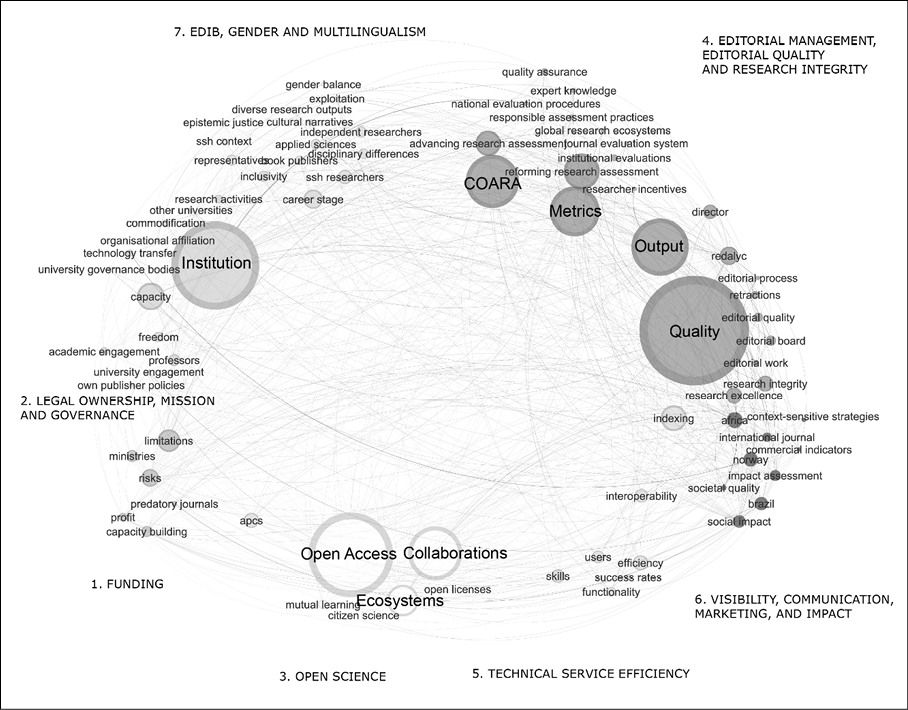
Using frequency counts and word clouds, the paper identifies the most prominent words across all of the initiatives: Quality, Institution, Open Access, Output, Coalition for Advancing Research Assessment (COARA), and Metrics. Grouped around the DIAMAS-DOAS 7 standards, it displays a list of concepts that exceed these base standards to seek other consensual dimensions that can describe a contextualized future for DOA.
Once done, the existing curated journal collections were revised to check whether these dimensions are evaluated for entrance. First, the national journal classification systems are characterized, such as the Índice de publicaciones seriadas científicas y tecnológicas colombianas (Publindex), Qualis, the Fundación Española para la Ciencia y Tecnología (FECYT), and CRISTIN. Secondly, the paper distinguishes the international indexing systems that include evaluation criteria for entrance and permanence at journal level: Latindex, SciELO; Bibliografía Latinoamericana en revistas de investigación científica y social (Biblat), Redalyc, AJOL, DOAJ, Scopus, and WoS – Clarivate.
2 The Challenges of Diamond Journals: Autonomy, Sustainability, Visibility, Legitimacy
The current trends existing in OA publishing reveal how openness can be featured by exclusiveness: two sides of a phenomena that seem opposite in nature. It has been extensively discussed that the development of the gold route by commercial publishers led to a new paywall for authors by transferring the costs of publication through “article processing charges” (APCs). The big scholarly publishers not only repeatedly charge authors for increasing revenues, but the dominant strategy is also to convene read and publish agreements with universities and funding institutions that run into millions of euros. Accordingly, there are different and conflicting routes toward OA at the global scale, with the tension between them stemming from both the degree of openness/closedness and the poles of autonomy/heteronomy (Beigel, 2025a).
Many have pointed to Plan S 1, with its related incentives and policy regulations in Europe, as one of the drivers of an exclusionary path of Gold OA (Debat & Babini, 2020). Indeed, this regional actor played a significant role in a rapid change that affected the dynamics of scholarly publishing both in Europe and across the globe. However, these negative effects have been considered by Coalition S, who are currently fostering several global projects to boost Diamond publishing (De Castro et al. 2024). Initiatives such as the Developing Institutional Open Access Publishing Models to Advance Scholarly Communication project (DIAMAS), The Diamond Discovery Hub, The Global Diamond Summits, Crafting the Future of Diamond Open Access (Craft-OA), and the newest Aligning and Mutualizing Nonprofit Open Access Publishing Services Internationally (Almasi) project have made substantial contributions to bolstering the quality, sustainability, and visibility of Diamond journals. The underlying doubt concerns the limits or the maneuver margin with which the EU’s OA strategy must confront the interests of the commercial publishers.
The dominance of the Web of Science (Clarivate) (WoS) or Scopus in academia’s value regime has been extensively discussed in the literature, with prior research having pointed out that these indexing services exclude vast circuits of scholarly communication that have existed for decades. The resilience of these publishing venues seems related both to the institutional support they have received and to the survival of national and regional multilingual academic audiences. Kulczycki et al. (2025) examined scholarly publishing beyond the oligopolies of commercial publishers, showing a more diverse and nuanced picture. Using national databases and the ISSN center, they compared the national journals from seven countries (three from Europe and four from Latin America). The latter emerged as distinct through its institutional publishing driven by public universities, often relying on public funding and the engagement of professors in the editorial venture. Conversely, the European countries were characterized by journals edited by professional associations and learned societies. While these offer organizational legitimacy, not all have been able to prioritize academic autonomy over commercial interests.
Despite the differences in terms of the institutional publishers, a commonality is evident: In both regions, when “national” scholarly publishing is observed by multisource databases, the landscape emerges as deeply embedded in non-commercial environments. Dagiane and Aibar (2025) argued that control over a community-managed domestic publishing infrastructure is a key factor shaping the autonomy of a national academic system. Such venues provide robust alternatives to the oligopolistic models prevalent in the Anglophone ecosystem, fostering multilingualism and more diverse research agendas (Kulczycki et al., 2025). Most of these journals, as expected, are Diamond. These journals are often international in terms of scope and the quality of expert peer review. However, those that are not included in the journal rankings suffer scarce visibility and de-legitimation.
The most prestigious journals that reach high-impact performance and legitimation are irremediably affected by the increasing number of manuscripts in all disciplines, along with the difficulties of solving peer review processes and other editorial tasks. This has inclined many learned societies to transfer editorship to commercial publishers – a common practice in science, technology, engineering, and mathematics. Differently, in the social sciences and humanities, most journals are edited at universities, where institutional support has been found to prevail over time (Late et al., 2024). One of the main consequences of the commercial management of journals is the systematic market intrusion in the publishing flux, which ultimately assumes full control over the entire editorial process, thereby causing a clash of scientific and economic rationalities (Taubert, 2012).
The extent to which these interferences meddle with the assessments traditionally performed by editors and peers puts in question scholarly editorship itself and the quality of these judgments. Eventually, it may also broaden the gray zone of predatory publishing (Sivertsen, 2022). The scourge of increasing APC prices and its exclusion effect has highlighted the relevance of Diamond journals as an alternative publishing path in community-led scholarly venues. However, some studies have characterized Diamond journals as suffering from artisan editorship (OPERAS, 2021). Nazarovets (2025) argued that the visibility of university journals remains limited, which is partially attributable to a lack of international submissions, as researchers often prefer journals with greater global reach and recognition. The barriers to international visibility include language restrictions, limited indexing in global databases, and a lack of standardization in metadata practices. These barriers, in turn, create a cyclical issue where journals struggle to attract high-quality international submissions, thereby reinforcing their local orientation. On their part, many stakeholders may believe that fostering Diamond journals would mean a return to a past where they were handcrafted by an altruist group of scholars.
2.1 The Definitions of Diamond and Nonprofit Journals
The use of the concept of “diamond” for no-fee OA journals has been scrutinized for various reasons, such as the colonial symbolism mentioned in the introduction. Given the increasing marketization of scholarly publishing, several projects have discussed definitions for these unrestricted journals. Beyond labels, although more appropriate denominations may emerge, the debate on Diamond journals exceeds paywalls. It stresses the features of these journals as community-led and owned by academic organizations with a research mission. This debate delves into the core of the problem of scholarly publishing, that is, its transformation into a profitable market that is increasingly independent from the scientific field.
Figure 1 displays the four relevant sources that propose definitions of Diamond journals. The German Directory of Open Access Journals (DOAG) is interesting, as it aims toward the curation of an open dataset of Diamond journals published in the country. It also involves articulated efforts on the national scale toward the dynamization of DOA through innovative concepts while increasing efficiency, providing better coordination, organization, and information.
Figure 1: Definitions of Diamond Journals
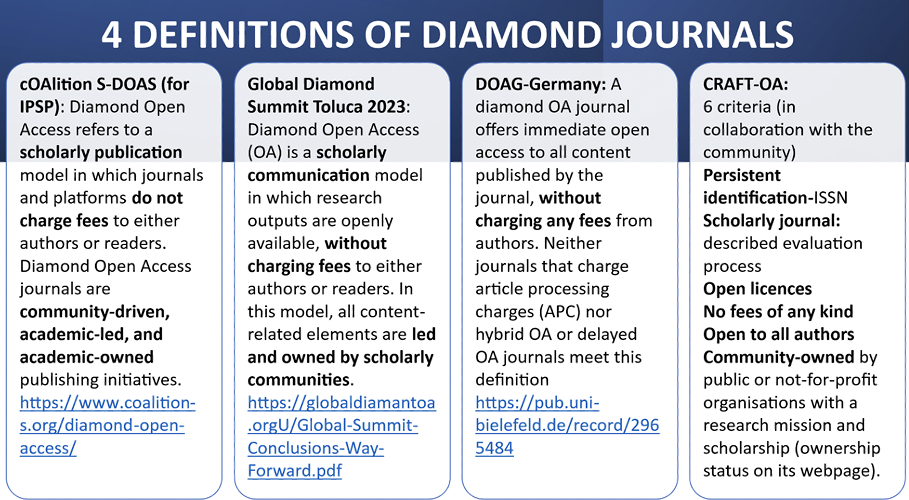
The DIAMAS project gathers 23 organizations from 12 European countries that are well-versed in OA academic publishing and scholarly communication. It has mapped institutional publishers and service providers, focusing on venues that do not charge fees to authors or readers. To support the Diamond model, it has also created the DOAS standards (discussed in further detail below). CRAFT-OA proposes six criteria for Diamond publishing as defined by the task force in collaboration with the community, among which the determination of a “scholarly” journal depends on the selection of papers via an explicitly described evaluation process before and/or after publication. No fees of any kind can be charged, and the journal should state this on its webpage. It considers voluntary contributions and donations acceptable, as long as these are not conditions for publication. A well-known compliance problem here is the lack of transparency in payment information. Simard et al. (2024) noticed that temporarily waiving APCs was a commonly used strategy by the Big 5 for-profit publishers, which adds more instability to the data on costs collected for a given journal.
Among the initiatives to foster diamond publishing, the recently created Diamond Discovery Hub (DDH) is worth highlighting, as it intends to be a comprehensive registry of institutionally published and scholar-led OA journals in Europe. The DDH will operationalize the DOA concept through comprehensive data-collection parameters and functionalities. It aims to make new facets of Diamond publishing visible, such as governance and mission, and to create a curated list of European journals that comply with the following six criteria: scholarly journal; open access with open licenses; no fees; open to all authors; community-owned; and persistent identifiers.
Another relevant initiative is the ALMASI project, which aims to align and mutualize nonprofit open access publishing services internationally. The main diagnosis of the initiative is that nonprofit publishing solutions exist but are scattered, lacking a unified structure. In this context, ALMASI aims to build a DOA ecosystem across Europe, Africa, and Latin America, offering free publishing services for authors and readers. ALMASI will map existing nonprofit services, set quality standards, and provide training for editors and staff. ALMASI strives to make knowledge globally accessible, benefiting diverse scholarly communities.
The global debate on the definition of DOA leapt forward during the Diamond Open Access Global Summits held in 2023 and 2024. The Toluca declaration in the Mexican summit emphasized global engagement as the way forward, with the organizing partners reinforcing their commitment to this approach. The Cape Town summit recommended the establishment of a Global Federation for Diamond Open Access, hosted by UNESCO. This distributed and federated infrastructure was envisioned as a network of national Diamond Capacity Centers and Regional Capacity Hubs similar to SciELO, Redalyc, and Latindex. Beyond the realistic progress of this federation, the shared goal of these summits is to foreground social justice and build an inclusive and equitable DOA movement.
Mounier and Rooryck (2023) argue that Diamond publishing is more than just the absence of fees for authors and readers, as the problem lies in the historical shift in academic publishing from being managed by academic communities to being controlled by large commercial publishers. Accordingly, the structural problem is not only to ensure complete, free OA but to preserve journals’ academic autonomy and allow the research community to regain complete control. They underscore the necessity of reclaiming autonomy through community-run publication models, although they argue that this should not be equated with “institutional publishing.”
Institutions nurture, protect, and confer status upon academics, yet they also create a scientific field marked by power struggles, unequal resource distribution, and social dynamics that may have little to do with knowledge creation. (…) In other words, collaborating with private, even commercial, publishers outside of their institutions is seen by some academics as a form of liberation from the power structures within the academic system. (Mounier & Rooryck, 2025: 18).
3 The Quality Standards for Diamond Community-led Scholarly Publishing
In light of the global summits and related initiatives discussed above, marketization and the consequent asymmetries emerging from paid OA cannot be solved solely with actions to support Diamond journals. The most difficult challenge is to change researchers’ choice of a journal, because this is not just an individual decision but a multicausal result of the evaluative cultures and the reputation regimes at stake, incentives and available funds, individual attitudes to OA, career stages, and institutional contexts, among other factors. The creation of new sources informing community-led journals is critical to contribute to the necessary interaction between open science and research assessment reforms. In this venture, interculturality must prevail along with the acknowledgement of the variety of journal structures and editorial models for Diamond scholarly publishing around the world.
In a previous paper, I have discussed the need to deepen the observations of publishers and the difference between what Ulrich’s database calls “corporate author” and “commercial publisher,” because it is instrumental to define ownership and academic autonomy (Beigel, 2025b). Taşkın et al. (2025) proposed classifying three broad publisher types by primary function: 1) professional publishers, focused on publishing scholarly journals and books; 2) research organizations, dedicated to research and higher education; and 3) scholarly societies, organized researcher communities aiming to advance their fields. According to the authors, while universities and societies may operate professional publishing activities, such as university presses, publishing is not their primary function. From this organizational perspective, they proposed including all types of commercial publishers observed in the journals indexed in the WoS in the first category.
Although general publishing is not one of the main functions of universities or research institutions, academic editorship has been born, shaped, and fed by learned societies and universities. Indeed, scientific journals were not created by the publishing market, but have been progressively acquired by commercial firms because of their increasing profitability. Outside the mainstream publishing circuit, academic editorship has remained in the hands of universities, as highlighted by recent research on thousands of active university journals (Nazarovets & Taşkın, 2025; Beigel, 2026). In a study observing national publishing (Kulczycki et al., 2025), the landscape looks very different from WoS journals: The category of commercial publishers represents a minimal share of the journals edited in Finland (1.6 %), Colombia (0.2 %), Mexico (2.5 %), Argentina (4.07 %), and Brazil (6.5 %), but with a relatively more notable share in Turkey (12.1 %) and Poland (8.2 %). The rest of the journals are mostly published and owned by learned societies and universities.
The commercial–noncommercial stake is present in the other approaches regarding Diamond journal standards and can be put at front in comparison with the DIAMAS’s seven standards. Several initiatives have discussed DOA standards adding new insights, thus making it pertinent to systematize all these inputs to reach a consensus. The Diamond Open Access Summit held in Toluca (México), for example, stressed “knowledge as a public good,” “community-driven,” and “multi-level cooperation.” These facets can be considered features of existing journals, but also an ideal to be reached. As can be seen in Figure 2, the most prominent words across all of the documents in this paper’s database, in order of frequency, are: Quality, Institution, Open Access, Output, COARA, and Metrics. Grouped around 7 standards, a set of concepts exceeds some of these to frame additional ones.
Figure 2: Most Frequent Concepts Found in the Multi-source Database
Sources: Consortium of the DIAMAS project. (2025); DIAMAS Project. (2023 – 2025); ALMASI Project. (2025–present); Bruns et al. (2022); Saenen et al. (2024); 3rd Global Summit on Diamond Open Access (2024); CRAFT-OA Project (2023–present). Note: The textual analysis was performed with GarganText and the illustration built with Gephi.
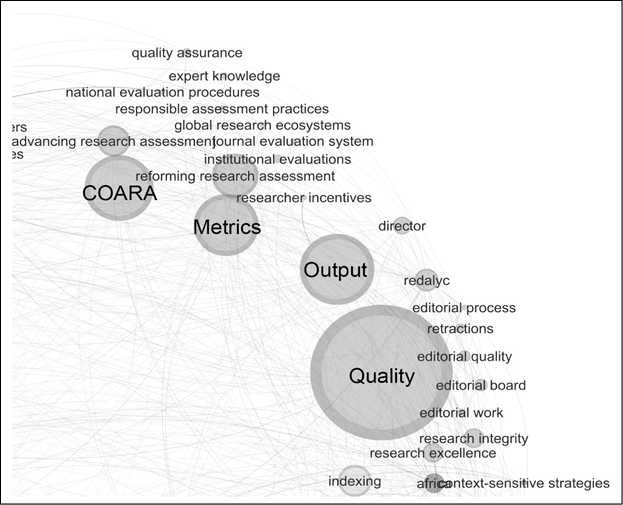
The two most frequently appearing concepts, Quality and Institution, are both linked to the key discussions affecting today’s scholarly publishing: academic evaluation, research quality, and autonomy. Focusing more closely on the network of concepts linked to Standard 4 (Editorial management and research integrity), it appears to be connected to Impact and the COARA principles. This reinforces the need to more deeply discuss how to certify a journal’s academic editorship to guarantee that manuscript selection is in the hands of the research community. Noticeably, research integrity refers to trust and confidence in the research process and its findings, and appears close to such concepts as honesty, transparency, rigor, reproducibility, and accountability. A closer look at the sub-network (see Figure 3) shows a set of concepts that are more related to research quality, or what is commonly referred to as “research excellence.” In the current state of scholarly publishing, I argue that research quality can be considered, because of its importance, as an independent standard from editorial quality.
Figure 3: Concepts Linked to “Editorial Quality”
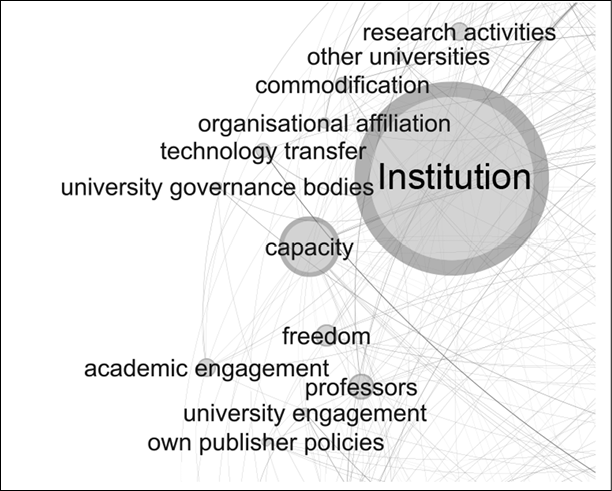
The other DIAMAS standards that appear within a complex network of concepts are Institution and Ownership. The role played by institutions in guaranteeing academic autonomy clearly appears in a different node, separating legal ownership from an active institutional publisher, linked to professors, academic freedom, and institutional publishing policies (see Figure 4). A clear definition in this standard is critical to protect against journals that are still formally owned by academic institutions but have transferred governance to a commercial publisher. Unlike the proposal by Mounier and Rooryck (2025) wich sepparates “community-led publishing” from “institutional publishers”, this suggests that publishing within a university setting is key to ensuring proper academic editorship.
Figure 4: Concepts Related to “Legal Ownership, Scholarly Mission, and Governance”
It may be worth adding two remarks to the DIAMAS list in order to display a more nuanced picture of the diverse concepts at work. The expanded list is as follows: 1) funding; 2) legal ownership by a research institution or scholarly organization; 3) academic editorship; 4) editorial quality; 5) peer review and research integrity; 6) open science 7) technical service efficiency; 8) visibility; and 9) EDIB, gender, and multilingualism. Both highlighted features are related to the fundamental issue of “community-led” publishing, which seems to be consensual throughout the different initiatives and reports. But what does this mean in terms of the concrete anchorage of the journals? According to DIAMAS, publishers include, but are not limited to, research performing organizations (RPOs) and organizations connected to them (university libraries, university presses, faculties, and departments). What exactly is, and what role is expected from the service providers? How to ensure that the latter will not lead to new forms of marketization? Pampel et al. (2024) argued that bridging the gap for community-driven publication means strategic infrastructure support by comprehensive, large-scale funding organizations. Sustainable publication structures can be found in university libraries with their established services, expertise, and strong networks. These are well-positioned to serve as active publication service providers for scholarly communities.
3.1 A Way Forward: Re-centering Indexation
The debate over the quality of the journals should acknowledge the pervasive effects of the standardization produced by an excellence value regime based on the accumulation of the impact factor. This quantitative indicator and the multiple rankings in use showed promise in establishing which journals are the most aspiring for the “best and the brightest” researchers. Accordingly, to effect a significant change in the situation, it is critical to take distance from any universal standardization and homogenizing ranking. Diverse and multiscale publishing circuits should be valued according to their social and academic relevance. The measurement of the real circulation of a given paper, in terms of citations, may find a contextualised indicator in the future, but, in the meantime, re-communalization of scholarly publishing seems the more pressing task.
There are different means to foster publishing in high-quality autonomous journals. An international survey on publishing practices and APC costs (Beigel et al., 2025) examined the factors considered by the researchers to select a journal to publish and the features assigned to a prestigious venue. Rankings and the impact factor played a relevant role in the options, but across disciplines, the factor with major incidence for determining prestige was indexation. This means that, beyond the journal rankings, the fact that a journal participates in a certain collection is valued. Sivertsen et al. (2025) mentioned a wide range of community-based journal evaluations, from national journal lists, quality indexing systems, to disciplinary curated registries. This brings us back to the ambiguous idea of indexation, one of the strings that could be untangled to foster a diamond future.
Since the DORA Declaration in 2012, he main criticism of the use of the impact factor is that this indicator replaces the expert review of the individual contributions of the researchers with manipulable indicators that only inform about the journals themselves. Moreover, the impact factor fostered the apparition of journal rankings that stratified in quartiles the indexes which were originally understood as lists in which inclusion was a proof of quality. However, not all indexation systems evolved in the same direction. By the time the Science Citation Index was created in 1964, other such indexes had emerged in Latin America with the goal of creating a catalogue of quality journals that published the regional output. These were intended to inform researchers and institutions, and to facilitate access and circulation of this knowledge (Cetto et al., 2010; Reyna Espinosa, 2015). The first experiences were the Biblioteca Regional de Medicina (BIREME, 1967), Citas Latinoamericanas en Ciencias Sociales y Humanas (CLASE, 1975) – which is celebrating its 50th anniversary – and the Indice de revistas latinoamericanas en Ciencias (PERIODICA, 1978). Latindex has been particularly active in framing the discussion on the difference between “excellence” and “quality” (Cetto & Alonso-Gamboa, 2011).
The use of the term “citation index” designated, in this case, the compilation of references of Latin American journals that appeared in the lists in the publications received in libraries (Sánchez, personal communication, December 18, 2025). This is how these first regional indexation systems were outlined, and their development in the current Bibliografía Latinoamericana (BIBLAT, UNAM-México) and Latindex continued to offer a catalogue of quality journals (Sánchez et al., 2021). Scielo and Redalyc provide a similar service, evaluating journal entrance and exit from their catalogues based on a rigorous set of criteria. They also provide their services as publishing platforms with access to metadata at the article level and advanced search engines.
The problem with the term “indexation” is that it is currently used to name the process of harvesting references by different types of platforms, or citation indexes and multiuse data bases. OpenAlex, Scopus, Crossref, Dimensions, Lens, WoS, and Google Scholar are commonly referred to as “indexing systems,” but there are several differences between them. Zheng et al. (2025) argued that citation indexes play a crucial role in understanding how science is produced, disseminated, and used. Dimensions and Lens are bibliographical databases, Google Scholar is a search engine nurtured by multiple sources, while Crossref includes the references of works published in journals that belong to a set of publishers, depending on the use of persistent identifiers. WoS and Scopus operate on proprietary platforms that require costly subscriptions, limiting access for financially constrained researchers and institutions.
Based on its perceived objectivity, Scopus and WoS have been largely considered as the unique citation indexes that can be used as sources of journal authority (Lillis & Curry, 2010). However, they have long been contested for their linguistic, geographical, and disciplinary biases. More recent is the exploration and discussion of their legitimacy because of their commercial biases or the expulsion of questionable articles from these collections. In this context, exploring diverse indexation systems and their evaluation criteria is useful to bring back the origins of these collections. They did not always intend to be “citation indexes,” but mostly attempted to become lists of high-quality or international journals. Figure 5 provides examples of the global/regional indexed collections, along with examples of the national indexes or national classification systems that will be discussed further.
Figure 5: Examples of National Indexes/Curated Journal Lists and Indexed Collections with Journal Evaluation
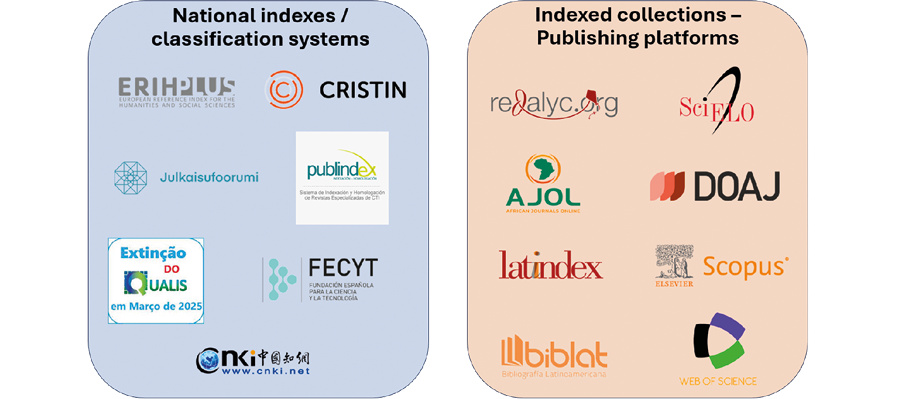
The difference between such platforms as OpenAlex and the curated collections is that the platforms included in Figure 5 provide curated lists of journals after implementing an entrance evaluation with a set of criteria to all applicant journals. WoS and Scopus emphasize editorial quality, technical efficiency, and impact, but are incapable of guaranteeing scholarly mission (or even institutionally based journals) or academic editorship. Other standards, while mentioned in the descriptive documents, clearly go unmet. According to Alonso-Alvarez (2024), AJOL, Scopus, and WoS define neither a valid peer review nor a minimum set of criteria – for instance, whether or not it is anonymous or double-anonymous, or the number of reviewers.
Table 1: The Diamond Quality Standards in the Evaluation Criteria of Diverse Indexation Systems
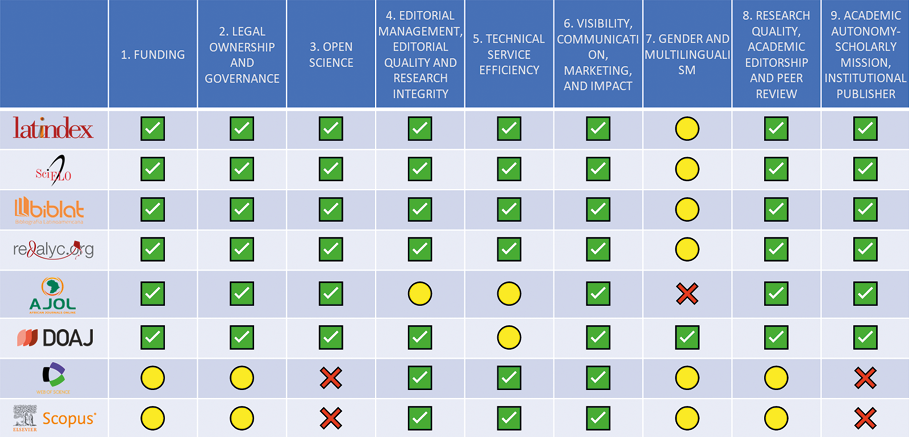
Table 1 shows that, in contrast, DOAJ, LATINDEX, BIBLAT, REDALYC, and SciELO include eight of the nine above-discussed quality standards. One of the merits of these indexed lists (that do not include citation reports) is their more comprehensive coverage of the scholarly literature of the humanities and social sciences, also serving the aims of documenting and stimulating multilingualism in scholarly publishing (Kulczycki et al., 2020; Sivertsen, 2022). These indexing systems evaluate the academic anchorage of the journal, which frequently defines whether the editorial power remains with scholars or if it has been transferred to commercial publishers. This takes us to the core of the crisis of the scholarly publishing market, which is not merely the legitimacy of editorial boards.
3.2 The Difference Between Curated Collections, Citation Indexes and National Information Systems
The four Latin American indexation systems described in Table 1 (Biblat, SciELO, Redalyc, Latindex) share common admission criteria that prioritize community-led journals. All four implement quality evaluations and indexation based on numerous, regularly revised criteria, without using citation indicators or the impact factor (Merlo Vega & Montoya-Roncancio, 2023). The university journal is, par excellence, the journal model fostered by these regional collections. While this increases trust, it may not be enough for researchers used to the evaluations by journal rankings. Latindex is a particularly interesting indexation system because it was created as a journal collection and a portal to increase visibility. This can be both an advantage and a weakness, because the information at the level of journals is well-established, while the metadata at the article level is only recently and partially available.2 Its governance is based in a regional network with national nodes and decentralized evaluations, expanding to all Ibero-American countries, which gives the system contextualized examinations (Cetto et al., 2010). During its 30 years of existence, Latindex discusses criteria and good practices in its annual meeting (Reyna Espinosa & Alonso Gamboa, 2025). Latindex not only dedicates efforts to the visibility of the portal’s Catalogue 2.0 and the admission or retrieval of journals, but it also offers free courses and capacity-building for editors and librarians. Noticeably, Latindex created a committee to detect spurious journals, observing suspicious editorial practices and preventing its incidence in Catalogue 2.0 (Abejón et al., 2024).
The Latin American publishing circuit has survived beyond commodification and has resisted the devaluation stemming from traditional impact assessments due to the presence of thousands of DOA journals in all disciplines, published mainly by universities. Successful stories of university journals are based on the use of open-source software and nonprofit managing systems, such as OJS-PKP. In another study, Beigel and Bruccoleri (2026) mapped 786 university portals that publish over 11,000 active community-led journals in Latin America. These institutional structures have played a central role in fulfilling the digitalization and professionalization of academic publishing in the region. This experience is significant nowadays given the provision of support from both universities and public agencies. Compared to the commercial circuit, an important feature of these regionally indexed journals is the resilience of autonomous editorship (Beigel, 2025b).
Visser et al. (2021) compared the most important bibliographical sources, arguing that their value depends on many different elements, such as coverage, openness, completeness, and data accuracy. The proprietary nature of WoS or Scopus restricts data sharing, as researchers are bound by licenses that prohibit free data exchange and transparency in collaborative projects. In response to these limitations, OpenAlex was developed by the nonprofit organization OurResearch to provide an inclusive, publicly accessible bibliographic dataset for the global research community, providing a freely available database with a particular emphasis on non-English speaking countries (Zheng et al., 2025). Nevertheless, there is a relevant technical difference between such platforms as OpenAlex or Crossref and indexing systems such as WoS, Scopus, Latindex, Redalyc, DOAJ, or SciELO. The latter are curated collections that include only journals/documents that are subject to admission evaluations.
There are also differences between the citation indexes and the national information systems included in Figure 5, such as the Norwegian CRIS, bibliographic databases, such as the China National Knowledge Infrastructure (CNKI), and national indexes, including Qualis from Brazil, Publindex in Colombia, or the Science and Technology Index (SINTA) in Indonesia. Some of these are open infrastructures that frequently offer a professional curatorship that allows any indexing system to retrieve metadata at the document level. In contrast, national curriculum databases, such as Brazil’s LATTES, are characterized by lower metadata quality in scholarly publishing as they are based on researchers’ personal uploads.
The national indexes or classification systems managed by governments or funding agencies are relevant indicators of a journal’s quality, but they all differ in terms of the involvement of the scholarly community, the incidence of the impact indicators in the classifications, and the range of journals under assessment (i.e., only national or also international journals). A well-established community-based national index is Norway’s CRISTIN, an integrated current research information system that includes a qualitative evaluation of all the journals that have published Norwegian researchers. It is an interesting case because the institutions receive part of their funding through a performance-based redistribution model, so they must report their academic publications every year to the “Norsk vitenskapsindeks” (Norwegian Science Index). The index classifies them into two levels without the use of the impact factor. They are awarded Level 1 when they are scholarly journals of quality, and Level 2 when they are part of superior, most-prestigious, international journals, which represent the top-20 % of all publications in each discipline (Sivertsen, 2018).
Led by Tsinghua University, the CNKI is the largest comprehensive database containing literature published since 1915. Moreover, CNKI has managed the “International and Domestic Influence of Chinese Academic Journals Statistics and Analysis Database” (CNKI, 2018). This database publishes international and domestic evaluation indicators for nearly 86,000 international academic journals and for over 6,000 scholarly journals officially published in China. Since 2018, CNKI has also released the “Annual Report for World Academic Journal Impact Index (WAJCI),” which provides information on renewed journal rankings. The other list of journals relevant in China is the CAS early-warning list, which represented a turning point in 2020 with its first release, which included 65 potentially problematic journals. Chen et al. (2025) showed a collective and persistent withdrawal from flagged journals, consistent with a reputation trap: Once stigmatized, journals experience lasting declines in submissions.
The case of Indonesia is interesting, given the country’s significant role in the global Diamond scholarly landscape, with 1,271 currently active journals (according to DOAJ in October 2025). Widianto et al. (2025) described the national accreditation system composed of the SINTA, which provides national accreditation, but heavily depends on international reputation. The classification system is organized into six tiers: SINTA 1: Highest quality journals with scores between 85 and 100. SINTA 2: High-quality journals with scores between 70 and 85. SINTA 3: Good quality journals with scores between 60 and 70. SINTA 4: Moderate quality journals with scores between 50 and 60. SINTA 5: Journals in the development stage with scores between 40 and 50. SINTA 6: Journals with the lowest accreditation scores, ranging from 30 to 40.
The Brazilian Qualis Periódicos is a curated and ranked list of all national and international journals in which Brazilian affiliated researchers and postgraduate students have published (Barradas Barata, 2016; Brasil, 2023). It was created by the Coordenação de Aperfeiçoamento de Pessoal de Nível Superior (CAPES) in 1998 to create a national classification of journals so as to feed indicators for the accreditation of the country’s postgraduate programs. Throughout its history, Qualis has undergone several changes. The methodology for the current Qualis Periódicos (2020) is based on four criteria: 1) a unique classification for each journal; 2) classification established by parent areas; 3) strata obtained from the combination of bibliometric indicators and a mathematical model prepared by CAPES; and 4) bibliometric indicators that consider the number of citations of a journal from Scopus (CiteScore), WoS (Impact), and Google Scholar. Based on these criteria, the classification is divided into eight strata, with each journal falling in a single stratum: A1, the highest, followed by A2, A3, A4, B1, B2, B3, B4, and C, indicating zero weight in the evaluation. Stratum C corresponds to journals with none of the indicators used in the methodology and/or that do not meet the good editorial practices defined by the Committee on Publication Ethics and the international databases used in Qualis Referência (CAPES, 2020c). However, Qualis was marked for disbandment after 2025.
4 Conclusions: Toward the Re-communalization of Scholarly Publishing
Section 3 analyzed the available initiatives, projects, and reports regarding the standards for Diamond journals. The seven-dimension DIAMAS proposition was employed with other approaches that highlighted not only editorial quality but also community-led scholarly publishing. Accordingly, I proposed a total of nine dimensions to consider: 1) funding; 2) legal ownership by a research institution or scholarly organization; 3) academic editorship; 4) editorial quality; 5) peer review and research integrity; 6) open science; 7) technical service efficiency; 8) visibility; and 9) EDIB and multilingualism. It is critical to prevent the “universalization” of costly DOA technical standards that could establish benchmarking between rich and poor institutions or countries. Awareness on the commercial versus noncommercial stake should place academic autonomy, research quality, and institutional anchorage among the top priorities of the DOA future.
I have argued that fostering diamondalization and seeking reliable sources of quality venues can be accompanied by rewarding multi-indexed journals. To the best of my knowledge, international indexed collections, such as BIBLAT, Redalyc, SciELO, Latindex, and DOAJ, comply with editorial and research quality standards. Moreover, they represent consistent lists of quality community-led journals. Indeed, there are thousands of Diamond journals that are included in two or more of these collections, providing truly reliable reasons to believe that a journal is anchored in the practice of autonomous editorship. Valorizing this kind of indexation can be useful both for researchers and evaluation committees.
There is a growing consensus that relevant science cannot be evaluated or measured solely by extracting indicators from WoS and Scopus. This is why coverage has become a core issue, alongside discussions of the notions of excellence, visibility, and impact. As it has been seen, regional indexing services, national information systems, and journal indexes are increasingly examined as a path to remedy these biases and improve responsible research assessments (Beigel, 2021; Sivertsen, 2018). To contribute to this research direction and reformist perspectives, it would be instrumental to have reliable open infrastructures that can shed light on bibliodiversity and multilingual output published in alternative circuits. As a collaborative infrastructure, OpenAlex is a progressive alternative that can help make regional and national data sources visible. However, this database is not an indexing system with curated and evaluated collections of quality journals.
Osalzan (2025) proposed an interesting indexing reform arguing that global services must involve editors from non-Western regions in setting selection criteria, ensuring inclusion without compromising rigor. However, it does not seem advisable to globalize standards of scholarly publishing, as this could blur the diverse starting points and needs of disparate regions and disciplines. One major issue in the debate is the criteria established by DIAMAS and the DDH related to persistent identifiers. A relevant component of Diamond journals in Latin American and other Southern regions is the absence of DOIs or other identifiers, which forms part of the digital world divide. Interoperability, therefore, is the goal, but cannot become another barrier. Contextualized solutions and preservation of academic autonomy should prevail, meaning that it becomes even more relevant to reach a consensus on Diamond principles while also fostering diversity: A one-size-fits-all solution is not advisable.
However, when confronted with the existing national accreditation systems that evaluate researchers in a given region, a paradox becomes apparent, whereby these quality journals are devalued constantly by conferring preference to the impact indicators. After more than two decades of devoted efforts to create a non-commercial publishing ecosystem in Latin America, the key issue remains in achieving legitimacy when recognition is at stake. Indeed, journals on the WoS – Clarivate and Scopus ranking continue to be better recognized in research assessments and highly rewarded in career promotion. This value regime was established through several means, including salary incentives, hierarchical classifications, and other symbolic rewards that had direct incidence in the research agendas (Ràfols et al., 2015; Marginson, 2021). To go beyond resilience means to build an academic reputation for these journals to become a desirable choice for researchers around the world.
In this direction, two complementary projects have been recently launched: Diamond Future, funded by the Berlin University Alliance, and the MSCA-Horizon Europe-funded OpenRAM. These seem poised to contribute to consolidating the regional collaboration between the Research Center for the Circulation of Knowledge (Universidad Nacional de Cuyo-Argentina), LATINDEX (UNAM-México) and the HERA Platform3 (Universidad Nacional de La Plata-Argentina). The main goals of this collaboration are to foster the circulation of the output published in journals indexed in Latin America and to create an interactive website for researchers and evaluators so as to boost the visibility of the landscape of Diamond journals. The main task is to focus on the researchers’ choices and beliefs, informing about scholarly venues with proven academic anchorage and editorship.
In the context of the increasing marketization of scholarly publishing, the existing Diamond journals are at risk and endangered. There is enough evidence of the frequent offers received by academic editors to buy the journals. It is not enough, then, to foster the diamondalization of OA journals at a one-by-one scale. A more radical change to decommercialize scholarly publishing needs incentives in various directions: a) to re-communalize learned societies’ journals coped by big publishers, b) to sustain technical improvements in quality diamond journals that have no access to persistent identifiers, c) to create federated publishing infrastructures, and/or d) networked diamond journals.
Accordingly, it may be wise to boost the synergy between the existing non-commercial publishing platforms (e.g., SciELO, Redalyc, OJS-PKP, Open Edition, Érudit) and the universities as publishing institutions that support community-led journals. Eventually, to pledge for recommunalization is not a structural solution itself when it is understood as a naive return to the good old days of small journals meant for the “best and the brightest.” Scholarly publishing is part of a field that struggles over the possession of a scarce symbolic capital (scientific prestige). However, a virtuous cycle may grow through multiscale publishing circuits open to all. These could allow space for more diversified research agendas and new career profiles, amid the research assessment reform, where several recognition paths should evolve.
References
3rd Global Summit on Diamond Open Access. (2024, December 8–14). The second summit: Integrating social justice into scholarly publishing [Conference information]. https://www.diamondoasummit.org
Abejón Peña, T., Córdoba González, S., Cetto, A. M., Alonso-Gamboa, J. O., & Polanco-Cortés, J. (2024). Fraudulent practices in the field of academic publishing: The Latindex experience. Canadian Journal of Communication, 49(4). https://doi.org/10.3138/cjc-2023-0027
Abubakari Ahmed, A., Al-Khatib, A., Boum II, Y., Debat, H., Gurmendi Dunkelberg, A., Hinchliffe, L. J., Jarrad, F., Mastroianni, A., Mineault, P., Pennington, C. R., & Pruszynski, J. A. (2023). The future of academic publishing. Nature Human Behaviour, 7, 1021–1026. https://doi.org/10.1038/s41562-023-01637-2
ALMASI Project. (2025). Aligning and mutualizing nonprofit open access publishing services internationally (ALMASI) [Research project]. European Union, Horizon Europe. https://almasi-project.eu
Alonso-Alvarez, P. (2024). Exploring research quality and journal representation: A comparative study of African Journals Online, Scopus, and Web of Science. Research Evaluation, 33. https://doi.org/10.1093/reseval/rvae057
Barradas Barata, R. de C. (2016). Dez coisas que você deveria saber sobre o Qualis. Revista Brasileira de Pós-Graduação, 13(30). https://doi.org/10.21713/2358-2332.2016.v13.947
Beigel, F. & Bruccoleri, M. (2026). Is there a Latin American model of diamond publishing? Exploring the University Portals. Zenodo. https://doi.org/10.5281/zenodo.18603143
Beigel, F. (2021). Los sistemas CRIS, su potencialidad para visibilizar diversas formas de producción e impulsar nuevas modalidades de evaluación. FOLEC-CLACSO. https://www.clacso.org/herramienta-1-los-sistemas-cris-su-potencialidad-para-visibilizar-diversas-formas-de-produccion-e-impulsar-nuevas-modalidades-de-evaluacion/
Beigel, F. (2025a). Cartografías para una ciencia abierta inclusiva. Revista Cubana de Información en Ciencias de la Salud, 36. https://acimed.sld.cu/index.php/acimed/article/view/3140
Beigel, F. (2025b). The transformative relation between publishers and editors: Research quality and academic autonomy at stake. Quantitative Science Studies, 6, 154–170. https://doi.org/10.1162/qss_a_00343
Beigel, F., Bruccoleri, M., Isuani, G., Trinca, T. P., & van Schalkwyk, F. (2025). Caught in the crossfire? A comparative study of researchers’ choices in scholarly publishing and the effects of national evaluation regimes with reference to article processing charges (APCs). SciELO Preprints. https://preprints.scielo.org/index.php/scielo/preprint/view/13209
Brasil, A. (2023). Between bibliometrics and peer review: The evolution and challenges of Brazil’s Qualis system (Version 1) [Preprint]. 27th International Conference on Science, Technology and Innovation Indicators (STI 2023). https://doi.org/10.55835/6442f8d5389baf2145b264d9
Bruns, A., Cakir, Y., Kaya, S., Beidaghi, S., & Taubert, N. C. (2022). Diamond Open Access Journals Germany (DOAG) (Version 1.1). Bielefeld University. https://doi.org/10.4119/unibi/2965484
CAPES. (2020). Metodologia do Qualis Referência: Documento base aprovado no CTC 198, de setembro de 2020. https://www.gov.br/capes/pt-br/centrais-de-conteudo/documentos/conselho-tecnico-cientifico-da-educacao-superior/anexos-ctc-es/DocumentobaseQualisCTC198SEI1606400.pdf
Cetto, A. M., & Alonso Gamboa, J. O. (2011). Calidad e impacto de la Revista Iberoamericana. Facultad de Ciencias, UNAM. https://www.latindex.org/lat/documentos/descargas/ciri2010.pdf
Cetto, A. M., Alonso Gamboa, J. O., & Córdoba González, S. (2010). Ibero-American systems for the dissemination of scholarly journals: A contribution to public knowledge worldwide. Scholarly and Research Communication, 1(1).
Chan, L., Hall, B., Piron, F., Tandon, R., & Williams, L. (2020). Open science beyond open access: For and with communities. A step towards the decolonization of knowledge. Canadian Commission for UNESCO IdeaLab.
Chen, X., Dorsch, I., & Maddi, A. (2025). Trapped by prestige: Systemic vulnerabilities of open access publishing (Version 1) [Preprint]. OpenIT.
China National Knowledge Infrastructure. (2018). CNKI. https://oversea.cnki.net/index/
Consortium of the DIAMAS project. (2025). The Diamond OA Standard (DOAS). Zenodo. https://doi.org/10.5281/zenodo.15227981
CRAFT-OA Project. (2023–present). Creating a Robust Accessible Federated Technology for Open Access (CRAFT-OA). Zenodo. https://zenodo.org/communities/craft-oa/
Dagiene, V., & Aibar, E. (2025). Publishing infrastructures in the semi-periphery: How research assessment shapes the research output of Spain and Lithuania. ResearchGate.
De Castro et al (2024). Galvanising the open access community. a study on the impact of plan S. Eurpean Union. https://doi.org/10.5281/zenodo.13738479
Debat, H. y Babini, D. (2020): “Plan S in Latin America: A Precautionary Note”, Scholarly and Research Communication, vol. 11, n° 1, 0101347, pp. 1–12. https://doi.org/10.22230/src.2020v11n1a347
DIAMAS Project. (2023–2025). Diamond Open Access Standard (DOAS) guide for journals. https://diamasproject.eu/
Frank, J., Foster, R., & Pagliari, C. (2022). Open access publishing: Noble intention, flawed reality. Social Science & Medicine, 317. https://doi.org/10.1016/j.socscimed.2022.115592
Kulczycki, E., Guns, R., & Pölönen, J. (2020). Multilingual publishing in the social sciences and humanities: A seven-country European study. Journal of the Association for Information Science and Technology, 71, 1371–1385. https://doi.org/10.1002/asi.24336
Kulczycki, E., Gamboa, J. O. A., Beigel, M. F., Digiampietri, L., Laakso, M., Pölönen, J., Taşkın, Z., Cuartas, G. V. (2025, June 11). Beyond the oligopoly: Scholarly journal publishing landscapes in Latin America and Europe. https://doi.org/10.31235/osf.io/cm5uz_v1
Late, E., Guns, R., Pölönen, J., Stojanovski, J., Urbanc, M., & Ochsner, M. (2024). Beyond borders: Examining the role of national learned societies in the social sciences and humanities. Learned Publishing. https://doi.org/10.1002/leap.1609
Lillis, T., & Curry, M. J. (2010). Academic writing in a global context: The politics and practices of publishing in English. Routledge.
Merlo Vega, J. A., & Montoya-Roncancio, V. (2023). Evaluation criteria for scientific journals. Revista Estudios de la Información, 1(1), 71–89. https://doi.org/10.54167/rei.v1i1.1223
Gatti, R. Mounier, P., & Rooryck, J. (2025). Beyond ‘no fee’: why diamond open access is much more than a business model. In Nicola Cavalli ed., Current Trends in Open Science. Will Open Science change the world? Ledizioni LediPublishing: Milano.
Nazarovets, M. (2025). University journals: A semi-systematic literature review of trends, challenges and future research directions. Insights, 38(13), 1–26. https://doi.org/10.1629/uksg.705
Nazarovets, M., Laakso, M., & Taskin, Z. (2025). University journals in the global academic publishing landscape: Mapping over 19,000 diverse titles. Open Science Framework. https://doi.org/10.31235/osf.io/q6fpw_v1
OPERAS-P. (2021). OPERAS-P: Supporting the development of the OPERAS research infrastructure. European Commission, Horizon 2020 Programme.
Osalzan, M. (2025). Role of editorial boards in ensuring quality in the era of predatory threats. Trends in Scholarly Publishing, 4(1), 38–42. https://doi.org/10.21124/tsp.2025.38.42
Pampel, H., Wrzesinski, M., Kaden, B., Bargheer, M., Kindling, M., & Schobert, D. (2024, August 5). Perspectives on the future of community-driven open access publishing. https://doi.org/10.59350/7evg5-jm930
Pinfield, S. (2025). The need for scientific, epistemic and participatory openness. Routledge.
Reyna Espinosa, F. R. (2015). La bibliografía Latinoamericana de la UNAM, a propósito de los 350 años de la primera revista científica. Ibersid, 9, 47–52.
Reyna Espinosa, F. R., & Alonso-Gamboa, J. O. (2025). Cooperative work of Latindex through its reports. Ibersid, 19(1), 13–21. https://doi.org/10.54886/ibersid.v19i1.5067
Saenen, B., Ancion, Z., Borrell-Damián, L., Mounier, P., Oliva Uribe, D., Papp-Le Roy, N., & Rooryck, J. (2024, febrero 20). 2nd Diamond Access Conference Report. 2nd Diamond Open Access Conference, Toluca, México. https://doi.org/10.5281/zenodo.10684544
Sánchez, A., Carrillo, O., & Durán, E. (2021). Portal BIBLAT: Nueva generación de indicadores bibliométricos para la ciencia latinoamericana y del Caribe. Boletín Académico y de Información, 65, 17–21.
Scheufen, M. (2015). The future of academic publishing. In Scheufen, M., Copyright versus open access: International law and economics (pp. 99–123). Springer. https://doi.org/10.1007/978-3-319-12739-2_5
Simard, M.-A., Butler, L.-A., Alperin, J. P., & Haustein, S. (2024). We need to rethink the way we identify diamond open access journals in quantitative science studies. Quantitative Science Studies, 5(4), 1042–1046. https://doi.org/10.1162/qss_c_00331
Sivertsen, G. (2018). The Norwegian model in Norway. Journal of Data and Information Science, 3(4), 2–18. https://doi.org/10.2478/jdis-2018-0017
Sivertsen, G. (2022). Publishing in the social sciences and its representation in research evaluation and funding systems. In T. C. E. Engels & E. Kulczycki (Eds.), Handbook on research assessment in the social sciences (pp. 238–261). Edward Elgar Publishing. https://doi.org/10.4337/9781800372559.00024
Sivertsen, G., Pölönen, J., & Røeggen, V. (2025). The increasing value of qualitative community-based journal evaluation [Abstract]. In RESSH 2025: Book of abstracts (p. 122). Nordic Institute for Studies in Innovation, Research and Education (NIFU); Federation of Finnish Learned Societies; Universities Norway. https://vastuullinentiede.fi/sites/default/files/2025-05/RESSH2025_Conference_Book_of_Abstracts.pdf#page=122
Steinhart, G., Collister, L., Huang, C.-K., Lippincott, S., Neylon, C., Riordan, D., Sellanga, J., Skinner, K., Thaney, K., & Tsang, E. (2024). 2024 state of open infrastructure: Trends in characteristics, funding, governance, adoption, and policy. Invest in Open Infrastructure. https://doi.org/10.5281/zenodo.10934089
Taşkın, Z., Pölönen, J., Kulczycki, E., & Laakso, M. (2025). Mapping the publisher types and collaborations behind Web of Science indexed journals [Advance online publication]. Quantitative Science Studies. https://doi.org/10.1162/qss.a.14
Taubert, N. C. (2012). Minerva and the development of science (policy) studies. Minerva, 50(3), 261–275. https://doi.org/10.1007/s11024-012-9208-4
Toluca. Cumbre Global sobre Acceso Abierto Diamante. (2023). Conclusions and future work. Manifesto on science as a global public good. https://globaldiamantoa.org/wp-content/uploads/2023/11/Global-Summit-Conclusions-Way-Forward-Esp.pdf
University of Cape Town Libraries, & UNESCO. (2024, December 8–14). 2nd Global Summit on Diamond Open Access: Centering social justice in scholarly communication to advance research as a public good [Conference]. Cape Town, South Africa. https://diamondopensummit.org
Visser, M., van Eck, N. J., & Waltman, L. (2021). Large-scale comparison of bibliographic data sources: Scopus, Web of Science, Dimensions, Crossref, and Microsoft Academic. Quantitative Science Studies, 2(1), 20–41. https://doi.org/10.1162/qss_a_00112
Widianto, E. D., Hadiyanto, Mantoro, T., & Nugroho, A. S. (2025). Subject area mapping of Indonesian journals from GARUDA and SINTA databases: A descriptive study. Science Editing, 12(2), 175–182. https://doi.org/10.6087/kcse.382
Zheng, M., Miao, B., & Larivière, V. (2025). Understanding discrepancies in the coverage of OpenAlex: The case of China. Open Science Framework. https://doi.org/10.1002/asi.70013
Date received: 6 November 2025
Date accepted: 20 February 2026
1 Plan S is an initiative for Open Access publishing that was launched in September 2018, supported by cOAlition S, an international consortium of research funding and performing organizations. Implemented in 2021 the Plan encompasses three different routes Open Access journals (mainly involving the payment of Open Access publishing fees; transformative arrangements and rights retention policies for Green Open Access. See De Castro et al 2024.
2 See the new Latindex Article discoverer at: https://latindex.org/latindex/noticia/344
3 The Tool for Scholarly Resources Assessment (HERA) is an already existing web-based tool that aims to simplify, streamline, and support the process of determining the quality and impact of a scholarly resource.