Tokenization Beyond the Market
From Monetary Sociology to Co-Design in Civic Blockchain Infrastructure
1 Introduction
Despite growing interest in blockchain for social good and in the sociology of money, researchers and practitioners have largely ignored the mechanisms by which sociological insights into money can inform the design of monetary systems, particularly tokenized ones 1. This paper addresses that gap by developing a co-design model for the construction of tokenized circuits of commerce within civic blockchain-understood here as blockchain-based infrastructure oriented towards local collaborative economies and based on participatory rule-making. The model is grounded in an analytical framework developed from complementary and community currency studies and monetary sociology, then extended to digital and tokenized systems.
The research question explored in this paper is: how can monetary design be grounded in the social relations, territorial values, and collective objectives that both precede a monetary architecture and are expected to be supported by it? The paper addresses this question with specific attention to situated token-based architectures.
The paper starts from a specific problem in blockchain for social good. Many initiatives in this field rely on token-based incentives to reward civic, ethical, or environmentally desirable behaviors, including in domains related to regenerative and circular economies (Mhlanga, 2023). Yet the notion of “social good” often remains weakly theorized and is frequently framed in terms of value production, efficiency, and incentive alignment. As Semenzin (2023) argues, blockchain-for-good discourses tend to interpret social good in rational and competitive terms, translating collective aims into measurable outputs and economic value. Within the heterogeneous field of blockchain for social good, this paper focuses on civic and community-oriented initiatives in which cryptographic tokens are used to organize value circulation, access, recognition, incentive, or governance within participatory and collaborative economies. The issue, then, is not simply whether tokens are used for desirable purposes, but how value is defined, measured, and embedded in tokenized architectures.
Economic sociology offers a useful analytical starting point for addressing this problem. Money is not treated here as a neutral medium of exchange, but as a social relation, an institution. This perspective matters for tokenized systems because token design does not only define technical parameters. It also establishes what counts as valuable, which practices deserve recognition, who can participate, who can access monetary means and resources, and under which rules circulation may occur. However, while it has consistently been used to develop robust analytical tools for understanding money, economic sociology has rarely been translated into operational approaches for designing monetary architectures.
This paper therefore addresses two gaps. On the one hand, blockchain-based tokenization is often developed through engineering-driven or market-oriented approaches that insufficiently account for the social and institutional nature of money. On the other hand, sociological theories of money have not yet been sufficiently mobilized to guide the concrete design of tokenized monetary systems. A related issue emerges in complementary and community currency studies, where classificatory and assessment approaches have been criticized for reducing the complexity of monetary artifacts and for obscuring the assumptions about money that inform them (Lucarelli & Gobbi, 2016; Toti, 2024). This complexity also concerns the sociality embedded in monetary design itself: as Doria and Fantacci (2017) show, monetary systems organize social relations not only through their external objectives but also through the way they define issuance, circulation, valuation, and use. The analytical framework outlined in Section 3 addresses these limits by identifying the dimensions and variables required to analyze monetary architectures beyond their technical or economic components.
This paper’s core contribution is the proposed design method for operationalizing the theoretical framework: a four-phase co-design 2 model that translates a sociological conception of money as a social and institutional relation into a process of monetary design. By involving local actors -including municipalities, local organizations, and citizens -alongside researchers, facilitators, and developers, the model broadens the participatory basis of what Martin (2013) calls Great Monetary Settlement. It creates a space in which monetary features and circulation boundaries are defined before token circulation begins, through decisions regarding actors and access rules, value flows, token functions, issuance mechanisms, forms of recognition and participation, and valuation criteria. This is also how the paper responds to critiques of blockchain for social good: the “good” to be supported is not assumed in advance, but specified through situated negotiations before being translated into token functions and rules.
The empirical material comes from two Urban Living Labs (ULLs), understood as situated experimental settings in which local actors collaboratively develop and test solutions (Viano et al., 2023b), implemented as part of a European project on circular urban economies (CUE) and civic technologies. Turin serves as the primary empirical illustration, while Aigaleo is used for comparative analysis to shed light on valuation, quantification, and pedagogical mediation. The analysis does not evaluate the effects of token circulation after implementation. Rather, it examines the prior moment in which the monetary architecture is defined, showing how concepts and selected variables become concrete design issues in neighborhood-based CUE contexts. In this way, the empirical material makes visible four central design problems: how good practices are selected and valued, how different contributions are made comparable, how token uses are differentiated, and how the boundaries of tokenization and rules of circulation are defined.
The paper proceeds as follows. Section 2 develops the theoretical framework, drawing on monetary sociology and complementary and community currency studies to conceptualize money as a situated socio-technical institution, before extending this perspective to cryptographic tokenization, civic token systems and the mutual shaping of social contexts, digital infrastructures, and monetary design. Section 3 presents the methodological approach, the analytical framework and its operationalization into a four-phase co-design model. Section 4 introduces the empirical context and analyzes the model’s application in the two ULLs, with Turin as the main empirical illustration. Section 5 discusses the implications of this approach for monetary design, commensuration, collective earmarking, off-chain governance, and civic blockchain. Section 6 concludes by outlining the limits of the present study and future research on token circulation and its effects.
This structure reflects the role of the different parts of the paper. The theoretical framework developed in Section 2 and the analytical framework presented in Section 3 provide the conceptual and methodological basis for the paper’s main contribution: the co-design model through which sociological insights on money are operationalized into monetary design, participatory steps, and technical choices for civic token systems.
2 Theoretical Framework: From Monetary Sociality to Token Design
This section develops the conceptual basis for approaching tokenized systems as monetary architectures rather than as merely technical infrastructures. It aims to show how the conjunction between the economic sociology of money and complementary and community currency studies requires a broad understanding of money-one that includes not only rules of issuance and circulation, but also the social, institutional, and territorial conditions that precede its introduction, shape its uses, and sustain it over time.
This study conceptualizes money as a socio-technical artifact3 to emphasize its material, institutional, and designed dimensions. Rather than just a symbolic relation or an abstract unit of account, money is also a constructed object whose form embodies social meanings, organizational logic, and power relations. This distinction is important for monetary design: monetary architectures are created through explicit rules and institutional choices, but their social effects also emerge through use, interpretation, and circulation.
This relation between design and use is conceptualized here as processual recursivity: monetary forms are shaped by social meanings, institutional arrangements, and collective objectives, while their circulation may, in turn, stabilize, reinforce, or transform those meanings and objectives. As such, monetary design is not understood as the technical configuration of an instrument, but as a situated process through which values, rules, relations, and forms of coordination are inscribed into monetary architecture.
The argument proceeds in three steps. First, a sociological understanding of money provides the entry point for an interdisciplinary perspective that brings together economic sociology, monetary anthropology, institutional political economy, and the philosophy of money. This perspective conceptualizes money as a social and institutional relation embedded in broader social configurations and situated relational networks. Second, complementary and community currencies (CCCs) are discussed as monetary design experiments that make visible the plurality of monetary architectures and their social and behavioral effects. Third, tokenization and civic blockchain are examined as infrastructures within which monetary functions can be differentiated, and their rules made more explicit, programmable, and traceable, an approach that, conversely, introduces new problems of participation, valuation, and revisability. These perspectives justify the need for a multidimensional framework, presented in Section 3, to analyze the social, territorial, digital, economic, and monetary conditions that shape and sustain tokenized circuits of commerce.
2.1 Money as a Social, Institutional and Situated Relation
Money is often presented in orthodox economic thought as a neutral and universal medium of exchange. Historical, anthropological, and sociological scholarship, however, offers a different understanding: money is both an institution and a social relation (Aglietta & Orléan, 1998; Ingham, 1996, 2004; Graeber, 2011). Rather than merely facilitating exchange, money participates in the reproduction of social relations and contributes to the stabilization of structures of power and meaning. It is a collectively instituted measure through which societies organize obligations, recognition, and value, thereby shaping forms of coexistence and the social order to which it belongs (Amato, 2010; Martin, 2013; Orzi, 2017).
An interdisciplinary reading, meanwhile, understands money as a universal yet historically situated phenomenon (Servet et al., 2008). This perspective makes it possible to move beyond the dominant perception of modern forms of money in capitalism as the only “natural” model, and to open analytical space for contemporary monetary experiments. In this paper, situatedness refers to this processual relation between monetary systems and social life: monetary architectures are shaped by and shape social meanings, institutions, and value orientations; these forces may, in turn, stabilize or transform each other. This is the relation that the paper conceptualizes as processual recursivity, as introduced above.
This perspective requires attending to the social configurations, power relations, forms of agreement, and situated practices that precede and shape monetary circulation. Polanyi (1944) shows that monetary and economic institutions are embedded in wider social, cultural, and political configurations, while Granovetter (1985) highlights how economic action is embedded in networks of social relations that shape meaning, trust, and coordination. Taken together, Polanyi and Granovetter elucidate two analytical levels: the macro-social, political, and institutional configurations that define money as a historical and social object, and the local networks and interpersonal ties within which monetary artifacts are concretely used, re-signified, and redefined. Zelizer’s work on earmarking further shows that monetary meanings are differentiated through situated practices of use, as actors assign purposes, destinations, and moral meanings to monetary forms. The work of Lee et al. (2004) on circuits of value adds spatial and material dimensions to this argument: monetary practices are embedded in geographies and social configurations that give meaning to circulation and communicate judgments about what is useful, legitimate, desirable, or worth sustaining.
Economic sociology therefore provides the basis for analyzing money as a relation structured by institutions, norms, and power. Ingham defines money itself as a social relation constituted through specific institutional configurations (1996; 2004). Marx ([1844] 1978) and Orzi (2017) direct attention to the role of money in shaping value flows, social relations, and reproduction, while Martin (2013) reminds us that even the choice of a standard of value has distributive and political effects. Evans (2009) further shifts the question from whether money corrupts or replaces values to how specific qualities of money become salient within particular relations. This point connects directly with Zelizer’s (1994, 2005) circuits of commerce, in which monetary practices are embedded in relational environments structured by meanings, norms, and obligations.
These perspectives justify the framework’s multidimensional orientation developed in this paper. If money is a social relation, an institution and a situated technology of coordination, its analysis cannot be limited to monetary variables in a narrow sense, such as quantity, circulation, or velocity. It must also include the relations, values, actors, territorial conditions, governance arrangements, and meanings that make monetary circulation possible within a specific local economic model or a broader model of social reproduction 4.
2.2 Complementary and Community Currencies as Monetary Design Experiments
CCCs make the design dimension of money empirically visible. In the context of contemporary monetary plurality, these experiments show that money can be configured as a purpose-specific medium through rules of issuance, circulation, and use. Gómez and Dini (2016) describe monetary plurality as a privileged field for testing and expanding monetary theories by observing how different monetary designs perform in practice. In this sense, CCCs do not merely illustrate alternatives to official money; they show that monetary architectures can be intentionally configured to support specific forms of coordination and social reproduction.
This perspective resonates with the literature on special-purpose monies (Zelizer, 1989, 1994), which shows that money does not always function as a homogeneous, general-purpose medium. Monetary forms may be created, restricted, or oriented toward specific uses, social relations, and institutional purposes. CCCs make this plurality explicit at the level of design, defining who may issue money, where it circulates, what it can be used for, which relations it supports, and which values it is expected to reinforce. They also show that economic coordination may combine exchange, reciprocity, and redistribution rather than being organized solely through market exchange (Polanyi, 1944; Orzi, 2017), thereby requiring a broader constellation of monetary and economic arrangements.
In their study of CCC experiments, Doria and Fantacci (2017) argue that the sociality of money lies not only in the external objectives that a currency may help achieve, but in the way monetary systems perform their basic functions through specific design choices. This renders monetary architecture itself a site of social organization. Dodd (2014) similarly emphasizes that monetary circuits generate forms of sociality structured by shared meanings, norms, and practices. Thus, CCC studies provide a concrete basis for analyzing how monetary rules, social meanings, and institutional arrangements are combined in practice.
The possible combinations among these dimensions make innumerable permutations possible, explaining why classificatory approaches to CCC require caution. Lucarelli and Gobbi (2016) warn that some classifications risk overshadowing the specific features of these experiences. Toti (2024) develops a related critique by showing how the indicators used in CCC taxonomies reveal implicit monetary theories and may reproduce narrow assumptions about money. Recognizing this concern, the analytical framework developed here does not use dimensions and indicators merely to classify monetary systems. Instead, it uses them to identify the social, economic, territorial, digital, and monetary components through which a monetary architecture is constituted and stabilized in practice.
2.3 Tokenization and Civic Blockchain as Programmable Monetary Design
Before examining blockchain-based tokenization, it is important to recall that the notion of the token has a longer and more contested history than blockchain discourse tends to acknowledge. As O’Dwyer (2023) argues, tokens are liminal artifacts, both more and less than money, whose value depends on what they stand for and mediate. Elsewhere, Maurer (2017) situates tokens within a longer history of devices that mediate value, accounting relations, and social recognition. As such, the novelty of tokenization in blockchain environments is not found in inventing token-like mediation, but in embedding that mediation within digital infrastructures.
This paper understands a cryptographic token as the digital representation-on a distributed ledger such as a blockchain-of a value, right, claim, access condition, or asset-related entitlement. Tokenized systems are socio-technical configurations in which these digital units can circulate and be assigned or redeemed according to rules that may be encoded through smart contracts and supported by off-chain organizational arrangements. The specific object of analysis is not tokenization in general, nor market-oriented token economies, but civic token systems: tokenized systems embedded in blockchain infrastructures and oriented towards local collaborative economies, participatory rule-making and the collective definition of values, objectives, and modes of functioning. Here, the term civic refers not only to public-sector or municipal involvement but also to hybrid socio-technical configurations involving community actors, civil society organizations, researchers, developers, and, where relevant, local institutions in the co-definition of rules, values, and objectives. Tokenization therefore extends the problem of monetary design into digital infrastructures, multiplying the possible ways in which value, recognition, circulation, and participation can be organized beyond the naturalized functions of capitalist forms of money.
A different genealogy of the token comes from behavioral psychology. Token economies were developed as systems of operant conditioning in which tokens functioned as generalized reinforcers, mediating between desired behaviors and material rewards (Kazdin & Bootzin, 1972; Kazdin, 2012). Tokens are instruments for shaping individual behavior through incentive structures, a logic that has migrated into contemporary behavioral economics, design thinking, and sustainability-oriented behavior change programs. It also underlies many blockchain-based reward systems, including initiatives framed as blockchain for sustainable development, blockchain for social good, or blockchain for social impact. Blockchain-based tools have also been adopted in fields shaped by digital activists and grassroots organizations, especially in digital commons, commons-based peer production and sharing, and social and solidarity economies (Domenicale et al., 2026a).
The perspective guiding this paper fundamentally differs from behaviorist and incentive-centered approaches. Tokens are not treated here as instruments for conditioning individual behavior toward predefined outcomes, but as components of collectively negotiated monetary architectures in which what counts as valuable, who can participate, and how recognition is organized represent open design questions in themselves. This distinction is essential for avoiding a reduction of civic token systems to incentive machines, and for responding to critiques that blockchain-based social good initiatives often remain weakly embedded in territorial relations and local forms of collective governance.
In blockchain-based tokenization, rules of issuance, transferability, recognition, and use can be formalized through on-chain and off-chain arrangements, made traceable, and partially automated. This makes assumptions about value, legitimacy, control, and coordination more visible. At the same time, once encoded in smart contracts, revising rules may require specialized technical expertise, making revisability a practical and political issue in tokenized monetary design.
This position differs from approaches that are primarily centered on cryptoeconomics, tokenomics, or token engineering. Cryptoeconomics and token engineering have contributed important tools for analyzing incentives, mechanism design, and system stability (Voshmgir & Zargham, 2019; Kampakis, 2022). Kim et al. (2024) distinguish among token economy, tokenomics, and tokenization: the first concerns reward structures based on users’ contributions; the second concerns the supply, distribution, valuation, and utility of tokens; and the third concerns the process by which rights, assets, or practices are converted into digital tokens. Although useful, these distinctions remain insufficient if token systems are analyzed only through their economic dimension. As Voshmgir (2024) note, tokenomics may risk reductionism by isolating economic mechanisms from the political, technical, legal, and non-economic factors involved in their design. This paper therefore treats tokenization, token economy, and tokenomics as interconnected dimensions of the same design problem: how token functions, incentives, issuance mechanisms, and conditions of circulation are socially and institutionally defined before technical implementation.
In the case analyzed here, blockchain enters the research as part of a civic technology infrastructure rather than as a superior alternative to analog or digital community currencies. Its relevance lies in the possibility of making some monetary rules explicit, programmable, traceable, and open to collective configuration. Civic blockchain can therefore be oriented against the disembedding tendency often associated with cryptocurrencies: rather than detaching monetary infrastructures from local social and political foundations, it can support their re-embedding within territorially situated contexts, where rules, meanings, and uses are negotiated with the actors involved. This potential depends on the participatory processes through which the infrastructure is configured, the purposes it is asked to serve, the governance arrangements that define circulation, and the economic model that local actors seek to implement. This is consistent with the civic blockchain perspective developed by Viano et al. (2022, 2023a), which treats blockchain not as a financial infrastructure for speculative assets but as a tool that can support social collaborative economies and local participation.
This requires a critical stance. Maurer et al. (2013) show that the promise of disintermediation shifts trust from institutions to code without dissolving the social character of money. Drawing on Ingham’s social theory of money, the problem with cryptocurrencies lies not only in their volatility, but also in their tendency to present monetary infrastructures as if they could operate independently of the social, political and institutional conditions that make money acceptable and stable (Ingham, 2020). Civic blockchain moves in the opposite direction only if tokenized infrastructures are re-embedded within territorially situated and collectively negotiated contexts. The technology itself does not guarantee this. Semenzin’s (2023) critique of blockchain for social good is relevant here: social good is often framed in rational, competitive, and value-producing terms within blockchain discourse. A civic token system cannot therefore assume that tokenization is socially beneficial by design. It must specify how social good is defined, by whom, and through which rules.
In tokenized systems, the differentiation of monetary uses becomes more explicit through token types, permissions, and circulation rules. This makes Zelizer’s concept of earmarking useful, but with a specific shift: in civic token systems, earmarking emerges not only during circulation; it may also be partially anticipated through the collective design of token functions and uses. Section 5 explores this point further.
The approach aligns with the Social Shaping of Technology (SST) tradition, which treats technologies as molded by social, political, economic, and cultural processes rather than as neutral or deterministic artifacts (MacKenzie and Wajcman, 1985; Williams and Edge, 1996). This is especially relevant for the civic blockchain approach, which should not be understood only as a protocol or digital tool, but as an infrastructure whose use depends on situated social, organizational, and material conditions. Williams and Edge (1996) show that the architecture of information technologies is itself the product of historical processes of social and economic shaping. In this respect, the work of Pink et al. (2016) on digital ethnography offers a useful methodological sensibility: digital media can be studied as material “things” embedded in everyday infrastructures, including devices, connectivity, energy, and ordinary practices of use.
Civic blockchain is therefore socially shaped not only at the level of code or interface, but also through the conditions that make it accessible, intelligible, and usable in a specific local context. Understood in this way, it can be approached as a situated token infrastructure: a configurable socio-technical system whose functions are shaped through local relations, collaborative practices, organizational mediation, and collective decisions about value, access, recognition, and circulation.
This infrastructural reading is central to the paper’s contribution because it brings blockchain and tokenized money into the same analytical space. This paper extends the SST orientation to money as a social technology (Ingham, 2020). It therefore treats cryptographic tokens as a socio-technical artifact shaped by social relations, institutional arrangements, territorial conditions, value orientations, and technical affordances. At the same time, it may help shape recognition, circulation, and forms of economic coordination.
3 Methodological Approach
The methodological problem addressed in this paper concerns not only how to analyze monetary systems and circuits of commerce, but also how to make the dimensions that constitute them available for design before monetary circulation begins. This requires moving from analysis to construction: from the study of monetary architectures as social, institutional, and technical configurations to the development of a process through which these configurations can be collectively discussed and shaped.
The theoretical framework developed in Section 2 provides the basis for an analytical framework originally developed to study monetary experiments, which, in this paper, is extended to tokenized systems by paying specific attention to digital infrastructures, programmable token functions, wallet permissions, on-chain and off-chain rules, and the technical constraints of blockchain implementation. This extension does not replace the monetary framework. Rather, it adds a technological specification: blockchain-based tokens.
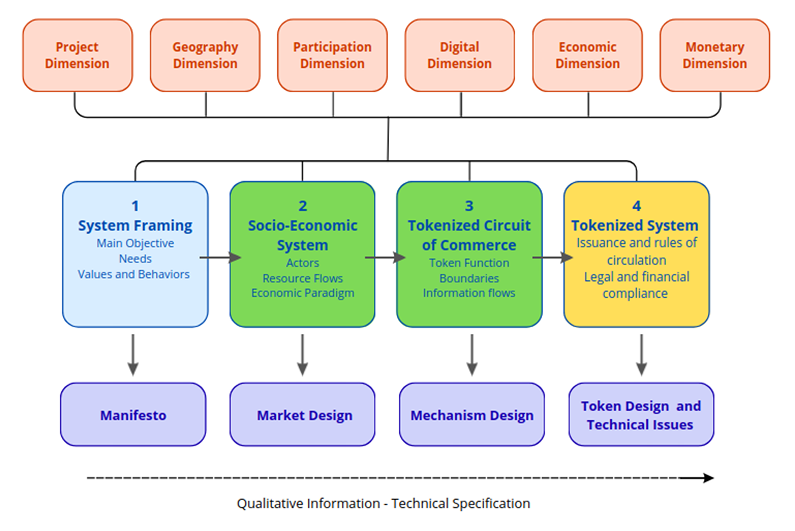
This points to the paper’s methodological proposal: adapting this framework into a four-phase co-design model 5. The model selects and reorganizes certain concepts and variables of the framework into phases, through which they become operational via workshops, facilitation tools, and guiding questions for constructing tokenized circuits of commerce. In this sense, the co-design model is the methodological device through which a sociological conception of money is translated into design practice, in this case for a tokenized local economy.
Figure 1: Visual representation: From analytical framework to co-design model, linked with tokenomics layer
3.1 The Analytical Framework
The analytical framework is built on the premise that monetary systems can be understood through the social, territorial, digital, economic, participatory, and monetary conditions that enable and sustain circulation over time.
In this perspective, tokenized economies are understood as hybrid systems spanning three interconnected spheres: social space, including governance, ethics, economic practices, and relational dynamics; digital infrastructures, platforms and protocols; and geographically situated projects and communities. Following Maurer et al. (2013), the apparent neutrality of digital currencies rests on a practical materiality in which social relations are translated into technical protocols rather than removed. This means treating digital infrastructure not as an external support for monetary circulation, but as one of the layers through which relations, rules, and forms of coordination are organized, constrained, and made operational.
We identify six interconnected dimensions: project, geography, participation and governance, digital infrastructure, economy, and monetary. The project and geography dimensions situate the system in its political, territorial, and organizational context. Participation and governance address who shapes the system and through which forms of involvement, mediation, and decision-making. The digital dimension concerns the infrastructures, affordances, and constraints through which values, rules, and forms of coordination are encoded into technical arrangements. The economic dimension identifies supported practices, value flows, boundaries, shared meanings, relations, and forms of economic integration. The monetary dimension focuses on issuance, circulation, acceptance, trust, functions, symbolic meanings, and the conditions under which different monetary forms operate within the circuit. Appendix A delineates the complete framework.
For this paper, three elements of the framework are especially important, as they connect it to the co-design model developed in the following section. The first is the analysis of monetary experiments as circuits of commerce. Following Zelizer (2005), this requires attention to the boundaries of the circuit, the actors involved, the types of transfer, the distinctive media used, the meanings attached to them, and the institutional arrangements that sustain trust, reciprocity, and control over internal transactions. The second element concerns value and commensuration. Following Lee et al. (2004), foregrounding value means asking not only what is produced, exchanged, or circulated, but also how economic activity is practiced and socially qualified within specific local circuits. On this basis, commensuration becomes a further step rather than an automatic assumption. Following Espeland and Stevens (1998), equivalences are not treated as given, but as social and political operations through which heterogeneous practices, goods, or contributions are made comparable. In methodological terms, this means that value, quantification, equivalences, and flows are not presupposed but instead become matters for collective definition and may also remain partially outside tokenization. The third element concerns forms of economic integration. A tokenized circuit does not necessarily organize all relations through exchange: reciprocity, redistribution, gift, lending, sharing, and collective access may coexist and require different forms of recognition, governance, and mediation.
Furthermore, consistent with the theoretical position developed in Section 2.3, the framework treats blockchain not as a neutral infrastructure, but as one component of a broader socio-technical configuration in which digital and material practices are entangled. This matters because tokenized circuits do not operate only within digital environments: they mediate relations among platforms, territories, material resources, organizational routines, and embodied practices. The framework therefore directs attention to the relational, institutional, territorial, and moral conditions through which a tokenized circuit becomes meaningful, socially legitimate, and territorially grounded.
By connecting heterogeneous dimensions and bridging disciplinary boundaries, the framework supports transdisciplinary collaboration and integrative forms of knowledge production. It also functions as a boundary object, facilitating dialogue and cooperation among researchers, facilitators, developers, local organizations, and community actors involved in the co-design process. Following Star and Griesemer (1989), it provides a shared reference flexible enough to accommodate different perspectives and forms of expertise, while maintaining sufficient coherence to support coordination around a common design process. This is particularly important in civic blockchain projects, which present monetary, technical, legal, territorial, and social questions that cannot be resolved within a single disciplinary or technical domain.
Adapting the framework into an operational model required identifying which variables to consider during the design phase. These variables are not transferred mechanically into the co-design process. Rather, they are selected and reorganized into a methodological sequence. The next section presents this operationalization.
3.2 Operationalizing the Framework into a Four-Phase Co-Design Model
Developing this study’s co-design process involved reorganizing selected variables into a stepwise model that progresses from framing a local socio-economic system to defining token functions, circulation rules, permissions, and feasibility constraints. This procedure set out to make sociological concepts of money usable for situated monetary design before token circulation begins. Co-design is understood here as a collaborative process in which local actors, researchers, facilitators, and developers contribute to the definition of the monetary architecture. Building on Ingham’s (2004) account of the political contract between the guarantor of monetary validity and its users, we extend the participatory dimension upstream: not limited to the acceptance of a monetary form after its issuance, but extended to the prior definition of values, rules, boundaries, and forms of recognition through which monetary circulation may become possible.
The model is structured into four phases: A. System framing; B. Socio-economic system; C. Tokenized circuit of commerce; D. Tokenized system. Each phase may include one or more workshops, depending on the local context, available time, and degree of familiarity with the digital infrastructure. The phases form a methodological sequence through which the framework is progressively translated into design decisions 6. Early phases focus on actors, values, practices, resources, and relations; later phases translate these elements into recognized practices, token functions, circulation rules, technical configurations, and sustainability constraints. Monetary and token-related variables are therefore introduced only after the socio-economic system has been framed, so that tokenization emerges from situated decisions about which artifact best supports collectively defined objectives, rather than from predefined incentive structures.
Table 1: Operationalization of selected framework variables into the four co-design phases
|
Co-design phase |
Indicators and variables mobilized |
Translation into design elements |
|
A. System framing |
Project: description/goals; problem or need addressed; explicit values; micro-objectives, motivations and resistances (informing Phase C). Participation and governance: engagement conditions. Geography: socio-economic context. |
Identifies the local problem or goal, the actors initially involved, their micro-objectives, motivations, resistances and value orientations. These elements converge into a preliminary shared frame, potentially formalized in a manifesto, which later orients the selection of recognized practices in Phase B and token types and their rules and quantities in Phase C. At this stage, the phase provides the first elements that may later inform token-related requirements, especially regarding actions, values, access conditions, actors, and possible incentives. |
|
B. Socio-economic system |
Project: openness/access; membership cost. Participation and governance: number of participants;. Geography: where; scale/level. Economic: conception of the economy; relationship with official markets and surrounding projects; types of transfers; resources, needs and value flows; integration forms. |
Mapping actors, resources, needs, practices and value flows within the socio-economic system, including relations with official markets and surrounding projects. This phase clarifies which flows are already active, which practices should be supported or strengthened, and which additional flows may need to be activated, as well as how they relate to the shared frame of values and objectives. These outputs provide the basis for tokenization decisions in Phase C and begin to inform the tokenomics layer by identifying possible token-mediated flows and recognizing practices and relations that should remain non-tokenized. |
|
C. Tokenized circuit of commerce |
Project: actors’ roles. Participation and governance: modes of involvement (incentives); information flow model; decision-making practices. Digital: ownership or control of infrastructure; digital/physical relation. Economic: circuit of commerce; boundaries and control over internal transactions; convertibility token/fiat money; value (good and services); distinctive media (token types); shared meanings; sociability; earmark; monetary design. Monetary: functions; issuance and creation; space of circulation; governance and control; symbology. |
Defines the tokenized circuit as a bounded system of transfers, meanings and relations. This phase decides how different practices are associated with specific media or forms of recognition. It also establishes which token types are needed, who can issue or use tokens, where they circulate, under which conditions they are accepted, and how circulation is governed, as well as establishing the conditions, transferability, recognized practices, and possible forms of reward, exchange, access, or certification. These elements are formalized into operational requirements concerning wallet types, permissions, and issuance mechanisms. |
|
D. Tokenized system |
Participation and governance: rule enforcement; accountability; organizational model. Digital: functionalities; type of digital tools (blockchain); adaptability/customization. Monetary: issuance mechanisms; acceptance; quantity; circulation rules; incentives against accumulation (token behavior); costs/fees; legal and financial compliance. |
Translates the co-design outputs into technical, institutional and monetary configurations. This phase assesses which functionalities can be implemented (only for platform co-design) or customized, and how automation should be used. It also evaluates the feasibility and sustainability of the proposed monetary architecture, including the coherence between issuance, circulation, expected uses, trust conditions, and legal requirements. |
Table 1 shows how selected indicators and variables from the analytical framework (see Appendix A) are reorganized into the four co-design phases. Some variables inform more than one phase and are progressively translated into different design decisions: first mapped in Phases A and B, actor roles are translated into wallet permissions and issuance rights in Phases C and D; shared values emerge in Phase A, orient the socio-economic system in Phase B, and guide token functions and quantification criteria in Phase C; digital affordances become fully relevant when tokenization decisions are translated into technical requirements in Phase D.
The outputs of each phase progressively inform the tokenomics layer, understood here as the operational translation of the framework into requirements for the tokenized system. In practice, these requirements are collected in a working document that links actors, recognized practices, token functions, wallet types, permissions, circulation rules, and platform functionalities.
Phase A. System Framing 7
The first phase prepares the conditions for co-design. It includes preliminary fieldwork, engagement activities, and educational moments, in this case on the circular economy, civic blockchain, tokens, and local monetary systems. Its purpose is to build a shared language, assess participants’ familiarity with the economic, territorial, and digital aspects considered relevant to the project, and identify the basic elements of the future circuit: actors, existing practices, needs, values, motivations, and resistances.
At this stage, the relevant framework variables concern project goals, problems addressed, explicit values, actors, motivations, forms of resistance, and territorial scale. These elements contribute to the construction of collective objectives and value frame-potentially formalized in a manifesto-which later orients the definition of the local economic model, as well as decisions on valuation, recognition, and token design.
Phase B. Socio-Economic System
The second phase focuses on the socio-economic circuit before tokenization or any other form of monetary mediation is introduced. Participants map actors, resources, needs, and existing or potential flows. These may include goods, services, spaces, tools, time, skills, participation, voluntary work, access to events, or shared resources. Each flow is discussed in terms of the relation called for-whether exchange, loan, gift, recognition, redistribution, or some other form of transfer 8.
Visual tools such as maps, actor cards, resource cards, post-its, and threads are used to support systemic thinking. A central facilitation exercise consists of placing shared values and objectives around the map, so that participants can relate specific flows to the broader frame of the local economy and discuss their meanings collectively. This shared frame provides a reference for later decisions concerning quantification, resource valuation, and incentive mechanisms. This is also the phase in which the social meaning of “good practices” begins to be discussed in relation to the economic model that the circuit is expected to support. The aim is to distinguish practices that should be maintained or strengthened from behaviors that may require activation or incentivization.
Phase C. Tokenized Circuit of Commerce
This phase is more differentiated than the previous ones and may require more than one workshop. Tokenization is introduced as a design possibility, not as a predefined solution. At this stage, shared meanings and perceptions of tokens are constructed or consolidated as participants move from the mapped socio-economic flows to the concrete articulation of the tokenized circuit. The manifesto, or shared value frame, becomes a practical reference for deciding which flows should be mediated by tokens, which should remain outside tokenization, for what purpose tokenization may be useful, and through which type of token. Depending on the group and the development of the process, the transition between Phase B and Phase C may also prompt a discussion of other forms of economic integration that can be activated.
The discussion concerns token functions, quantities, issuance rules, conditions of use, wallet types, permissions, transferability, and the distinction between what should be mediated on-chain and what should remain off-chain. Participants assess whether incentives or rewards are needed to support specific practices or relations associated with the mapped flows. They are also invited to determine which token type should mediate each flow, including the possibility of combining multiple token types within the same circuit, and to define the actors involved in the tokenized system, along with their corresponding wallets, permissions, and access conditions.
In this sense, the manifesto may evolve into a regulatory reference, especially for actions that are not automated by smart contracts and must remain governed by off-chain agreements, organizational rules, or collective practices.
This phase interprets token categories in relation to local practices, values, and social relations rather than treating them as fixed technical objects. A community token may function as a bounded medium of exchange; a reward token may recognize or encourage specific practices; a coupon may provide access to goods or services; and an NFT may represent an object, a shared asset, a certification, or a temporary right of use. The same technical standard can therefore acquire different meanings depending on the circuit of commerce in which it is embedded. Appendix B provides more detail about the token types used in CommonsHood, the civic blockchain wallet developed by the University of Turin that serves as the basis for this paper’s empirical material (see Section 4.1).
The decisions made in this phase make visible a process that can be understood as collective earmarking. Before circulation begins, token uses are differentiated through decisions about which token type should correspond to which flow, which actors can issue or use it, and which meanings are attached to it. This differs from, but does not replace, the form of earmarking analyzed by Zelizer (1994, 2005), which may later emerge during actual use, when participants allocate, interpret, and possibly re-signify tokens according to situated meanings and preferences. Because this second configuration depends on circulation, it is not assessed here; instead, Section 5 addresses it as a future empirical question.
This phase also makes processes of valuation, quantification, and commensuration explicit. Participants are invited to discuss whether and how heterogeneous practices, resources, or contributions should be recognized, quantified, and made comparable within the circuit. In this sense, equivalences are not assumed in advance but must be collectively negotiated, justified, and evaluated in relation to the system’s shared values and objectives 9.
Finally, the phase includes reflection on symbolic elements such as names, logos, and visual identities associated with the different token types. Rather than mere aesthetic components, names, logos, and visual elements are treated as integral to the meaning-making process and the construction of collective identity 10.
Phase D. Tokenized System
The fourth phase translates the design choices progressively defined throughout the previous phases into technical, institutional, and monetary feasibility, with particular attention to token quantities, issuance and distribution modes, potential accumulation, opportunities for circulation, access conditions, and uses available to different actors. At the same time, this phase considers the relation between the different value circuits activated in the system and the artifacts that sustain, organize, and shape them. Furthermore, the phase aims to verify whether the proposed architecture is coherent with the recognized practices, needs, values, and collective objectives defined in the previous phases.
A first distinction concerns the degree of co-design of the blockchain platform itself. In some cases, platform co-design may be possible, especially when developers are directly involved in the project or when open-source infrastructures enable local communities to participate in adapting the technical architecture. In other cases, the process does not involve developing new functionalities, but customizing existing ones. In the case of CommonsHood, this means assessing how the available functions can be adapted to the socio-economic and tokenized circuit defined in the previous phases.
A further distinction concerns the balance between automated and manual operations. Greater flexibility can sometimes be achieved through manual transactions between users and wallets that use the blockchain without smart contract automation. Developers and researchers therefore examine which proposed functions can be implemented through the existing infrastructure, which require adaptation, and which cannot be implemented within the available timeframe, budget, and technical conditions.
At the end of Phase D, the adjusted proposal can be returned to local actors before technical implementation or broader experimentation. This step is important because territorial expectations, technical feasibility, and monetary design do not always coincide. The model therefore does not assume that co-design produces a final, stable architecture in a single sequence, recognizing that it depends on further testing over time.
3.3 Empirical Context: Co.R.Pu.S. and the ULLs
The empirical material analyzed in this paper was developed as part of the European project Co.R.Pu.S.: Phygital Models of Cooperation in the Retrofitting of Public Space. The project brings together three interconnected domains: public space and participatory design, circularity at urban level, and civic digital infrastructure.
The experimentation was organized through two ULLs: one located in District 4 of Turin and one in Aigaleo, a municipality in the Athens metropolitan area. In this study, the ULLs provide the situated and participatory settings in which the co-design model is adapted, applied, and progressively refined with local actors (Viano et al., 2023b). Both contexts are characterized by forms of urban marginalization and by the presence of local actors already engaged in community-oriented practices. However, the two cases differ significantly in their territorial networks, existing practices, and forms of participation.
The Turin ULL constitutes the main empirical focus of this paper because it enabled a longer, more continuous co-design process involving in-person workshops, recurring interactions with local actors, and the progressive testing of CommonsHood. The experimentation developed around a Library of Things, swap practices, local events, and associative networks mediated in particular by Les Petites Madeleines (LPM), which played a central role in connecting the research activities with the neighborhood context.
The Aigaleo ULL focused on upcycling and circular practices related to the transformation of a public park in a social housing area, alongside the establishment of a municipal Community Lab for workshops, making activities, and collective interventions in public space. Although engagement was more limited than in Turin, the case offered useful comparative insights into valuation processes, quantification difficulties, and the pedagogical mediation required to make tokenization and circularity understandable.
Both ULLs featured co-design processes supported by CommonsHood. The Co.R.Pu.S. experimental setting did not introduce CommonsHood as a ready-made monetary system, but as a flexible infrastructure enabling local actors to define possible token functions, access rules, recognition mechanisms, and circulation boundaries. CommonsHood allows users and communities to create and customize cryptographic tokens and does not impose a single predefined economic model. Rather, it provides a modular infrastructure whose functionalities, token types, token values, user roles, and permissions can be adapted to different local exchange models. Each experiment, therefore, involves context-based co-design that concerns both the socio-economic interaction model and the application’s technical features. This process also requires negotiation between local actors’ expectations and the feasibility of implementation, including technical, temporal, and budgetary constraints.
The empirical material used in this paper includes workshop observations, facilitation activities, co-design outputs, collectively produced materials, discussions on tokenization choices, and reflections that emerged during the iterative adaptation of the co-design methodology itself. The empirical analysis does not aim to evaluate the success of token circulation after implementation. Rather, it examines how the co-design model operates in practice and how theoretical problems concerning value, recognition, commensuration, participation, and circulation become concrete design questions within situated processes of monetary design.
3.4 Applying the Co-Design Model: Evidence from the Co.R.Pu.S. ULLs
In Turin, Phase A was grounded in the long-term territorial work carried out by LPM, including the previous collective construction of a manifesto centered on social justice, participation, and sustainability. The process then included one workshop and one open activity corresponding to Phase B, focused on the socio-economic system, as well as a condensed Phase C workshop, because local actors had already worked on the Library of Things scenario, making them relatively familiar with the basic idea of tokens 11. Phase D developed through technical alignment, adaptation of CommonsHood functionalities, and the initial testing of selected scenarios.
In Aigaleo, the process followed a more compressed, mainly online path, with one workshop addressing the socio-economic system and another focused on tokenization, complemented by work carried out by local mediators and project partners.
One of the first elements to emerge across the two ULLs concerned the need to strengthen the pedagogical dimension of the process. Early experimentation showed that concepts such as blockchain, tokenization, wallets, token circulation and forms of economic integration required contextual mediation. This required expanding the co-design process beyond workshop tools 12 directed solely at citizens and towards incorporating a broader pedagogical package for facilitators. This included glossaries, visual narratives of the overall process, guidelines for stakeholder mapping, facilitation supports, examples grounded in everyday practices, and indications of criticalities linked to timing, participation, and comprehension. Participants engaged more easily with these concepts when they were anchored in concrete practices already present in the territory, such as borrowing tools, exchanging second-hand objects, or participating in local activities.
In Turin, Phase B focused on mapping actors, resources, needs, and flows associated with neighborhood activities. Because the value frame had been partly elaborated through LPM’s long-term territorial work, a key facilitation device was to position shared objectives and collective values around the territorial map itself. This made the map not only descriptive, but also normative: it helped participants evaluate whether specific practices, goods, or flows aligned with the desired local economic model.
By focusing on value flows and using the shared value frame as a reference, the process made visible both what was exchanged or circulated and how those exchanges occurred. Practices such as lending, gifting, sharing, and participation were understood as relational and community-oriented activities rather than as ordinary monetary transactions. These distinctions became central when participants later discussed which practices should be tokenized and which should remain outside token mediation.
In Phase C, the shared frame of social justice, participation, and sustainability oriented the discussion on which practices should be recognized and how. The Library of Things scenario saw uploading an object as linked to sustainability, because it supports reuse and reduces the need to buy new goods; lending and borrowing activated participation within the circuit; and welcome rewards were discussed as a means of guaranteeing a basic access capacity for users who did not have objects to contribute. Token rewards were treated as design choices connected to the values and objectives of the local socio-economic model.
Participants also discussed which flows should be tokenized, which token types should be used, and for what purposes. Community tokens, reward mechanisms, coupons, and NFTs were considered potential mediators or representations of value associated with different social functions. One of the clearest examples concerned the exchange scenario. Participants discussed whether to maintain the equivalence “one object = one token” or allow different valuations based on emotional attachment, perceived quality, or market value. The provisional solution was to maintain a uniform equivalence, because second-hand objects exchanged in this context were understood as part of a non-market setting oriented toward accessibility and participation. Notably, the possibility of informal agreements among participants was not excluded, demonstrating that equivalence was not imposed as a technical rule, but negotiated in relation to the meaning of the exchange.
A second example concerned gift practices. During the discussion, participants did not simply ask whether gifts could be represented technically by tokens; they questioned whether token mediation would remain consistent with the social meaning attributed to the practice. Some participants initially associated gifts with social justice, suggesting that recognizing gift practices could support broader access and redistribution within the circuit. Others argued that gifts should remain a form of reciprocity, suggesting that translating them into a quantified reward would weaken their meaning. After a collective discussion, the group moved toward leaving gifts outside token mediation. This decision is empirically relevant because it shows that co-design also creates space to decide what should intentionally remain non-tokenized.
This point also clarifies the relation between tokenization and the broader circuit of commerce. The boundary of the tokenized circuit is not determined solely by token-mediated flows, as the circuit also includes off-chain relations, non-tokenized practices, and actors who may participate in the socio-economic system without directly using the blockchain infrastructure.
This phase made the distinction between on-chain and off-chain dimensions a central design issue. Participants, facilitators, and developers discussed which aspects required formal token mediation and which could remain dependent on informal relations, collective norms, or external governance arrangements. In Turin, some rewards could be automated because they corresponded to predefined platform actions, such as uploading an object or activating a loan. In these cases, automation encoded a previous collective decision that these actions should count as “good practices” within the circuit. Other situations required manual issuance. For example, during a swap party, an object may be brought without having been uploaded to the platform beforehand; in that case, the corresponding token recognition must be issued manually. This distinction shows that automation does not replace social judgment but only stabilizes those rules that have already been collectively defined. At the same time, other situations continue to require mediation and contextual evaluation.
Phase D and the initial testing activities made it possible to revisit the sustainability of earlier decisions concerning issuance, token quantities, and valuation criteria, and to define these elements for the additional scenarios that emerged during the process. This stage also showed how local mediation and technical constraints shape the circuit’s final configuration. LPM introduced the Library of Tools for associations as an additional scenario, even though it had not initially emerged as a direct demand from citizens during the mapping activities. This is important because it shows that local mediation does not only facilitate participation; it can also orient the configuration of the circuit by identifying needs and possibilities that participants do not immediately express. The scenario later proved useful and appreciated by participating organizations, making visible both the generative role of territorial mediators and the possible asymmetries embedded in co-design processes.
A further line of adaptation emerged during the test of Library of Tools, when an association already active in a local time bank suggested that CommonsHood could also support this kind of scenario. Researchers and developers began to consider how the application could be adapted in this direction. This example shows that the technical infrastructure is not simply applied to a predefined model: it can be redirected by situated use cases that emerge during the co-design process.
Initial testing after Phase D confirmed this uneven development of the scenarios. Some uses were activated through swap parties and the Library of Tools, while the Library of Things was slower to begin operating autonomously, partly because informal lending practices were already in place in the territory and broader participation had not yet been activated through public communication. This suggests that technical availability does not automatically produce circulation: the circuit also requires social intelligibility, perceived usefulness and organizational support.
The Aigaleo ULL offered useful comparative insights into valuation and quantification. While Turin could rely on established practices of sharing and exchange, Aigaleo participants tended to return to market benchmarks when discussing value and token quantities, citing material prices, labor costs, or material quality. The Turin research group proposed alternative criteria, such as valuing donated materials according to their usefulness for collective work at a specific moment and taking into account storage constraints, size, and immediate community needs. However, participants preferred to postpone adjusting valuation criteria until the Community Lab began operating and token circulation could be observed in practice. This difficulty reinforced the importance of a stronger pedagogical package and a more clearly articulated value framework before entering tokenization decisions.
At the same time, Aigaleo showed the importance of integrating individual and group micro-objectives. The Community Lab was framed not only as a collective infrastructure for circular practices but also as a space that could support personal projects and everyday needs in a context marked by economic vulnerability. Participants considered using materials and tools, as well as token-mediated access, to build objects for home use or potential sale. Therefore, this case shows that collective objectives and individual needs are not necessarily mutually exclusive-they must be articulated within the socio-economic model before token rules are defined.
The Aigaleo case also made it clear that not all relevant actors in the socio-economic system are expected to participate via the blockchain infrastructure. Children, for example, were involved in co-design activities related to public space and material reuse, but their participation was not intended to be mediated by tokens. Their recognition connected to other objectives: giving visibility to children’s voices in local decisions and supporting their appropriation of the territory. This example clarifies that the tokenized circuit of commerce cannot be reduced to token-mediated flows. It also includes actors, practices, and forms of recognition that remain attached to the broader socio-economic circuit without being directly translated into blockchain-based transactions.
4 Discussion
The empirical application of the co-design model clarifies the paper’s specific contribution. It shows how the monetary architecture through which civic token systems operate is defined before circulation begins, and how sociological concepts of money can be translated into design decisions concerning valuation, commensuration, earmarking, tokenization boundaries, off-chain governance, and the situated configuration of civic blockchain infrastructures. At the same time, it opens a further research agenda concerning whether and how token circulation contributes to the reproduction of the desired economic model and supports the practices, relations, and forms of coordination upon which that model depends.
4.1 From Analytical Concepts to Design Decisions
The co-design process shows how the framework operates as more than an analytical grid. Its categories become practical design questions. Actors and roles become questions of participation, wallet permissions and issuance rights; value flows become decisions about which practices should be strengthened through tokens, which goods, services, or resources should circulate through them, and which forms of cooperation and access the circuit aims to support. In this sense, the co-design process makes explicit the circuit’s capacity to communicate judgments about value: it defines what is recognized, what is made comparable, what is allowed to circulate, and what remains outside token mediation.
This extends the work of Lee et al. (2004) on local circuits of value as social and material geographies sustained through flows of production, consumption, and exchange. In CUE contexts, these axes are not abandoned, but reconfigured through circular practices such as reuse, repair, lending, sharing, upcycling, and collective access. Lee et al. (2004) show that circuits of reproduction may embody multiple social objectives -environmental, cultural, ethical, or linked to social justice- even if capitalist relations tend to reduce this plurality to singular measures of value. The co-design process analyzed here reopens this plurality by asking which forms of value should be recognized and quantified, and how they should be circulated.
Shared meanings also serve as criteria for differentiating token types through collective earmarking. Before circulation begins, participants discuss which token forms should mediate specific flows, which meanings should be attached to them, and how symbolic elements may reinforce their role within the circuit. This renders monetary architecture both a set of rules concerning issuance, circulation, use, and governance and a constellation of economic, financial, symbolic, and relational instruments. This is one of the main ways the paper addresses the gap between sociological theories of money and concrete monetary design.
The empirical material also clarifies the need for co-design. If money is understood as a social relation and an institution, the relevant design problem is not only how to issue tokens but also who participates in defining the relations, values, forms of coordination, and obligations that money is expected to organize. The process broadens the participatory basis of the monetary agreement by involving local actors before the architecture is stabilized, and by making explicit which values, rules, boundaries, and forms of recognition should guide circulation. This also addresses the limits identified in blockchain-for-social-good approaches, in which values are often assumed rather than collectively defined and inscribed in the architecture.
The comparison between Turin and Aigaleo is important here. In Turin, the value frame had already been partially sedimented through LPM’s long-term territorial work and could be mobilized to orient the discussion on good practices, rewards, token quantities, and valuation criteria. In Aigaleo, the value frame proposed by the researchers as a synthesis of the engagement process was not fully appropriated by local mediators before tokenization was discussed. This made decisions about quantities, rewards, and valuation criteria harder to ground outside market-driven pricing practices and references to the euro. The difference shows that external actors cannot simply formulate a value frame and then apply it. Without becoming intelligible and usable for the actors involved, it cannot effectively guide the conscious inscription of values into monetary architecture.
The methodological relevance of pedagogical mediation also emerges from this process. The empirical fieldwork showed that concepts such as value flows, reciprocity, recognition, circulation boundaries, tokenization, wallets, forms of economic integration, token circulation, and on-chain/off-chain or phygital relations require translation into situated examples and concrete practices. Pedagogical tools, therefore, form part of the operationalization of economic sociology, making these concepts usable in design situations and enabling participants to discuss how meanings, values, economic instruments, and technical possibilities can be connected in the construction of the monetary architecture.
4.2 Valuation, Quantification, and Commensuration as Situated Processes
The empirical material shows that commensuration cannot be separated from prior processes of valuation and quantification. It is one of the core design problems of tokenized circuits of commerce. In Turin, the discussion around the equivalence “one object = one token” did not derive from market price, labor time, or an abstract economic metric, but from a collective attempt to define a measure coherent with the social meaning of the exchange. The provisional rule privileged accessibility, participation, and equivalence within the CUE model, as the circuit supported.
The rule was not self-evident. Participants discussed whether second-hand objects should all be treated as equivalent, or whether different valuations should be allowed based on emotional attachment, perceived quality, or market value. This shows that commensuration was negotiated in relation to the meaning of the exchange and to the kind of circuit participants wanted to support. This meant that equivalence became a situated decision concerning what should count as comparable within the circuit and how to organize comparison.
This point brings the empirical material into dialogue with the work of Espeland and Stevens (1998), which understands commensuration as a social and political process through which heterogeneous qualities are rendered comparable through a common metric. In contrast to market-based pricing, where commensuration is largely naturalized through price and abstract labor (Marx, [1867] 1976), the co-design process reopens the question of the principles that can guide comparison. These principles concern both the metric-how heterogeneous elements are made comparable-and the frame of reference through which participants define what can be valued, why, and through which medium.
Commensuration is therefore not shaped solely by the local economic model that the circuit aims to support; it also helps shape that model by defining which practices, values, and relations become comparable, recognizable, and exchangeable. It operates recursively, translating collective values into practical equivalences, while those equivalences stabilize specific understandings of what the circuit is for and how value should circulate within it. In this sense, equivalence does not depend primarily on market price, but on a situated process of valuation grounded in shared values, collective objectives, and the economic model to be implemented. This helps reduce the risk of reproducing commodification, because quantification is made explicit and contestable rather than naturalized as price.
The comparison with Aigaleo strengthens this point. Where practices of sharing and exchange were less consolidated, participants tended to return more readily to market benchmarks, such as the costs of materials and labor, or material quality. Facilitators proposed alternative criteria, such as valuing donated materials based on their usefulness for collective work at a specific moment, while also considering storage constraints and immediate community needs. However, participants preferred to postpone defining valuation criteria until the Community Lab began functioning and token circulation could be observed, while temporarily retaining the market price as a familiar reference point.
This contrast shows that alternative commensuration principles depend on prior practices, shared meanings, facilitation work, and the degree to which a collective value frame has become socially intelligible. Tokens do not create value by themselves. They express and operationalize a prior act of valuation. The design question is which commensurating principle is selected, by whom, and with what consequences. This foregrounds the political dimension of metrics: although shared measures may facilitate coordination, they may also discipline behavior by defining which practices count as valuable and which remain invisible.
This political dimension becomes especially relevant when negotiated measures are embedded in digital infrastructures. Once equivalences, quantities, or reward rules are stabilized-particularly through smart contracts-they may become difficult to renegotiate. This difficulty is not only social but also technical: when coordination is relocated into code and infrastructure, contested rules may appear more neutral and durable than deliberative agreements. Read in light of Ingham’s (2004) critique, the inscription of rules into code does not necessarily neutralize their political character; it may instead rigidify arrangements that were originally negotiable. For this reason, the co-design approach emphasizes revisability, while also recognizing that blockchain architectures may constrain its practical implementation.
4.3 Collective Earmarking and Differentiated Token Functions
In the co-design process, the differentiation of token uses before circulation makes a collective form of earmarking visible. This extends the classic notion of earmarking. Following Zelizer (1994, 2005), money does not homogenize social life: it is continually differentiated through meanings, uses, relations, and allocations. However, in tokenized systems, differentiation does not appear only through the situated use of money after circulation. It can also be anticipated in the design phase, when token types, functions, permissions, and circulation rules are collectively discussed and assigned to specific flows. This shifts the focus from the marking of money to the broader process through which money is invented and reinvented by its users (Dodd, 2014; Doria & Fantacci, 2017).
This represents a form of collective earmarking because expected uses, meanings, and limits are defined before circulation begins. During co-design, the categorization and allocation of tokens result from relational work explicitly articulated among participants. Negotiation is collective and grounded in a shared framework of principles, values, and project objectives, which are then translated into the valorization of context-specific practices related to the value flows of the socio-economic system.
In the Library of Things scenario, for example, value was first attributed to the “good practices” that the community intended to recognize, incentivize, or strengthen, and only afterward was the quantitative dimension considered. Uploading an object could be linked to sustainability, since it supports reuse; lending and borrowing could be linked to participation, because they activate the circuit; and welcome rewards could be linked to social justice, by providing basic access for users who do not have objects to contribute. As such, token rewards were not neutral incentives. They became design choices through which collective values were translated into differentiated monetary functions.
The paper therefore distinguishes between collective earmarking in design and individual or situated earmarking in circulation. On the one hand, earmarking appears as a collective and deliberative process during co-design, when participants define what counts as valuable, which flows should be recognized, and which token type is appropriate. On the other hand, earmarking may operate as an individual practice during use of the web-app, specifically when users decide how to allocate and interpret their tokens, including in ways that may exceed or reinterpret automated rules. This second configuration remains open because circulation has not yet been fully observed empirically.
The issue is therefore not whether tokenized systems orient behavior-all monetary systems do-but how behavioral orientations are collectively defined, negotiated, and legitimized before they are embedded into circulation rules, incentives, permissions, and conditions of use. This moves the analysis away from a narrow incentive-based understanding of tokens. Earmarking also invites a reflection on decision-making that is not merely rational or functional. It concerns not only the allocation of specific amounts of money or tokens, but also the motivations and choices that lead individuals and collectives to select a particular monetary mediation and to question whether it is coherent with the relationship or action being mediated. This is the reason for the centrality of the discussion of gift practices: the relevant question was not whether a gift could technically be rewarded, but whether doing so would remain consistent with the social relation that the gift was understood to express.
4.4 Boundaries of Tokenization and Off-Chain Practices
The empirical material also shows that tokenization is not equivalent to translating all social practices into tokens. Practices such as gift-giving, volunteering, and informal participation generated hesitation because token mediation could alter their meaning. The discussion of gift practices in Turin is particularly relevant: the group moved toward leaving gifts outside token mediation, not because they could not technically be rewarded, but because quantification risked weakening the form of reciprocity expressed 13.
This decision is central to the paper’s critique of blockchain for social good. The “good” is not given by the presence of incentives, nor by the fact that a practice is tokenized. It emerges through the negotiated boundary between what should be mediated by tokens and what should remain governed through other forms of relation, recognition, or collective norm. Co-design therefore not only produces tokenization choices; it also creates a space for collectively defining the moral boundaries of tokenization and the broader economic circuit of commerce.
Token-mediated flows alone do not determine the boundary of a tokenized circuit. The circuit also includes off-chain relations, non-tokenized practices, and actors who may participate in the socio-economic system without directly using the blockchain infrastructure. This was visible in Aigaleo, where children participated in co-design activities related to public space and the reuse of materials, although their participation was not expected to be mediated through tokens. In that case, recognition was linked to specific micro-objectives of a target group, such as giving visibility to children’s voices in local decisions and supporting their appropriation of the territory. Off-chain governance is therefore not external to the tokenized circuit. Facilitation, trust, shared narratives, local mediation, organizational routines, and informal agreements remain essential components of CUE.
In Turin, this became visible in the distinction between automated rewards and manual issuance. This distinction depended not only on the value attributed to a practice, but also on the degree to which each scenario was translated into platform functionalities. In the Library of Things, rewards linked to predefined actions could be automated: uploading an object or completing a loan activated token recognition because these actions had been incorporated into the web-app workflow. In the swap party scenario, by contrast, token recognition had to be issued manually because the practice took place at neighborhood events that were not integrated into a specific web app. In both cases, however, token issuance expressed a prior collective judgment about which practices should count as valuable within the circuit. The difference concerned the mode of implementation, namely, whether automated or manual.
This point is central for understanding the hybrid character of the circuit. The off-chain layer remains necessary because it is where values are negotiated, exceptions are handled, trust is maintained, and rules can be revised when the circuit changes.
From an SST perspective, the distinction between automated and manual forms of token issuance shows that blockchain does not simply implement social objectives. It participates in shaping them by making some practices easier to recognize, reward, and trace, depending on whether they are translated into platform functionalities or remain governed through off-chain procedures. This also responds to critiques of blockchain for social good: the issue is not only whether tokens incentivize behavior, but how collectively defined values are translated into different modes of implementation-automated, manual, on-chain, or off-chain. The circuit is therefore sustained by a hybrid architecture in which platform functionalities, token rules, off-chain governance, and social relations remain interdependent.
4.5 Civic Blockchain and Co-Design as Collective Decision-Making
Blockchain is relevant here because it makes visible that monetary functions can be differentiated, recombined, and programmed. At the same time, the civic blockchain approach shows that technology-including monetary technology-should not be conceived only as a tool for citizens, but also as something that can be configured with them. This is why the focus shifts to co-design, understood as a collaborative process involving developers, municipalities, researchers, associations, territorial mediators, and community participants. This is particularly important because the cases analyzed here are not purely grassroots monetary practices, but situated collaborations in which technical, institutional, and territorial actors all shape the emerging monetary architecture.
The Turin case also highlights possible asymmetries embedded in co-design processes, which could be further assessed using the “legitimated voices” indicator within the participation and governance dimension of the analytical framework. Local mediation and technical constraints shaped the final configuration of the circuit: some scenarios were introduced by local mediators, others were postponed because of platform priorities, and further possibilities emerged from associations already active in the territory. These processes show that the infrastructure is not simply implemented; it is redirected through situated use cases, local mediation, technical constraints, mutual listening, and negotiation.
Initial testing confirms that technical availability does not automatically produce circulation. Swap parties and the Library of Tools generated some initial uses, whereas the Library of Things developed more slowly as an autonomous practice, partly because informal lending arrangements already existed locally and public outreach had not yet broadened participation. This indicates that token circulation depends on social intelligibility, perceived usefulness, and organizational support, not only on the existence of a wallet or token functionality.
Therefore, the co-design model operates as a mechanism of embedding. It connects token functions, circulation principles, and governance rules to territorial practices, local values, and collective objectives prior to technical implementation. Interpreted through the SST perspective, the infrastructure does not simply receive social objectives from outside; it participates in their translation, stabilization, and partial transformation.
5 Conclusion
This paper has developed a co-design model for constructing tokenized circuits of commerce within civic blockchain infrastructures. Its contribution lies in showing how sociological concepts of money can be operationalized before circulation begins, at the moment in which the local economic model, values, rules, token functions, circulation boundaries, and forms of recognition are defined. Our proposal for co-design is built through a passage from a theoretical understanding of money as a social relation, institution, and social technology to the need for a multidimensional, inherently interdisciplinary framework that makes monetary architectures intelligible as social, territorial, digital, economic, and monetary configurations.
The empirical application demonstrates that monetary design can serve as a space where concepts such as valuation, negotiation, relational work, earmarking, commensuration, and circuits of commerce become practically usable. These concepts do not remain mere external theoretical categories; they support collective reflection and the intentional inscription of values and territorial objectives into the system’s architecture. In this sense, economic sociology is mobilized not only to interpret monetary phenomena but also to help communities, researchers, and technical actors construct monetary architectures aligned with local economic models and with the social relations they seek to sustain.
The paper responds to two gaps identified in the introduction. First, it shows how the sociology of money can be mobilized in practice to construct monetary architectures. Second, it proposes a co-design process through which monetary experiments-in this case, blockchain-based ones-can be anchored in territorial relations, collective objectives, and shared values, rather than reproducing commodifying, speculative, or market-centered logics. The empirical material from the co-design process in the two ULLs of Co.R.Pu.S. shows that this requires pedagogical mediation, local knowledge, negotiation around value and quantification, and attention to what should remain outside token mediation.
Although the framework and the co-design model were developed in the context of civic blockchain, their analytical and operational logic is not limited to this domain. They may also be relevant for other monetary design contexts, including analog community currencies, municipal currencies and grassroots economies that incorporate local or social money. The key point is that monetary architectures are not neutral instruments: they are value-laden configurations that organize relations, recognition, and circulation.
The paper analyses the design phase and the model’s early adaptation, but it does not assess the long-term effects of token circulation. As such, future research should examine how users interpret, allocate, and possibly resist tokens in practice; whether collective earmarking in design is reinforced, transformed, or contested during circulation; and whether tokenized circuits contribute to the reproduction of social ties, the extension of product life cycles, proximity-based sharing, participation, and self-management. Further research should also examine the filters and asymmetries that shape participatory monetary design. Local mediators, researchers, developers, public institutions, technical constraints, timeframes, and funding conditions all influence which voices are deemed legitimate and which design options are deemed feasible. These elements are not external to monetary architecture-they are part of the process through which values are translated into rules, functions, and infrastructures.
The central issue is therefore not whether tokens can support social good in general, but how the “good” to be supported is defined, by whom, through which monetary forms, and under which conditions of revisability.
References
Aglietta, M., & Orléan, A. (1998). La monnaie souveraine. Odile Jacob.
Amato, M. (2010). L’enigma della moneta. Orthotes.
Arnstein, S. R. (1969). A ladder of citizen participation. Journal of the American Institute of Planners, 35(4), 216–224. https://doi.org/10.1080/01944366908977225
Ash, J., Kitchin, R., & Leszczynski, A. (2016). Digital turn, digital geographies? Progress in Human Geography, 42(1), 25–43. https://doi.org/10.1177/0309132516664800
Blanc, J. (2011, February 16–17). Classifying “CCs”: Community, complementary and local currencies’ types and generation. International Conference on Community and Complementary Currencies, Lyon, France.
Bindewald, L., Nginamau, M., & Place, C. (2013). Validating complementary and community currencies as an efficient tool for social and solidarity economy networking and development: The deployment of the theory of change approach and evaluation standards for their impact assessment. In Proceedings of the International Conference on Potential and Limits of Social and Solidarity Economy, Palais des Nations, Geneva, Switzerland, 6–8 May 2013. NGLS.
Bindewald, L., & Place, C. (2015). Validating and improving the impact of complementary currency systems through impact assessment frameworks. International Journal of Community Currency Research, 19(D), 152–164. https://doi.org/10.15133/j.ijccr.2015.015
Caliskan, K., & Callon, M. (2010). Economization, part 1: Shifting attention from the economy towards processes of economization. Economy and Society, 39(1), 1–32. https://doi.org/10.1080/03085140903424519
Cardullo, P., & Kitchin, R. (2025). Provincialising platform citizenship: Citizen participation in and through civic platforms. Digital Geography and Society, 8, 100123. https://doi.org/10.1016/j.diggeo.2024.100123
Corrons, A. (2017). Monedas complementarias: dinero con valores. Revista Internacional de Organizaciones, 18, 109–134.
Cenere, S. (2025). Locating the alternative digital: Care, code, and community for alternative urban economies. Digital Geography and Society, 8, 100114. https://doi.org/10.1016/j.diggeo.2025.100114
Dodd, N. (2014). The social life of money. Princeton University Press.
Domenicale, I., Toti, C., Avanzo, S., Viano, C., & Schifanella, C. (2026a). An interdisciplinary approach to the coordination layer of DAOs and the design of token economies. In M. Lustenberger, F. Spychiger, & L. Küng (Eds.), Decentralized autonomous organizations-Governance, technology, and legal perspectives (DAWO 2025). Springer proceedings in business and economics. Springer. https://doi.org/10.1007/978-3-032-03273-7_4
Domenicale, I., Toti, C., & Viano, C. (2026b). Tokenomics design for local communities. Interdisciplinary method for co-design. Frontiers in Blockchain, 9, 1758395. https://doi.org/10.3389/fbloc.2026.1758395
Doria, L., & Fantacci, L. (2017). Evaluating complementary currencies: From the assessment of multiple social qualities to the discovery of a unique monetary sociality. Quality & Quantity, 52, 1291–1314. https://doi.org/10.1007/s11135-017-0535-4
Espeland, W. N., & Stevens, M. L. (1998). Commensuration as a social process. Annual Review of Sociology, 24, 313–343.
Evans, M. S. (2009). Zelizer’s theory of money and the case of local currencies. Environment and Planning A: Economy and Space, 41(5), 1026–1041. https://doi.org/10.1068/a40210
Fung, A. (2006). Varieties of participation in complex governance. Public Administration Review, 66(s1), 66–75. https://doi.org/10.1111/j.1540-6210.2006.00667.x
Gómez, G. M., & Dini, P. (2016). Making sense of a crank case: Monetary diversity in Argentina (1999–2003). Cambridge Journal of Economics, 40(5), 1421–1437. http://eprints.lse.ac.uk/67120/
Graeber, D. (2011). Debt: The first 5,000 years. Melville House.
Granovetter, M. (1985). Economic action and social structure: The problem of embeddedness. American Journal of Sociology, 91(3), 481–510.
Ingham, G. (1996). Money is a social relation. Review of Social Economy, 54(4), 507–529. https://doi.org/10.1080/00346769600000032
Ingham, G. (2004). The nature of money. Polity Press.
Ingham, G. (1998). On the underdevelopment of the “sociology of money.” Acta Sociologica, 41(1), 3–18. https://doi.org/10.1177/000169939804100102
Ingham, G. (2020). Money: Ideology, History, Politics. Polity.
Kampakis, S. (2022). Auditing tokenomics: A case study and lessons from auditing a stablecoin project. The Journal of the British Blockchain Association, 5(2). https://doi.org/10.31585/jbba-5-2-(1)2022
Kazdin, A. E. (2012). Behavior Modification in Applied Settings (7th ed.). Waveland Press.
Kazdin, A. E., & Bootzin, R. R. (1972). The token economy: An evaluative review. Journal of Applied Behavior Analysis, 5(3), 343–372.
Kim, Y. S., Hong, S.-P., & Majer, M. (2024). Validation of value-driven token economy: Focus on blockchain content platform. Future Internet, 16(5), 178. https://doi.org/10.3390/fi16050178
Lampinen, A., Light, A., Rossitto, C., Fedosov, A., Bassetti, C., Bernat, A., Travlou, P., & Avram, G. (2022). Processes of proliferation: Impact beyond scaling in sharing and collaborative economies. Proceedings of the ACM on Human-Computer Interaction, 6(GROUP), Article 41. https://doi.org/10.1145/3492860
Lee, R., Leyshon, A., Aldridge, T., Tooke, J., Williams, C., & Thrift, N. (2004). Making geographies and histories? Constructing local circuits of value. Environment and Planning D: Society and Space, 22(5), 595–617. https://doi.org/10.1068/d50j
Lee, R. (2006). The ordinary economy: Tangled up in values and geography. Transactions of the Institute of British Geographers, 31(4), 413–432. https://doi.org/10.1111/j.1475-5661.2006.00223.x
Lewkowicz, M., Bødker, S., Boden, A., & Fedosov, A. (2019). Technical design and development of future platforms (White Paper). COST Action “Sharing and Caring.” https://sharingandcaring.eu/sites/default/files/files/D22%20final.pdf
Lucarelli, S., & Gobbi, L. (2016). Local clearing unions as stabilizers of local economic systems: A stock flow consistent perspective. Cambridge Journal of Economics, 40(5), 1397–1420. https://doi.org/10.1093/cje/bew021
MacKenzie, & D., Wajcman, J. (1985). The social shaping of technology. Open University Press.
Maurer, B., Nelms, T. C., & Swartz, L. (2013). “When perhaps the real problem is money itself!”: The practical materiality of Bitcoin. Social Semiotics, 23(2), 261–277.
Maurer, B. (2017). How would you like to pay? How technology is changing the future of money. Duke University Press.
Marx, K. (1978). Economic and philosophic manuscripts of 1844. In R. C. Tucker (Ed.), The Marx–Engels reader (2nd ed., pp. 66–125). W. W. Norton. (Original work published 1844)
Marx, K. (1976). Capital: A critique of political economy (Vol. 1, B. Fowkes, Trans.). Penguin Books. (Original work published 1867)
Martin, R. (2013). Money: The unauthorized biography – From coinage to cryptocurrencies. New York: Vintage.
Mhlanga, D. (2023). Blockchain technology for digital financial inclusion in the industry 4.0, towards sustainable development? Frontiers in Blockchain, 6, 1035405. https://doi.org/10.3389/fbloc.2023.1035405
O’Dwyer, R. (2023). Tokens: The future of money in the age of the platform. Verso.
Orzi, R., Borrello, R., Costa, C., Gómez, G., Herrera, R., Placencia, A., & Saiag, H. (Eds.). (2012). Moneda social y mercados solidarios II: la moneda como lazo social. Ediciones CICCUS.
Orzi, R. (2017). La moneda social como lazo social. Su viabilidad actual y su proyección futura en el marco de una posible “otra economía” [PhD work, Universidad de Buenos Aires]. http://repositorio.filo.uba.ar/bitstream/handle/filodigital/5998/uba_ffyl_t_2017_11379.pdf
Pink, S., Horst, H., Postill, J., Hjorth, L., Lewis, T., & Tacchi, J. (2016). Digital ethnography: Principles and practice. Sage.
Polanyi, K. (1944). The great transformation: The political and economic origins of our time. Farrar and Rinehart.
Primavera, H. (2002). Moneda social: ¿gattopardismo o ruptura de paradigma? POLIS, Revista Latinoamericana, 2, Desolación y nuevos vínculos sociales. https://journals.openedition.org/polis/7872
Semenzin, S. (2023). ‘Blockchain for good’: Exploring the notion of social good inside the blockchain scene. Big Data & Society, 10(2), 20539517231205479. https://doi.org/10.1177/20539517231205479
Servet, J.-M., Théret, B., & Yıldırım, Z. (2008). Universalité du fait monétaire et pluralité des monnaies: De la confrontation coloniale à la rencontre des sciences sociales. In E. Baumann, L. Bazin, P. Ould-Ahmed, P. Phélinas, M. Selim, & R. Sobel (Eds.), Argent des anthropologues, monnaie des économistes (pp. 167–207). L’Harmattan.
Star, S. L., & Griesemer, J. R. (1989). Institutional ecology, “translations” and boundary objects: Amateurs and professionals in Berkeley’s Museum of Vertebrate Zoology, 1907–39. Social Studies of Science, 19(3), 387–420. https://doi.org/10.1177/030631289019003001
Sutherland, W., & Jarrahi, M. H. (2018) The sharing economy and digital platforms: A review and research agenda. International Journal of Information Management, 43, 328–341
Toti, C. (2024). Taxonomies of CCCs: Unveiling money’s political nature. International Journal of Community Currency Research, 28. https://doi.org/10.15133/j.ijccr.2024.004
Viano, C. (2024). Context-based civic blockchain: Localising blockchain for local civic participation. Digital Geography and Society, 6, Article 100090. https://doi.org/10.1016/j.diggeo.2024.100090
Viano, C., Avanzo, S., Boella, G., Schifanella, C., & Giorgino, V. (2023a). Civic blockchain: Making blockchains accessible for social collaborative economies. Journal of Responsible Technology, 15, 100066. https://doi.org/10.1016/j.jrt.2023.100066
Viano, C., Avanzo, S., Cerutti, M., Cordero, A., Schifanella, C., & Boella, G. (2022). Blockchain tools for socioeconomic interactions in local communities. Policy and Society, 41(3), 373–385. https://doi.org/ 10.1093/polsoc/puac007
Viano, C., Tsardanidis, G., Dorato, L., Ruggeri, A., Zanasi, A., Zgeras, G., Mylona, V., Efthymiou, I., & Vlachokyriakos, V. (2023b). Living labs for civic technologies: A case study-Community infrastructuring for a volunteer firefighting service. Frontiers in Public Health, 11, 1189226. https://doi.org/10.3389/fpubh.2023.1189226
Voshmgir, S. (2024, March 20) ‘What is cryptoeconomics, tokenomics, token engineering...’, Token Kitchen.
Voshmgir, S., & Zargham, M. (2019). Foundations of cryptoeconomic systems (Working Paper Series No. 1). Institute for Cryptoeconomics, WU Vienna University of Economics and Business.
Williams, R., & Edge, D. (1996). The social shaping of technology. Research Policy, 25(6), 865–899.
Zelizer, V. A. (1989). The social meaning of money: ‘Special monies’. American Journal of Sociology, 95(2), 342–377.
Zelizer, V. A. (1994). The social meaning of money: Pin money, paychecks, poor relief, and other currencies. Basic Books.
Zelizer, V. A. (2004). Circuits of commerce. In J. C. Alexander, G. T. Marx, & C. L. Williams (Eds.), Self, social structure, and beliefs: Explorations in sociology (pp. 122–144). University of California Press.
Zelizer, V. A. (2005). Circuits within capitalism. In V. Nee & R. Swedberg (Eds.), The economic sociology of capitalism (pp. 289–322). Princeton University Press.
Acknowledgement
Thanks to the reviewers for the long process of progressive refinement that enabled the article to be published.
Funding
This work was supported by the Italian Ministry of University and Research (MUR), the Dutch Research Council (NWO), and the Greek General Secretariat for Research and Innovation (GSRI) under the Driving Urban Transitions Partnership, co-funded by the European Union, under Grant No. 101069506.
Date received: 19 November 2025
Date accepted: 18 August 2026
Appendix A. The Analytical and Operational Framework: Six Dimensions
The framework presented here was developed to capture the complexity of tokenized systems beyond their technical and economic dimensions. It integrates six interconnected analytical dimensions, each articulated through specific indicators and variables. Indicators are presented in bold, variables in italics. Although developed in relation to civic blockchain, the framework is not confined to this context: its logic applies to any monetary experiment.
Project
The project dimension provides general information about the initiative. It gathers essential descriptive data that allow for a contextual understanding of it.
This dimension includes seven key indicators. The first concerns the project’s status or activity. Other indicators refer to the general description and objectives of the project, including the problems and needs it intends to address, and the values it explicitly promotes, in line with the reflections of Orzi et al. (2012), Corrons (2017), and Primavera (interview, RAMICS Conference, Barcelona 2017), which will be investigated through its website, foundational documents, and interviews. Furthermore, it considers membership costs and the degree of openness-that is, who can participate, through which access mechanisms. The final indicator concerns the actors involved, drawing on the CCC literature (Bindewald et al., 2013, p. 7; Orzi et al., 2012, pp. 153–156). Rather than a purely functional classification, this dimension attends to their roles, micro-objectives, individual motivations, and resistances, with the latter introduced to capture critical positions toward proposed practices or digital infrastructures that inform the design of appropriate incentives.
Geography
The geography dimension complements the project dimension by focusing on the spatial embeddedness of the project, which is shaped by the socio-material specificities of urban contexts and by the capacity of local actors to engage in place-based forms of participation, value creation, and resource circulation. The geographical location indicator situates the initiative within a specific territory and is complemented by information on scale. The description of the socio-economic context aims to provide essential information on the demographic, historical, social, and economic aspects of that community or territory. A further indicator concerns scaling up and replication; it examines scalability, transferability, adaptability, and proliferation, following Lampinen (2022), who argues that location-oriented collaborative economies require strategies beyond simple scalability. The digital dimension addresses the bidirectional relationship between digital and spatial components (Ash et al., 2016).
Participation and governance
The participation and governance dimension examines the project’s organizational and participatory structure. Indicators include the initiator, that is, who promotes the project and with what imaginaries, a variable that can be extended through the concept of political discourse as developed in digital geography (Cardullo and Kitchin, 2025); engagement, measured by, for example, number of participants and modes and levels of involvement; and level of participation, which invokes frameworks such as Arnstein’s Ladder (1969) and Fung’s Democracy Cube (2006) to examine the legitimacy and quality of involvement. Internal organizational structure is examined in terms of information flow mode, decision-making practices, and leadership and organizational models, drawing on Orzi (2012) and the CCC literature (Blanc, 2011; Bindewald et al., 2013).
Digital
The digital dimension focuses on the infrastructure that underpins the project as a whole, extending beyond tokenomics alone. Rather than treating technology as a neutral support, this dimension helps assess how the technical properties and the affordances (the possible uses of a technology, deriving not only from its technical features but also, and particularly, from user interpretations and expectations) of digital tools encode and embed the project values and goals. The mediation indicator, building on Lewkowicz et al. (2019) and Sutherland and Jarrahi (2018), captures how the platform enables communication and information, sharing, matching, economic transactions, behavioral modeling, monitoring, certification and notarization, and extended reach. The functionalities indicator describes the concrete interaction mechanisms provided by the platform. Type of digital tools specifies the technology adopted (e.g., blockchain, IoT) and access modalities (e.g., mobile, desktop). Ownership of infrastructure addresses whether the code is proprietary or free and open source. Adaptability assesses the degree of customization possible, ranging from the use of existing tools to the selection of modular functionalities, partial customization, and full co-design from scratch. Finally, the digital/physical relationship indicator addresses how digital mediation affects circular flows in urban spaces and urban spatialities and policies at different scales.
Economy
The economy dimension is grounded in an interdisciplinary perspective spanning economic sociology, heterodox economics, and the anthropology of money. The conception of the economy indicator captures circular practices-reuse, recycling, upcycling, sharing-in this case, referring to the CUE model. Other indicators include the relationship with official markets-measured by variables such as conversion to fiat money and types of exchange (sale and purchase of goods and services, and gifts and voluntary contributions)-and the relationship with the surrounding social context (Orzi, 2012). Two additional indicators are: the value of goods and services, which may or may not be expressed through pricing, and the needs satisfied by the economic system, including non-material needs (Orzi et al., 2012). It also includes the question of value: how goods, services, practices, and contributions are valued, whether through price, alternative forms of equivalence, symbolic recognition, or other non-market criteria. In this sense, the framework includes value flows, understood not only as flows of goods and services, but as situated processes through which value is produced, attributed and circulated. The conception of the economy indicator also includes value flows, understood not only as flows of goods and services, but as situated processes through which value is produced, attributed and circulated. Following Lee et al. (2004), privileging the question of value means focusing both on what economic activity is about and on how it is practiced. This allows the framework to observe not only production, consumption and exchange, but also reuse, repair, lending, sharing, upcycling, and collective access as practices through which value is socially and materially constituted. The circuit of commerce, drawn from Zelizer (2004, 2005), is articulated through five core elements: defined boundary and control over transactions; a distinctive set of transfers within social ties; the use of distinctive media of exchange; shared meanings among participants; and an institutional structure reinforcing credit, trust, and reciprocity, with mutual shaping included a key variable, in line with the original meaning of “commerce.” Earmarking allows us to examine the categorization of monetary uses, the meanings attributed to specific amounts, and the cultural norms that regulate allocation. Sociability addresses the types of social relations generated, emergent practices, and shared moral frameworks embedded in monetary circulation (Zelizer, 2005), as well as how monetary design elements influence participant relationships and values (Doria e Fantacci, 2017). Finally, following Polanyi (1944), forms of economic integration are understood as outcomes of the interaction between reciprocity, redistribution, and exchange.
Monetary
The monetary dimension addresses the characteristics of the currencies employed, both from a technical-institutional perspective and in relation to their socioeconomic effects. Among the core indicators are those established in CCC studies and mainstream economics: technology, costs and fees, quantity in circulation, velocity of circulation, and functions of money. The latter is analyzed alongside observations of actual context-specific uses (Amato, 2010; Orzi et al., 2012; Servet et al., 2008; Zelizer, 1994). The space of circulation indicator addresses the actors and places where the currency is accepted, and their relationships-evoking both the concept of market space and the circuit of commerce to provide an enriched perspective that includes relational and symbolic meanings. The trust indicator follows Orzi (2017) and Aglietta and Orléan, distinguishing hierarchical trust (based on authority and institutions), ethical trust (grounded in shared values and norms), and network-based trust (emerging from interpersonal relationships). The monetary architecture indicator-linked to Doria and Fantacci’s view of money’s intrinsic sociality-includes issuance and creation, conditions of acceptance, value guarantee, and incentives against accumulation. It also incorporates the variables governance and control over circulation (Orzi et al. 2012; Primavera, 2002). Legal compliance and financial compliance indicators address regulatory classification, fiscal accountability, traceability, user identification systems, and anti-money laundering regulations. Symbolic meaning and individual perception indicators focus on the symbolic and identity-related value that money acquires for the individual user, in contrast to earmarking’s concern with the socially attributed purposes of money (Orzi et al., 2012). Sociability informs the indicator objectives and guiding values explicitly promoted (through the monetary architecture).
Five ex post indicators-observable only once real monetary circulation exists-are based on empirical work by Orzi et al. (2012) but align with the Co.R.Pu.S. project’s aims, so we focus on the effects linked to participation and circularity. This set of indicators addresses effects on the circulation of goods and services (number of transactions per product unit, shift from ownership to access-based consumption or use, extended product lifecycles); impacts on participation and self-management, emergence of proximity-based sharing models and decentralised circular circuits, and influence of monetary circulation on social ties and the values promoted through the system-even where such values were not explicitly encoded in the original monetary architecture.
Tokenomics Layer
The extension of the framework to tokenized systems requires a transversal tokenomics layer that cuts across the project, participation, and governance dimensions, as well as the digital, economic, and monetary dimensions. Its function is operational: it helps translate the socio-economic and monetary design of the circuit into the requirements and configurations of a tokenized system.
Accordingly, the layer is organized by configuration areas rather than formal indicators:
\\ Documentation and protocols, including white papers, manifestos, technical descriptions, repositories, value statements, and other documents that make explicit the goals of the tokenized system, the problems or needs it addresses, and the rules governing participation, circulation, and governance. These materials are not only descriptive but contribute to stabilizing the normative and institutional frame of the circuit.
\\ On-chain and off-chain rule implementation in the form of, for example, smart contracts, automated issuance, manual issuance, non-automated on-chain transfers, validation procedures, traceability, accounting ledgers, manifestos, regulations, and community agreements. This distinction is central because not every rule can or should be encoded, and not every valuable practice requires token mediation.
\\ Access and governance arrangements, including modes of access, openness or closure of the circuit, membership conditions, fees, collective or individual wallets, DAO-based structures, decision-making mechanisms, conflict-resolution procedures, and on-chain/off-chain governance processes. This area clarifies who can access the system, who can participate in decision-making, who can issue or manage tokens, and which rules are governed by organizational agreements rather than code.
\\ Incentive and recognition mechanisms, including intrinsic motivations, material and non-material incentives, reward mechanisms, behavioral orientation, and forms of recognition. In this framework, these elements are not treated as behavioral conditioning mechanisms in a narrow sense. They are analyzed as grounded-design choices that may orient practices only when the practices to be encouraged have first been collectively discussed, justified, and connected to the local economic model and its value frame.
\\ Technical infrastructure and platform adaptability, including blockchain type, decentralization level, infrastructure architecture, functional requirements, ownership of the infrastructure, open-source conditions, the possibility of introducing new smart contracts, modularity, customization of the tool, and degree of platform co-design. These elements make visible the technical conditions that enable or constrain the implementation of the socio-economic model.
\\ Token configuration, which concerns token type, token standard, token function, transferability, token behavior, issuance mechanisms, and value guarantee. These elements translate social and economic decisions into specific media of exchange, recognition, access, certification, or representation of assets.
\\ Circulation and convertibility, capturing circulation space, circulation rules, velocity of circulation, quantity in circulation, transaction fees, convertibility with fiat money, internal convertibility between tokens, and interaction with other actors or partners within the platform. This area examines how tokens move within the circuit, which actors are entitled to use them, under what conditions their circulation is allowed, and whether the system remains closed, is partially open, or is connected to official markets.
\\ Symbolic and perceptual elements, including token names, logos, visual identities, symbology, and individual perception, which are relevant because tokens do not circulate only as technical units; they also carry meanings, expectations, and forms of recognition.
This tokenomics layer remains a work in progress. It is used here as operational support for collection requirements and for translating co-design outputs into token-based configurations. For more detail, see Domenicale et al. (2026a, 2026b).
Appendix B. Token types in the Co.R.Pu.S. project
Within the Co.R.Pu.S. project, the co-design process has produced four token types, each corresponding to specific social relations and functions within the tokenized circuit of commerce. While these token types rely on standardized technological formats, their meaning and function are not predefined. They are configured through co-design processes and reflect context-specific social relations, practices, and value frameworks.
Community tokens function as local media of exchange within bounded circuits, serving as a unit of account and a medium of exchange. Tokens are fungible insofar as they are treated as coins. Yet, drawing on the social perspective on money, individual practices of earmarking may emerge whenever the system allows tokens to be allocated across multiple flows and models-thus challenging the notion of fungibility typically attributed to fiat money.
Reward tokens are issued to recognize or incentivize virtuous practices and serve as behavioral modeling mechanisms. In the Co.R.Pu.S. project, they are attributed to circular or participatory behaviors; their support stems from the collective validation and recognition of good practices. Reward tokens may coincide with or differ from community tokens, depending on the needs of the project and the local context.
Coupons represent access rights to goods or services offered by associations, shops, or other local actors functioning as collective wallets. They can represent the full value of a good or service, or serve as discounts. In some cases, they are acquired through community reward tokens, thereby extending the circuit of commerce by including goods and services provided by collective actors. Their value is guaranteed by the underlying good or service.
NFTs (Non-Fungible Tokens) act as digital twins of physical assets or shared resources. While they may acquire value through exchange, their main role is to represent ownership and its temporary or permanent transfer, or as non-transferable personal certifications that enable specific actions within the ULL. They function as connectors between the physical and digital domains and do not intrinsically carry an exchange value.
These token types do not constitute fixed categories, but are defined and adapted through co-design processes. Their configuration reflects context-specific decisions regarding which social relations are to be mediated, incentivized, or left outside tokenization.
Table A presents the token elements available in CommonsHood, linking their technical basis to their operational use within Co.R.Pu.S. Element indicates the token as it appears in the application; Technology base specifies the underlying standard, distinguishing, for example, between fungible tokens, whose units are interchangeable and have identical properties, and non-fungible tokens (NFTs), which are individually identifiable and may represent distinct assets, rights, or objects. Description explains the element and its technical properties, including features such as divisibility, redeemability, mintability, and circulation after use. In the case of coupons, for instance, tokens are non-divisible and redeemable, and once returned to the issuer they cannot re-enter circulation, although new sets may be minted. Use case shows how each element is used in the project scenarios; and Functional category identifies the function it performs within the tokenized circuit, such as exchange, access, recognition, certification, or asset representation.
Table A: Technical and Functional Characteristics of CommonsHood Tokens.
|
Element |
Technology base |
Description |
Use case |
Functional Category |
|
NFT |
NFT (ERC-721) |
Individually identifiable, non-fungible token with a unique ID and associated metadata describing what it represents. |
Badge/Certificate ERC721 Role-based Minting Role-based Transferability Task-Based Acquisition Burnable for Additional Rewards or Collectible as Proof of Presence |
Certify the completion of a task or a status |
|
Representation of Physical Objects ERC721 Role-based Transferability Temporary Transfer |
Digital representation of a physical object |
|||
|
Event Ticketing ERC721 Role-based Minting Role-based Transferability Lifecycle Options: \ Burnable \ Collectible NFT |
Create, distribute, and manage digital tickets for community-based events |
|||
|
Element |
Technology base |
Description |
Use case |
Functional Category |
|
Coupon |
Fungible token ERC20 |
Non-divisible token representing a redeemable right or entitlement. Once returned to the issuer,it cannot re-enter circulation, although additional sets may be minted. |
Coupon ERC20 Role-based Minting Open Transferability Burnable Upon Use |
Represent specific benefits as discount vouchers; free access passes; rights to use shared spaces. |
|
Coin |
Fungibletoken ERC20 |
Token whose units are interchangeable because they have identical properties and equal value. |
Community-Value Token ERC20 Open Transferability Designed Tokenomics |
Community currency |
|
Purpose-Driven Token ERC20 Role-based Minting Role-based Transferability |
Support mission-aligned behaviors; incentivize targeted actions;facilitate access to resources. |
1 In this article, the term token refers specifically to digitally issued units circulating within blockchain-based systems. However, the notion itself is not limited to blockchain technologies. A more detailed discussion of the concept is provided in Section 2.3.
2 This paper uses co-design in relation to the civic blockchain approach, where blockchain-based wallets and cryptographic tokens are treated as civic technologies rather than speculative financial tools. In this context, design becomes co-design because the socio-economic model, token functions, access rules, and technical features are negotiated with local actors rather than predefined by the infrastructure.
3 The notion of artifact resonates with sociotechnical approaches in Science and Technology Studies, where designed objects are understood as carriers of social relations and normative assumptions. It also connects with debates on artifacts that distinguish between objects intentionally created by designers and objects whose uses and functions may exceed those original intentions.
4 The distinction between a local economic model and broader processes of social reproduction refers here to the scale and scope of monetary circuits. Money may circulate within bounded local circuits, as in many complementary and community currencies, or within wider and more institutionalized systems of reproduction, such as the capitalist monetary economy. The point is not to oppose these scales, but to clarify that monetary architectures are always embedded in specific arrangements that organize access, circulation, recognition, and reproduction according to the imaginaries, values, and objectives of the actors and institutions that bring them into circulation.
5 For a preliminary systematization of the tokenomics layer within the DAO coordination framework, including the interdisciplinary method for the design of token economies in collaborative and community-based contexts, see Domenicale et al. (2026a). For a more technical-operational development of the multidimensional framework and the four-phase co-design methodology-including token economy concepts, expected outputs, KPIs, and token design specifications-see Domenicale et al. (2026b).
6 While CommonsHood currently provides a shared and flexible technical environment that enables customization and integration across the ULL contexts, it is also subject to platform co-design. This implies that not only the tokenized systems, but the functionalities of the application itself are progressively defined and refined through participatory interaction with locally grounded projects. Future implementations aim to stabilize this flexibility into more structured, adaptable configurations for broader deployment. At the same time, this condition implies that certain elements may remain outside the tokenized system, giving rise to negotiation processes around what can be included, how, and to what extent. These negotiations require not only participation in workshops but also moments of alignment among actors, as well as the mediating role of facilitators, who synthesize inputs and reintroduce them into the collective process for validation and revision. While the empirical material is used here as a heuristic basis to inform the methodological proposal, a more systematic empirical analysis of the implementation and outcomes of the tokenized systems will be developed in future work following the conclusion of the experimentation phase.
7 In this case, it has been conceived as part of a broader engagement process, providing preparatory activities that inform and support the subsequent co-design phase. However, it may also be conducted as a stand-alone preliminary fieldwork phase.
8 This phase also draws on Lee et al. (2004, 2006), who understand value as simultaneously social and material. Focusing on value means attending not only to what economic activity is about, but also to how it is practiced. In the context of CUE initiatives, the emphasis shifts from production-centered models toward practices such as reuse, repair, sharing, lending, and redistribution, which reorganize both the circulation and the forms of access to resources. This means approaching value not only through economic output, but through situated practices considered useful, meaningful, or socially desirable within the local circuit.
9 The question of value and its quantification remains a critical issue in small-scale tokenized systems, where standard modeling tools are not easily applicable. In these contexts, value attribution may depart from market-based logics, privileging locally defined practices, contributions, and collective objectives. Section 5 further develops this issue.
10 A project may rely on an existing visual identity, while DAOs-especially central actors such as the promoting organization-may require a logo consistent with their social and institutional role in the circuit. Token logos follow different logics depending on their function: coupons may refer to the good or service offered, or to the issuing DAO; NFTs may visually recall what is certified or represented; community or reward tokens may refer to the values, practices, or flows they are meant to support. Facilitators may use this moment to ask who proposes the graphic elements, who validates them, whether the process is participatory, mediated, or centralized, and whether the visual language reflects values emerging from engagement. These choices can later be observed empirically through users’ perceptions, acceptance, and reinterpretation of the symbols.
11 The C.O.S.O model for a library of things, and the related functionality in the CommonsHood application, were first co-designed in the period 2022–2024. The tokenized models were then refined and expanded, and a second version of the app was developed in the period 2024–2026. As such, it represents an advance on previous works such as Viano (2024) and Cenere (2025)
12 Co-design materials include both facilitation tools and pedagogical supports. The former include physical or digital maps, colored threads for flows, cards for objectives and good practices, visual tokens representing different token types, scenario cards, and templates for matching local requirements with application functionalities. The latter include, for example, explanatory sheets on token types, forms of economic integration, wallet roles, and circulation rules.
13 This decision can be read through Polanyi’s distinction between forms of economic integration. Gift practices may be sustained through reciprocity, trust, and proximity rather than through market exchange or monetary mediation. The decision not to tokenize them, therefore, recognizes that some forms of value should not necessarily be made comparable or quantifiable, because their meaning depends on relational, long-term, and neighborhood-based forms of reciprocity.