The Controversial Relationship Between Adolescents' Media Use and School Performance
A Call for a Repertoire-Oriented Perspective
1 Introduction
Ongoing discussions about banning smartphones in schools or age restrictions for social media highlight the challenges posed by adolescents’ private media use to educational policy and practice. These challenges are often met with protection instead of empowerment and the promotion of competencies among young people. Teachers and parents are particularly concerned that the use of social media and digital games may negatively affect school performance. However, empirical studies provide no clear evidence of this. Existing studies in this field have produced mixed results: some find correlations, positive as well as negative (e.g., Akter et al., 2013; Hawi & Samaha, 2016), while others do not (e.g., Ellore et al., 2014; Usman et al., 2014). This body of research forms the starting point of the present article, in which we aim to take a more nuanced look at current research approaches to this issue.
In deep mediatized societies, nearly all elements of the social world are inextricably linked to digital media, which have become temporally and spatially omnipresent in daily life (Hepp, 2019). Both formal and informal educational contexts are undergoing dynamic changes due to far-reaching mediatization and digitalization processes. This entails not only context-specific changes, such as relevant topics, communicative practices, and the competencies required of (young) people, but it also significantly affects the relationships between the changes listed. The boundaries between school, family, and peer group are blurred by digital communication options, for example, when adolescents communicate via the same messenger with actors of all these social domains (Rummler et al., 2021). While a large body of research examines the relevance of digitalization for schools on the one hand and for the family and peer group on the other, studies on the interplay between these socialization and educational contexts are far sparser. We argue against viewing social domains and the related media ensembles separately, instead advocating for an examination of their interconnections.
In this article, we outline and discuss the current state of research on the connections between young people’s media use and their school performance. We then present the concept of media repertoires and use examples of two of our own studies to demonstrate the concrete empirical collection and analysis of media repertoires. The first focuses on excessive digital media practices, while the other sheds light on changes in repertoires over time. Building on this, we propose the repertoire approach, which is specified as a learning-related media repertoire, to address research questions about the connection between media use and school performance. The two concluding chapters provide an outlook for further research on individual media repertoires and school performance and discuss the potential and limitations of the concept.
2 State of the Art: Media Use and School Performance
The contentious debate about school performance and (private) media use reflects a discourse characterized by divergent focal points in contemporary research. The literature offers contradictory findings as to the impact of young people’s private media use on their school and learning processes. Specifically, some studies report negative effects of media use time, whereas others find positive effects. To elucidate the assumed or observed negative influences of private media use on school and learning outcomes, the literature posits the so-called mitigation hypotheses (for an overview, see Gnambs et al., 2020). First, according to the time-displacement hypothesis, extreme digital media use results in reduced time for school-related activities and, consequently, inferior academic performance (Subrahmanyam & Renukarya, 2015). Second, the sleep-delay hypothesis posits that extreme media consumption leads to later bedtimes, which, in turn, adversely impact cognitive performance (for a comprehensive overview, refer to Hale & Guan, 2015). Third, the attention-deficit hypothesis contends that individuals who engage extensively with media demonstrate diminished attentional performance in academic contexts. Fourth, the extinction hypothesis asserts that afternoon media consumption impedes information-processing related to school learning material. Notably, the stimulus density and gratification structures of digital media (especially games) run counter to the learning process in schools, which is aimed at delaying gratification (Mößle et al., 2012).
The aforementioned mitigation hypotheses are predominantly monocausal and strongly media-centric; therefore, it is imperative to undertake a more thorough examination of the social conditions that underpin Internet and media usage, as described by Helm and Matzner (2024) and Mößle (2012). Evidence suggests that the family plays a crucial role in the school performances of children and adolescents. Research has demonstrated the family’s relevance along multiple dimensions. Notably, there is a broad consensus that social inequalities are closely related to children’s school performance (Scharf et al., 2020). For instance, the socioeconomic status of the family has repeatedly been identified as a predictor of children’s educational success (e.g., Reardon, 2013; Shah & Anwar, 2014; Suleman et al., 2014). This effect can be reinforced by growing up in a deeply mediatized society due to the digital divide and the resulting lack of access to educational media, applications, and media competencies (Potzel, 2024; Sanders, 2020; Smahel et al., 2020).
In parallel, studies have focused on the phenomenon of problematic internet use, an umbrella term for various types of repetitive, impairing behaviors associated with media (Helm & Matzner, 2024) and their impact on school performance. Despite the relatively low prevalence estimates of internet gaming or social media disorder among adolescents in Western countries (Berber et al., 2025; Boer et al., 2020; Melodia et al., 2022), there is a growing research interest in this area. The literature on the topic employs a variety of approaches to operationalizing the phenomenon. Whereas some concentrate exclusively on the duration of internet usage, others encompass a more extensive array of influencing factors, including the neglect of school obligations among adolescents (e.g., Huang, 2022; Kammerl et al., 2022). Analyses may approach problematic internet use in its totality or be limited to specific applications and activities, including digital games, social media, online shopping, and pornographic online media. The field of research progressing the most is currently that of digital games. In 2018, the World Health Organization (2018) included Internet Gaming Disorder in the ICD-11 and DSM-5 mental disorder classification systems. Given that problematic internet use is conceptualized as an overarching phenomenon, encompassing problematic use of digital games or social media, we also discuss studies related to these specific forms of use. Cross-sectional studies have indicated that adolescents who exhibit problematic internet use tend to achieve lower academic outcomes than their peers (Hawi & Samaha, 2016; Lepp et al., 2014; Marín Vila et al., 2018), which manifests primarily in lower marks. On the one hand, Mößle (2012) reveals clear correlations between excessive media use and problematic media content, on the one hand, and academic performance, on the other hand. However, a longitudinal perspective reveals that these relationships are mutual influences. Mößle also identifies different social influencing factors, as well as differences between the effects of gaming and TV-watching on academic performance. In a longitudinal study, Gentile et al. (2011) found that pathological gaming of young people is associated with substandard academic performance. The longitudinal study by van den Eijnden et al. (2018) conducted in the Netherlands has shown that social media disorder is a predictor of diminished academic performance in young adolescents. Conversely, as posited by van den Eijnden et al. (2018), no substantial evidence was found as concerns internet gaming disorder.
Other studies present a divergent cross-sectional picture. Although a prevailing body of evidence indicates that gaming is associated with diminished academic performance (see Gentile et al., 2011; Wartberg et al., 2019), this correlation appears to be absent from the context of social media usage (see Wartberg et al., 2019). Nonetheless, Chao et al. (2025) found that excessive social media use is negatively associated with academic performance, albeit not with self-perceived academic performance. Sun and Chao (2024) further observed that excessive social and hedonistic media use are positively correlated with media multitasking, whereas excessive cognitive use is negatively correlated with it. This, in turn, is linked to attention problems, which are reflected in a decline in academic performance. In contrast, Kristensen et al. (2024) reported that excessive gaming has no direct effect on academic performance in a subgroup of boys but has an indirect effect on academic self-efficacy, which in turn affects academic performance. Based on a qualitative exploratory analysis, Kutluay and Karaca (2025) developed a path model to examine the relationship between “smartphone addiction” and academic performance. In addition to a significant influence of excessive smartphone use, they found significant correlations with the duration of social media use and cyberloafing (i.e., the use of digital media for personal purposes during school hours). A comprehensive review of the extant literature reveals inconsistent findings regarding the relationship between problematic internet use and academic performance. Nevertheless, most of the available evidence suggests a negative correlation.
In addition, a few studies have examined specific forms of media use among young people and their impact on school performance. Gnambs et al. (2020) utilized large-scale data sets to investigate the longitudinal relationship between students’ daily computer gaming time and their academic performance, focusing on school grades in mathematics and reading competencies. Their findings of the study demonstrate that daily computer gaming was associated with marginally diminished academic performance in mathematics and German language proficiency 2 years later. These effects cannot be confirmed for subject-related competencies, however. De Guevara Rodríguez et al.’s (2024) findings show that increased internet use generally has a negative impact on the academic performance of Spanish students. In particular, more frequent use of instant messaging apps is associated with poorer mathematics performance among girls. Yet the authors found no significant association for video game use. Meanwhile, Cheng et al. (2024) examined the impact of active and passive social media use on academic performance. Although they observed no correlation for purely passive use, they reported that high levels of active use may be associated with poorer academic performance, as may a combination of both types of use. In contrast, Qamili and Osmani (2026) demonstrated, based on a sample of Kosovar adolescents, that social media can also contribute positively to informal learning processes related to the acquisition of English as a foreign language. Sundqvist et al.’s (2025) findings show a negative correlation between screen time and preschoolers’ grammar and vocabulary skills. However, they point out that the quality of screen content (particularly educational and prosocial content) has a positive impact on vocabulary development, though not on grammar. Overall, exposure to foreign-language content was associated with lower vocabulary and grammar scores. In parallel, researchers such as Dore et al. (2026) discuss the diverse ways in which family influences and early childhood media use can affect children’s school readiness.
Research focusing on the time spent using the internet outside of school mostly reports negative effects on academic achievement as well. Some describe daily internet use outside of school of 6 hours or more as ‘extreme internet use’ (OECD, 2016, 2017; Wallner-Paschon et al., 2018), and the OECD (2017, p. 228) identifies a negative correlation between extreme internet usage and student competencies. In their analyses, Anger et al. (2026) find a negative correlation between prolonged media use and students’ PISA scores, which they attribute to the time-displacement hypothesis. Furthermore, their findings reveal social disparities in media use. Controlling for individual and familial characteristics, Wallner-Paschon et al. (2018) also observe a correlation between extreme leisure-time internet use and lower school grades using Austrian PISA data. Contrary to the time-displacement hypothesis, however, they demonstrate that reduced learning time is not a decisive factor in lower performance. Díaz-López et al. (2021) show that a significant proportion of surveyed students (more than 50%) expressed the conviction that their study time would increase if they did not have continuous access to information and communications technologies. Indeed, their survey revealed that 20% of respondents identify digital media as a contributing factor in their declining academic performance. However, other studies do not demonstrate any correlation or even find an opposing relationship. For instance, Wittwer and Senkbeil (2008) identified no substantial correlation between the frequency of internet use and academic achievement. Meanwhile, other research points out the potential of private media use, such as online gaming, to contribute to the development of school-relevant skills (Chiappe et al., 2013; Granic et al., 2014; Shute et al., 2015).
Another bundle of studies addresses the relationship between academic performance and specific content-related contexts of media use, for instance, distinguishing between school- or information-related activities and entertainment-oriented activities. Wallner-Paschon et al. (2018) report a concomitant positive influence of internet use for information search and for completing school tasks, whereas entertainment-oriented use is associated with lower performance. Lee and Wu (2013) highlight that more frequent information-seeking activities by young people predict better knowledge of metacognitive strategies, which, in turn, is associated with higher reading literacy. In contrast, more frequent internet use for social entertainment activities predicts poorer knowledge of metacognitive strategies, which in turn leads to poorer reading literacy. Similarly, Brand-Gruwel et al. (2009) show that using the internet to search for information promotes problem-solving skills. Regarding social networks, Marker et al.’s (2018) meta-analysis pointed to a negative influence of both general use of these sites and use during class or preparation time on academic achievement. However, they reported a slight positive correlation between the school-related use of social media applications (e.g., to obtain support with school tasks) and school performance. Chao et al. (2025) investigated the relationship between academic motivation and different types of social media use among Chinese students. Their findings indicate that academic motivation can catalyze the use of social media for academic purposes while concurrently mitigating its excessive use. Moreover, they demonstrated the utilization of academic resources to influence perceptions of academic performance positively, while having no discernible impact on actual performance. The existing research suggests that excessive use exerts an influence on perceived academic performance but not on actual academic performance. However, Erdogdu and Erdogdu (2015) find no significant effects of out-of-school internet use for school purposes on performance in reading, mathematics, and science in their analysis of PISA 2012 data for Turkey.
The literature on the topic predominantly adopts a rather limited and frequently monocausal perspective to analyze the relationship between adolescents’ media use and their school performance. Analyses frequently overlook the particular modalities of media utilization, the underlying motivations for their use, and the impact of social domains and social dimensions inherent to media use. As deep mediatization progresses, the practices located in formal or informal educational contexts can be viewed less and less as dichotomous or isolated. Developing an understanding of learning and educational processes in childhood and adolescence therefore requires adopting approaches that do not separate them into different contexts but instead conceptualize them from a relational and actor-centered perspective. The present article addresses these challenges by following the approach of learning-related media repertoires.
3 Media Repertoire Approaches
3.1 Conceptualization and Research Using a Media Repertoire Approach
The concept of media repertoire was initially proposed by Hasebrink and Popp (2006), who describe it in a later publication as “the entirety of media [an individual] regularly uses” (Hasebrink & Domeyer, 2012, p. 759). This contrasts with media ensembles, which comprise all media present within a social domain (e.g., school or the family). The fundamental assumption is that media repertoires are “the result of many single situations of selective behavior; they are compositions of many media contacts, including a variety of different media and content” (Hasebrink & Domeyer, 2012, p. 762). The repertoire-oriented approach is predicated on three principles. First, the research focuses on the user rather than the medium, as it is user centered. Second, all the media a person regularly uses are considered, not merely a single medium, as it is repertoire oriented. Third, the relationality of the media incorporated in the media repertoire is examined, and, therefore, its “inner structure and coherence” (Hasebrink & Domeyer, 2012, p. 760). The theoretical foundation for this concept is congruent with the uses-and-gratification approach, which posits that individuals utilize media in accordance with their needs. Moreover, psychological perspectives reveal a correlation between personality traits and media consumption. In parallel, sociological theories, including Bourdieu’s concept of social class, emphasize the influence of social positions on media use, which encompasses goals and resources for specific media practices. The concept of media repertoire is predicated on these fundamental assumptions and seeks to incorporate both individual prerequisites and media-selection strategies, as well as the social contexts of media use. From a sociological perspective, the changes brought about by deep mediatization (Hepp, 2019) are reflected in media repertoires, particularly in the omnipresent and changing use of devices and applications.
The majority of media repertoire analyses to date have concerned adults, with a comparatively limited focus on children and young people. The most informative data on children’s and adolescents’ media repertoires is derived from research on families (Gonser et al., 2014) or couples (Niemand, 2020; Röser et al., 2019). This literature indicates that parental attitudes and media-related practices (digital or not) are pivotal in determining how families utilize and are equipped with media and, consequently, the media repertoires of their children. Verboord’s (2023) study lends further support to these findings by identifying connections between the development of media and news repertoires and parents’ media-use habits and their social networks. However, research also highlights the impact of other social domains, including peers and school, on young people’s media repertoires, as well as socio-demographic factors like gender, age, and migration background (Pahayahay & Khalili-Mahani, 2020; Verboord, 2023). In this context, the majority of research on media repertoires concentrates on particular domains, such as information or news repertoires (Merten, 2020; Peters & Schrøder, 2018; Schneider & Eisenegger, 2018; Schwarzenegger, 2020; Verboord, 2023; Vulpius et al., 2022), digital media repertoires (Gonser et al., 2014; Hasebrink et al., 2019), social media repertoires (Frey & Friemel, 2023), or media theme repertoires (Kleinen von Königslöw & Förster, 2014). Moreover, a relatively small number of studies have adopted a longitudinal perspective and accounted for developmental changes in media repertoires (Gonser et al., 2014; Rothenberger et al., 2019).
The next two sections focus on two studies (funded by the German Research Foundation) examining young people’s media repertoires and their development. One project was recently completed, whereas the second one is ongoing at the time of writing. They deal with disparate research topics and employ a combination of methods for data collection and analysis. They are therefore particularly suitable for illustrating different areas of application of the concept before adopting a repertoire-oriented view of the connections between (private) media use and school performance again.
3.2 Exemplary Research from a Qualitative Longitudinal Study
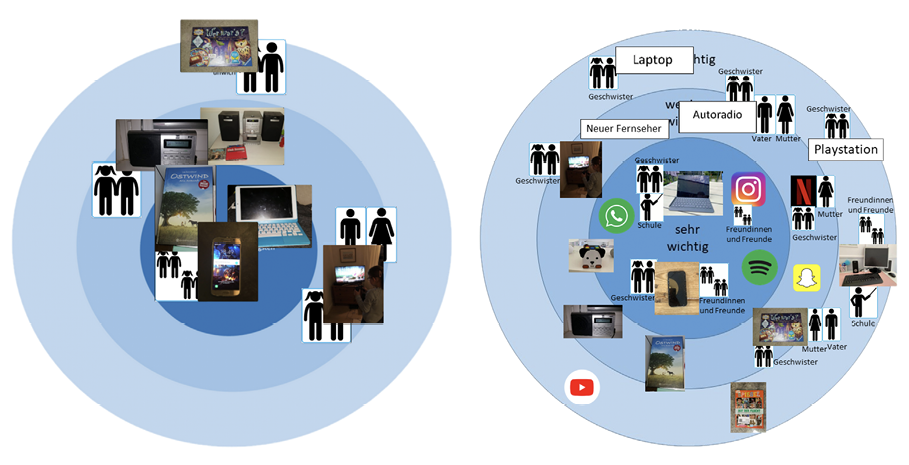
The project “ConnectedKids – Socialization in a Deep Mediatized Society (short: ConKids)” 1 involved a 5-year longitudinal study (2018–2023), with a focus on media-related socialization processes among children and adolescents in the family context. Following the theoretical and methodological perspective of communicative figurations research (Hepp & Communicative Figurations Research Network, 2017), media socialization was conducted in the context of various social domains (Lampert et al., 2025). The study also entailed the documentation and analysis of changes in media consumption patterns during the transition from childhood to mid-adolescence and, therefore, young people’s media repertoires (Potzel et al., 2024). The sample comprised two cohorts of 16 children each at the first survey. The younger ones were 6 years old at the first interview in 2018, and the older cohort included 10-year-old children. In addition to four waves of qualitative interviews with children/adolescents and one parent each, a laying technique was used to compile the adolescents’ media repertoires for each survey (Figure 1). Families were requested to submit photographs of the media their children were using at the time, which were then sorted into concentric circles during the interviews. The media practices most important to the individual were placed in the innermost circle, and those least important were placed in the outer circle. During the interviews, significant actors in the domain of media practices were identified and classified as symbolic images of individual media repertoires (Potzel et al., 2024). The collected data were analyzed using qualitative content analysis (Kuckartz & Rädiker, 2023), employing a triangulated approach combining cross-sectional and longitudinal analyses. 2
The findings regarding the relationship between school and private media use turned out to be more insightful in the older cohort, so the following will present the results for the 10- to 15-year-old participants. The results indicate that at the age of 10, children’s media repertoires consisted predominantly of devices and applications used within the family or peer group. Media used in school or privately for learning purposes were scarce among the sample (primarily books), and individuals used digital devices to search for information or communicate with classmates about learning-related topics, such as homework or tests via messenger. As the children aged, the influence of the social domain of school and its media ensemble on the media repertoires of young people also became more apparent. Children and adolescents used the devices provided by their schools alongside recommended apps, or they were inspired by media content for personal use. In parallel, young people increasingly used their personal digital devices at school and for homework and utilized the internet and social media in diverse ways to learn about news, current topics, and issues of personal interest to them. Although the sample showed a tendency toward higher levels of education, similar trends were observed in all cases. Developments in media repertoires appeared to be shaped primarily by the prevailing media-related attitudes in the social domains of family, peers, and school. These findings provide a comprehensive explanation for the development of differences in media repertoires (Lampert et al., 2025; Potzel et al., 2024). The example in Figure 1 illustrates the disparities in a girl’s media repertoire between ages 10 and 15. On the one hand, a notable diversification of her media repertoire occurred over time, especially as concerns the use of different applications. On the other hand, there was a shift in the actors with whom she regularly used digital media. While the influence of school on her individual media repertoire was negligible at the time of the first survey (despite indications in the interview that schoolbooks are utilized), this role was undergoing a shift towards the pre-eminent position of her tablet by the fourth survey wave. She utilized the device for a multitude of purposes, including to consume films and series via streaming services, communicate with friends via social media, and pursue academic goals. She used the device to take notes and work on assignments during school hours and for her homework in the afternoon. These findings point to the necessity of adopting an actor-centered approach that acknowledges relationality within the entire media repertoire instead of staying within the confines of a single medium or social domain.
Figure 1: Comparison of the media repertoires of a girl in the ConKids project between the first and last survey waves (ages 10 and 15, respectively)
3.3 Exemplary Research from a Qualitative Reconstructive Study
The running project “Excessive Digital Practices in the Late Youth (Exis)” 3 uses a sorting task to collect the media repertoires of 19–22-year-olds as part of biographical interviews. One of the overarching research questions asks: What orientations underlie excessive digital media practices, and how are they embedded in the everyday structuring of individuals? The term “excessive digital media practices” is used here for two reasons. First, the broad concept of excessiveness allows us to take the perceptions of those affected as our starting point instead of applying a list of criteria for addiction or disorder. Second, by centering practices, the study does not focus exclusively on individuals or the media but rather on their interplay in practices embedded in the broader contexts of social life. Unlike most other studies in this field, this project does not examine a single media genre in isolation (e.g., social media or digital games) but instead uses a repertoire approach. This opens up the possibility of understanding, on the one hand, why time limits are more difficult to enforce for some media than for others and, on the other hand, how different media practices are interwoven.
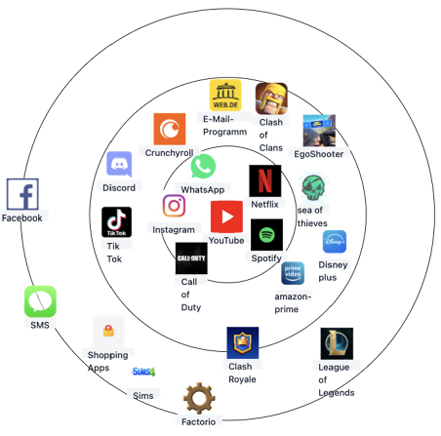
The sample consists of 27 people, including 17 men, eight women, and two non-binary individuals. Socioeconomically, the sample is quite diverse, comprising individuals with varying levels of formal education and differing professional qualification requirements. They were recruited from the panel of the study “Trajectories of Excessive Internet Use in Families (VEIF)”, which was conducted over 10 years using questionnaires. The selection criterion concerned indications of problematic media practices, either currently or within the last 2 years, based on the information reported in the questionnaires. Approximately 2 weeks before the biographical interviews, the interviewees were asked to keep a media diary on their smartphones using a specific application. Over 7 days, they provided insight into their everyday media life in the form of texts, emoticons, voice messages, photographs, screenshots, and videos. For the subsequent interviews, the media used were prepared with matching icons. Using the open-source application MeSort (https://mesoftware.org/), the interviewees were asked to digitally arrange icons on concentric circles via drag-and-drop, placing particularly important media in the center and less important media further out (see Figure 2). They also expressed their thoughts aloud and discussed concrete media contents, as well as the significance of different people and contexts to particular media practices. The data was then analyzed reconstructively using the documentary method (Nohl, 2017).
The research data produced in this survey setting (multimodal media diaries, results of the sorting task, and verbal contextualization in the interview) offered a differentiated impression of the young people’s media repertoire and allowed us to interpret it with regard to the excessiveness of digital media practices. Figure 2 illustrates a typical scenario, in which various digital games, social media and video platforms, streaming services for music, movies, and TV shows, as well as a shopping app, play a role in everyday life. The example is from a person who spent over 10 hours a day on a video game console, computer, or smartphone at the time of the study. The participant was on sick leave from work and attributed his excessive screen time to a lack of alternatives and distraction from work-related problems. A similar pattern of behavior had emerged a few years earlier when he was having social problems at school and tried to distract himself by playing video games intensively. In this case, as in others in the sample, the parallel use of multiple apps and media is typical of excessive usage patterns. When excessive media use serves as a coping strategy for other problems in life, a single medium is no longer enough to escape negative thoughts; using multiple visual and auditory media at the same time stimulates the senses to the extreme, creating an almost numbing effect. Although this study did not specifically ask about school performance, the open and biographical approach to the phenomenon yielded some insights regarding the learning-related media repertoire. For example, the excessive practices are accompanied by neglect of (vocational) school tasks.
Figure 2: Media repertoire of a young man in the Exis project
4 Conceptual and Methodological Proposition: Learning-Related Media Repertoires
Drawing on the findings of these two studies, this article posits that the concept of media repertoires should be considered a fundamental starting point in examining the relationship between young people’s (private) media use and their school performance. We refer specifically to the learning-related media repertoire, which requires the exploration of two domains, namely, the media repertoires of young people in the context of school and formal learning as well as private media use.
Figure 3: Illustration of the learning-related media repertoire. Source: authors
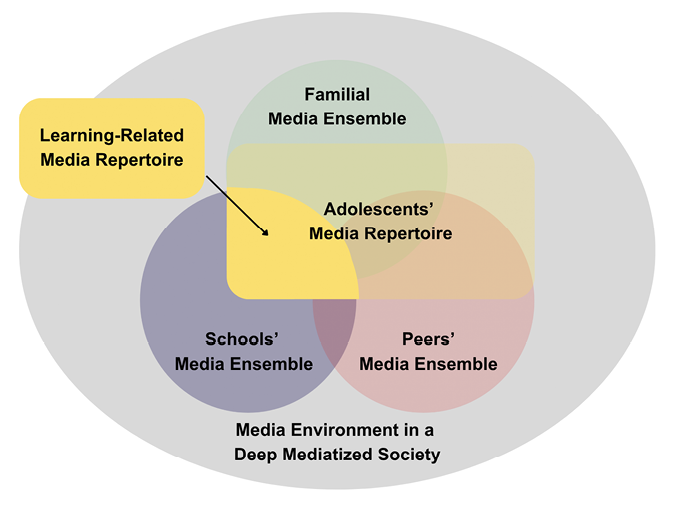
By learning-related media repertoires, we mean relatively stable, cross-media patterns in an individual’s media practices applied to educational purposes (Kramer et al., 2023). These repertoires develop dynamically across social domains and are characterized by their interdependency. Figure 3 demonstrates the extent to which young people’s individual media repertoires overlap with the different media ensembles of important social domains (in this case, family, peers, and school) within the media environment. A significant proportion of the media repertoire consists of the learning-related media repertoire, which in turn reflects media practices congruent with the school’s media ensemble. The exact proportion is contingent on individual and social circumstances. In this context, connections, tensions, or discrepancies can be expected between the media ensembles, educational occasions, and actor constellations in the family and at school, as well as, for instance, computer game guilds and the school class. All of these influence how the individual’s learning-related media repertoire differentiates and develops. The media ensemble and the associated media practices of the family of origin form the primary framework for the development of a child’s media repertoire. According to socialization theory, shared media routines contribute to the development of media preferences and skills. When entering the school system, the school’s media ensemble and the media practices prioritized in the classroom connect to the children’s media repertoire to varying degrees. Importantly, the quality of fit may vary, with some arrangements being more suitable than others. Furthermore, over time, learning-related media practices may multiply or be modified or phased out. This phenomenon is also evident when comparing the two media repertoires of a girl at ages 10 and 15, as depicted in Figure 1.
In both formal and informal settings, opportunities arise to diversify the learning-related media repertoire, with the specific context placing varying demands on the repertoire. This analysis focuses not on the technical and instrumental handling of media but on the mastery of registers and rules in social domains that shape the networks of interdependence and the media practices that constitute them among actors. From an individual standpoint, learning and educational processes are also characterized by divergent motivations and individualized objectives.
5 Call for Research on the Learning-related Media Repertoire Approach
Research based on the concept of learning-related media repertoires departs from the predominant consideration of individual media practices linked to a specific device, application, context, or usage time. In doing so, it addresses the limitations of recent research on media practices and school performance (see Chapter 2). Accordingly, we argue for future research to increasingly follow this direction and operationalize dynamic relationships between media practices and educational contexts. This can capture the mixing of informal and formal (digital) educational practices in a deeply mediatized society, since relationality, in particular, is conceived from the actor’s perspective. Future research should take into account both the heterogeneity and the individuality of individual media repertoires. This approach highlights the question of which media ensembles are available to which individuals in which contexts, and what patterns of behavior they must acquire to use them effectively in learning and educational processes. It is equally well suited to addressing issues of unequal educational opportunities (digital divide) and the conditions necessary for successful digital education.
As the two studies described here (ConKids and Exis) show, triangulating survey settings are of particular value to depict a repertoire in all its facets and entanglements. Visualization techniques play a central role in this process. They help interviewees recall media practices that would otherwise have gone unmentioned because of the difficulty of recalling everyday media use. The laying techniques or sorting tasks used here to represent media repertoires can serve to prepare interview questionnaires, be used as illustrations for interviewees and researchers during interviews, and aid researchers in their interpretation of the data in combination of different results. The interaction between various media practices and important social domains, as well as individual actors in this field, makes it possible to trace changes in learning-related media repertoires. In this context, it can be useful to gather complementary perspectives—such as those of parents, teachers, and peers—to gain deeper insight into an individual’s media repertoire or to further examine the media ensembles of social domains and their influence on the learning-related media repertoire. The focus is not only applicable to children and adolescents, but also to other age groups, in line with the principle of lifelong learning.
In our view, interdisciplinarity offers significant added value for further research on the topic. Since media repertoire research does not originate directly from media education but rather from communication studies, the approach’s interdisciplinary nature is evident both in its origins and in its adaptation to media education research. This applies to weak interdisciplinarity, which may combine subdisciplines of educational science (e.g., school research and media education), but strong interdisciplinarity bonds should also be considered. These can result, for example, from collaboration among media and communication studies, design studies, psychology, sociology, and educational science. Given that media education draws on various disciplines, collaboration with related fields is a natural step.
6 Conclusion
As demonstrated in the preceding explanations, the learning-related media repertoire approach can offer a method for addressing the controversy about adolescents’ media use and their school performance. This approach is distinct from those of most previous studies, which (with a few exceptions) focus on use times or problematic media-use patterns. These explanatory approaches are predominantly monocausal and media-centric, as exemplified by the mitigation hypothesis. However, in a deep mediatized society, this approach appears deficient, and an actor-centered perspective is required that centers the individual and its social environment. The analysis of learning-related media repertoires concentrates on the suitability of all media practices, in terms of content and context, for learning-related requirements. Therefore, it also resolves the frequently cited dichotomy between private and media use in the school context. As frequently observed, this dichotomy no longer exists in its pure form but rather consists of fluid transitions in the context of social influences and media convergence. In this regard, the learning-related media repertoire approach can reflect not only individual media practices but also the influences of different social domains and their specific media ensembles, as well as their intersections.
Problematic internet use is frequently cited in the extant literature as contributing to disparities in school performance. The repertoire orientation enables the incorporation of specific media usage behaviors, including excessive media practices, and can therefore address these assumptions, as evidenced by the Exis study. Furthermore, it is possible to identify more enduring shifts in learning-related media repertoires, which may indicate, among other things, alterations in the composition of schools’ media ensembles or changes related to individual, social, societal, and technological development. For instance, these alterations could be identified in the outcomes of the ConKids study and delineated through a longitudinal examination of the media repertoires of children, adolescents, and young adults.
However, from a methodological perspective, the learning-related media repertoire approach also has limitations, especially as it requires analyzing a wide range of individual media practices and incorporating diverse social domains and their media ensembles into the repertoires. Longitudinal analyses facilitate the examination of alterations and interrelationships between individual media repertoires and school performance but are very time consuming and resource intensive. Moreover, when using retrospective biographical approaches, certain aspects may appear more or less significant than they actually were in the individual’s past, which poses methodological challenges for research on learning-related media repertoires. Nevertheless, we believe that the learning-related media repertoire approach is worth pursuing to investigate the increasing media convergence and blurring of social domains in the future, which will likely be further exacerbated by the wide range of applications that generative AI, for example, offers and will offer in the future for informal and formal learning processes.
References
Akter, S., D’Ambra, J., & Ray, P. (2013). Development and validation of an instrument to measure user perceived service quality of mHealth. Information & Management, 50(4), 181–195. https://doi.org/10.1016/j.im.2013.03.001
Anger, C., Betz, J., & Plünnecke, A. (2026). Nutzung digitaler Medien von Kindern und Jugendlichen. Auswirkungen auf die psychische Gesundheit und die Bildungsleistungen. https://www.iwkoeln.de/fileadmin/user_upload/Studien/Gutachten/PDF/2026/Fr%C3%BChjahrsgutachen_Bilmo_2026_04_13.pdf
Berber, S., Potzel, K., Kammerl, R., Wartberg, L., & Meyer, C. (2025). Time spent on the Internet, problematic gaming and social media use among adolescents: Longitudinal findings on the impact of the COVID-19 pandemic. MedienPädagogik: Zeitschrift Für Theorie Und Praxis Der Medienbildung, 50–74. https://doi.org/10.21240/mpaed/00/2025.02.18.X
Boer, M., Van Den Eijnden, R. J. J. M., Boniel-Nissim, M., Wong, S.-L., Inchley, J. C., Badura, P., Craig, W. M., Gobina, I., Kleszczewska, D., Klanšček, H. J., & Stevens, G. W. J. M. (2020). Adolescents’ Intense and Problematic Social Media Use and Their Well-Being in 29 Countries. Journal of Adolescent Health, 66(6), S89–S99. https://doi.org/10.1016/j.jadohealth.2020.02.014
Brand-Gruwel, S., Wopereis, I., & Walraven, A. (2009). A descriptive model of information problem solving while using internet. Computers & Education, 53(4), 1207–1217. https://doi.org/10.1016/j.compedu.2009.06.004
Chao, M., Sun, W., Liu, J., Ding, J., & Zhu, Y. (2025). Exploring the Bright and Dark Sides of Social Media Use on Academic Performance: Contrasting Effects on Actual Perceived Performance. Journal of Computer Assisted Learning, 41(1), Article e13111. https://doi.org/10.1111/jcal.13111
Cheng, W., Nguyen, P. N. T., & Nguyen, N. D. (2024). How active/passive social network usage relates to academic performance among high school students in Taiwan. Education and Information Technologies, 29(9), 10805–10820. https://doi.org/10.1007/s10639-023-12254-x
Chiappe, D., Conger, M., Liao, J., Caldwell, J. L., & Vu, K.-P. L. (2013). Improving multi-tasking ability through action videogames. Applied Ergonomics, 44(2), 278–284. https://doi.org/10.1016/j.apergo.2012.08.002
De Guevara Rodríguez, M. L., Lopez-Agudo, L. A., & Marcenaro-Gutierrez, O. D. (2024). The impact of different uses of the Internet on students’ performance progression throughout primary education. Education and Information Technologies, 29(10), 12457–12525. https://doi.org/10.1007/s10639-023-12354-8
Díaz-López, A., Mirete-Ruiz, A. B., & Maquilón-Sánchez, J. (2021). Adolescents’ Perceptions of Their Problematic Use of ICT: Relationship with Study Time and Academic Performance. International Journal of Environmental Research and Public Health, 18(12), Article 6673. https://doi.org/10.3390/ijerph18126673
Dore, R. A., Avelar, D., Singletary, B., Schmeer, K., & Justice, L. M. (2026). Print and Screen Media in Families Experiencing Low Income: The Impact of Stressors and Protective Factors. Infant and Child Development, 35(1), Article e70084. https://doi.org/10.1002/icd.70084
Ellore, S. B., Niranjan, S., & Brown, I. U. J. (2014). The Influence of Internet Usage on Academic Performance and Face-to-Face Communication. Semantic Scholar. https://api.semanticscholar.org/CorpusID:218642264
Erdogdu, F., & Erdogdu, E. (2015). The impact of access to ICT, student background and school/home environment on academic success of students in Turkey: An international comparative analysis. Computers & Education, 82, 26–49. https://doi.org/10.1016/j.compedu.2014.10.023
Frey, T., & Friemel, T. N. (2023). Social Media Repertoires: Investigating Multifaceted Social Media Use Among Late Adolescents. Journal of Quantitative Description: Digital Media, 3, 1–33. https://doi.org/10.51685/jqd.2023.002
Gentile, D. A., Choo, H., Liau, A., Sim, T., Li, D., Fung, D., & Khoo, A. (2011). Pathological Video Game Use Among Youths: A Two-Year Longitudinal Study. Pediatrics, 127(2), e319–e329. https://doi.org/10.1542/peds.2010-1353
Gnambs, T., Stasielowicz, L., Wolter, I., & Appel, M. (2020). Do computer games jeopardize educational outcomes? A prospective study on gaming times and academic achievement. Psychology of Popular Media, 9(1), 69–82. https://doi.org/10.1037/ppm0000204
Gonser, N., Grammel, M., & Müllner, S. (2014). Fernsehen, Facebook und Familie—Eine Mehrmethodenstudie zur Erfassung traditioneller und digitaler Medienrepertoires im Familiensetting. In M. Seidl & G. Schmiedl (Eds.), Forum Medientechnik – Next Generation, New Ideas (pp. 11–25). Werner Hülsbusch.
Granic, I., Lobel, A., & Engels, R. C. M. E. (2014). The benefits of playing video games. American Psychologist, 69(1), 66–78. https://doi.org/10.1037/a0034857
Hale, L., & Guan, S. (2015). Screen time and sleep among school-aged children and adolescents: A systematic literature review. Sleep Medicine Reviews, 21, 50–58. https://doi.org/10.1016/j.smrv.2014.07.007
Hasebrink, U., & Domeyer, H. (2012). Media repertoires as patterns of behaviour and as meaningful practices: A multimethod approach to media use in converging media environments. Participations. Journal of Audience and Reception Studies, 9(2), 757–779.
Hasebrink, U., Lampert, C., & Thiel, K. (2019). Online-Erfahrungen von 9- bis 17-jährigen. Ergebnisse der EU kids Online-Befragung in Deutschland 2019. Verlag Hans-Bredow-Institut.
Hasebrink, U., & Popp, J. (2006). Media repertoires as a result of selective media use. A conceptual approach to the analysis of patterns of exposure. Communications, 31(3), 369–387. https://doi.org/10.1515/COMMUN.2006.023
Hawi, N. S., & Samaha, M. (2016). To excel or not to excel: Strong evidence on the adverse effect of smartphone addiction on academic performance. Computers & Education, 98, 81–89. https://doi.org/10.1016/j.compedu.2016.03.007
Helm, P., & Matzner, T. (2024). Co-addictive human–machine configurations: Relating critical design and algorithm studies to medical-psychiatric research on “problematic Internet use.” New Media & Society, 26(12), 7295–7313. https://doi.org/10.1177/14614448231165916
Hepp, A. (2019). Deep mediatization (1st edn). Routledge.
Hepp, A., & Communicative Figurations Research Network. (2017). Transforming Communications. Media-related Changes in Times of Deep Mediatization. ZeMKI - Zentrum für Medien-, Kommunikations- und Informationsforschung. https://media.suub.uni-bremen.de/bitstream/elib/3345/1/00105985-1.pdf
Huang, C. (2022). Social media addiction and personality: A meta‐analysis. Asian Journal of Social Psychology, 25(4), 747–761. https://doi.org/10.1111/ajsp.12531
Kammerl, R., Zieglmeier, M., & Wartberg, L. (2022). Diskussionsfelder der Medienpädagogik: Problematische Internetnutzung – Desiderat der Medienpädagogik? In U. Sander, F. Von Gross, & K.-U. Hugger (Eds.), Handbuch Medienpädagogik (pp. 753–761). Springer Fachmedien Wiesbaden. https://doi.org/10.1007/978-3-658-23578-9_88
Kleinen von Königslöw, K., & Förster, K. (Eds.). (2014). Medienkonvergenz und Medienkomplementarität aus Rezeptions- und Wirkungsperspektive (1st edn). Nomos.
Kramer, M., Kammerl, R., Potzel, K., & Wartberg, L. (2023). Bildungsbezogene Medienrepertoires als Schnittstelle informeller und formaler Bildung – ein Überblick und neue Perspektiven für die Forschung. In K. Scheiter & I. Gogolin (Eds.), Bildung für eine digitale Zukunft (pp. 159–185). Springer VS. https://doi.org/10.1007/978-3-658-37895-0_7
Kristensen, S. M., Jørgensen, M., & Haug, E. (2024). I want to play a game: Examining sex differences in the effects of pathological gaming, academic self-efficacy, and academic initiative on academic performance in adolescence. Education and Information Technologies, 29(15), 19711–19728. https://doi.org/10.1007/s10639-024-12632-z
Kuckartz, U., & Rädiker, S. (2023). Qualitative Content Analysis: Methods, Practice and Software (2nd edn). SAGE Publications Ltd. https://doi.org/10.1080/1743727X.2023.2244777
Kutluay, E., & Karaca, F. (2025). A model proposal explaining the influence of smartphone addiction related factors on high school students’ academic success. Education and Information Technologies, 30(3), 4061–4098. https://doi.org/10.1007/s10639-024-12947-x
Lampert, C., Potzel, K., & Kammerl, R. (Eds.). (2025). Sozialisation in einer sich wandelnden Medienumgebung: Zur Erweiterung und Veränderung des Beziehungsnetzwerks. Nomos Verlagsgesellschaft mbH & Co. KG. https://doi.org/10.5771/9783748963301
Lee, Y.-H., & Wu, J.-Y. (2013). The indirect effects of online social entertainment and information seeking activities on reading literacy. Computers & Education, 67, 168–177. https://doi.org/10.1016/j.compedu.2013.03.001
Lepp, A., Barkley, J. E., & Karpinski, A. C. (2014). The relationship between cell phone use, academic performance, anxiety, and Satisfaction with Life in college students. Computers in Human Behavior, 31, 343–350. https://doi.org/10.1016/j.chb.2013.10.049
Marín Vila, M., Carballo Crespo, J. L., & Coloma Carmona, A. (2018). Rendimiento académico y cognitivo en el uso problemático de Internet. Adicciones, 30(2), 101–110. https://doi.org/10.20882/adicciones.844
Marker, C., Gnambs, T., & Appel, M. (2018). Active on Facebook and Failing at School? Meta-Analytic Findings on the Relationship Between Online Social Networking Activities and Academic Achievement. Educational Psychology Review, 30(3), 651–677. https://doi.org/10.1007/s10648-017-9430-6
Melodia, F., Canale, N., & Griffiths, M. D. (2022). The Role of Avoidance Coping and Escape Motives in Problematic Online Gaming: A Systematic Literature Review. International Journal of Mental Health and Addiction, 20(2), 996–1022. https://doi.org/10.1007/s11469-020-00422-w
Merten, L. (2020). Contextualized Repertoire Maps: Exploring the Role of Social Media in News-related Media Repertoires. Forum Qualitative Sozialforschung Forum: Qualitative Social Research, 21(2). https://doi.org/10.17169/FQS-21.2.3235
Mößle, T. (2012). Dick, dumm, abhängig, gewalttätig? Nomos. https://doi.org/10.5771/9783845236902
Mößle, T., Bleckmann, P., Rehbein, F., & Pfeiffer, C. (2012). Der Einfluss der Medien auf die Schulleistung. In C. Möller (Ed.), Internet- und Computersucht: Ein Praxishandbuch für Therapeuten, Pädagogen und Eltern (2nd edn, pp. 68–78). Verlag W. Kohlhammer.
Niemand, S. (2020). Alltagsumbrüche und Medienhandeln: Eine qualitative Panelstudie zum Wandel der Mediennutzung in Übergangsphasen. Springer Fachmedien Wiesbaden. https://doi.org/10.1007/978-3-658-30738-7
OECD. (2016). Does it matter how much time students spend online outside of school? (PISA in Focus No. 59). OECD. https://doi.org/10.1787/5jm5fb7cq0zp-en
OECD. (2017). PISA 2015 Results (Volume III): Students’ Well-Being. OECD. https://doi.org/10.1787/9789264273856-en
Pahayahay, A., & Khalili-Mahani, N. (2020). What media helps, what media hurts: A mixed methods survey study of coping with COVID-19 Using the media repertoire framework and the appraisal theory of stress. Journal of Medical Internet Research, 22(8), Article e20186. https://doi.org/10.2196/20186
Peters, C., & Schrøder, K. C. (2018). Beyond the here and now of news audiences: A Process-Based Framework for Investigating News repertoires. Journal of Communication, 68(6), 1079–1103. https://doi.org/10.1093/joc/jqy060
Potzel, K. (2024). Digital media and digital divides: An exploration of primary school-age children’s use of and access to digital media. Media Education Research Journal, 13. https://doi.org/10.5281/ZENODO.14582192
Potzel, K., & Draheim, S. (2025). Weiterentwicklung der methodologischen und methodischen Anlage der ConKids-Studie. In C. Lampert, K. Potzel, & R. Kammerl (Eds.), Sozialisation in einer sich wandelnden Medienumgebung (pp. 43–68). Nomos Verlagsgesellschaft mbH & Co. KG. https://doi.org/10.5771/9783748963301-43
Potzel, K., Draheim, S., Domdey, P., Lampert, C., & Kammerl, R. (2024). Changes in young people’s media repertoires: Longitudinal Insights from a communicative figurational approach. Medien & Kommunikationswissenschaft, 72(3), 280–296. https://doi.org/10.5771/1615-634X-2024-3-280
Qamili, S., & Osmani, F. (2026). The influence of brand value on English language acquisition: The role of social media, peer interaction, and community exposure. Educational Process International Journal, 21(1). https://doi.org/10.22521/edupij.2026.21.27
Reardon, S. (2013). The widening income achievement Gap. Educational Leadership, 70, 10–16.
Röser, J., Müller, K. F., Niemand, S., & Roth, U. (2019). Das Internet im Medienrepertoire: Die Koexistenz alter und neuer Medien in den Haushalten. In J. Röser, K. F. Müller, S. Niemand, & U. Roth, Das mediatisierte Zuhause im Wandel (pp. 119–149). Springer VS. https://doi.org/10.1007/978-3-658-26073-6_6
Rothenberger, L., Elmezeny, A., & Wimmer, J. (2019). Mediating media usage in times of migration: Family rules and media repertoires of Arab refugee children and teens in Germany. MedienPädagogik: Zeitschrift Für Theorie Und Praxis Der Medienbildung, 35, 55–73. https://doi.org/10.21240/mpaed/35/2019.10.19.X
Rummler, K., Müller, J., Kamin, A.-M., Richter, L., Kammerl, R., Potzel, K., Grabensteiner, C., & Schneider Stingelin, C. (2021). Medienhandeln Heranwachsender im Spannungsfeld schulischer und familialer Lernumgebungen. MedienPädagogik, 42, 63–84. https://doi.org/https://doi.org/10.21240/mpaed/42/2021.03.10.X
Sanders, R. (2020). Iriss ESSS Outline: Digital inclusion, exclusion and partcipation. Iriss. https://doi.org/10.31583/esss.20200911
Scharf, J., Becker, M., Stallasch, S. E., Neumann, M., & Maaz, K. (2020). Primäre und sekundäre Herkunftseffekte über den Verlauf der Sekundarstufe: Eine Dekomposition an drei Bildungsübergängen. Zeitschrift für Erziehungswissenschaft, 23(6), 1251–1282. https://doi.org/10.1007/s11618-020-00981-7
Schneider, J., & Eisenegger, M. (2018). Newsrepertoires junger Erwachsener: Mediennutzung und Politikwahrnehmung im Wandel. In N. Gonser (Ed.), Der öffentliche (Mehr-)Wert von Medien (pp. 93–107). Springer VS. https://doi.org/10.1007/978-3-658-20498-3_7
Schwarzenegger, C. (2020). Personal epistemologies of the media: Selective criticality, pragmatic trust, and competence–confidence in navigating media repertoires in the digital age. New Media & Society, 22(2), 361–377. https://doi.org/10.1177/1461444819856919
Shah, M. A. A., & Anwar, M. (2014). Impact of parent’s occupation and family income on children’s performance. International Journal of Research, 1(9), 606-612.
Shute, V. J., Ventura, M., & Ke, F. (2015). The power of play: The effects of Portal 2 and Lumosity on cognitive and noncognitive skills. Computers & Education, 80, 58–67. https://doi.org/10.1016/j.compedu.2014.08.013
Smahel, D., Machackova, H., Mascheroni, G., Lenka, D., Elisabeth, S., Ólafsson, Kjartan, LIvingston, Sonia, & Hasebrink, Uwe. (2020). EU Kids Online 2020: Survey results from 19 countries. EU Kids Online. https://doi.org/10.21953/lse.47fdeqj01ofo
Subrahmanyam, K., & Renukarya, B. (2015). Digital Games and Learning: Identifying Pathways of Influence. Educational Psychologist, 50(4), 335–348. https://doi.org/10.1080/00461520.2015.1122532
Suleman, Q., Hussain, I., & Nisa, Z. (2014). Effects of parental socioeconomic status on the academic achievement of secondary school students in district Karak (Pakistan). International Journal of Human Resource Studies, 2(4), 14–32. https://doi.org/10.5296/ijhrs.v2i4.2511
Sun, W., & Chao, M. (2024). Exploring the influence of excessive social media use on academic performance through media multitasking and attention problems: A three-dimension usage perspective. Education and Information Technologies, 29(18), 23981–24003. https://doi.org/10.1007/s10639-024-12811-y
Sundqvist, A., Koch, F.-S., & Barr, R. (2025). Beyond Words and Time: Investigating the Association Between Screen Use, Vocabulary and Grammar Development in Five-Year-Olds. Journal of Cognition and Development, 26(4), 539–557. https://doi.org/10.1080/15248372.2025.2456816
Usman, N. H., Alavi, M., & Shafeq, S. M. (2014). Relationship between internet addiction and academic performance among foreign undergraduate students. Procedia - Social and Behavioral Sciences, 114, 845–851. https://doi.org/10.1016/j.sbspro.2013.12.795
Van Den Eijnden, R., Koning, I., Doornwaard, S., Van Gurp, F., & Ter Bogt, T. (2018). The impact of heavy and disordered use of games and social media on adolescents’ psychological, social, and school functioning. Journal of Behavioral Addictions, 7(3), 697–706. https://doi.org/10.1556/2006.7.2018.65
Verboord, M. (2023). Bundles of trust? Examining the relationships between media repertoires, institutional trust, and social contexts. Communications, 49(2). https://doi.org/10.1515/commun-2022-0013
Vulpius, J., Lehaff, J., Schrøder, K. C., & Peters, C. (2022). Exploring changing news repertoires: Towards a typology. Journalism, 24(1), 78–100. https://doi.org/10.1177/14648849211047384
Wallner-Paschon, C., Höller, I., & Hafner, J. (2018). Extreme Internetnutzung zu Hause und Schülerkompetenzen. Zeitschrift für Bildungsforschung, 8(2), 189–209. https://doi.org/10.1007/s35834-018-0213-z
Wartberg, L., Zieglmeier, M., & Kammerl, R. (2019). Accordance of adolescent and parental ratings of internet gaming disorder and their associations with psychosocial aspects. Cyberpsychology, Behavior, and Social Networking, 22(4), 264–270. https://doi.org/10.1089/cyber.2018.0456
Wittwer, J., & Senkbeil, M. (2008). Is students’ computer use at home related to their mathematical performance at school? Computers & Education, 50(4), 1558–1571. https://doi.org/10.1016/j.compedu.2007.03.001
World Health Organization. (2018). International statistical classification of diseases and related health problems (11th Revision). https://icd.who.int/browse11/l-m/en#/http%3a%2f%2fid.who.int%2ficd%2fentity%2f1448597234
Date received: 28 January 2026
Date accepted: 8 July 2026
1 The project “ConnectedKids – Socialization in a Deep Mediatized Society (short: ConKids)” (original German title “ConnectedKids – Sozialisation in einer sich wandelnden Medienumgebung”) is funded by the German Research Foundation DFG (395562718) and coordinated by Prof. Dr. Rudolf Kammerl and Dr. Claudia Lampert. For more information, see: www.conkids.de.
2 A more detailed description of the sample, data collection, and evaluation and the methodological approach can be found in Potzel and Draheim (2025).
3 The project “Excessive Digital Practices in the Late Youth (Exis)” (original German title “Exzessivität digitaler Praktiken in der späten Jugendphase (Exis)”) is funded by the German Research Foundation DFG (542995399) and coordinated by Jun.-Prof. Dr. Michaela Kramer. For more information, see: https://www.hf.uni-koeln.de/43022.