Historical Time Machines Revisited
Narrative Persuasion in Virtual Reality
1 Introduction
Virtual reality (VR) has recently been increasingly integrated into history education (e.g., Villena-Taranilla & Diago, 2025). Museums now use VR to make time travel real and allow visitors to immerse themselves in the past, for instance. However, whether and how VR can be used as an educational tool remains debated. Although its use can boost interest and, thus, the motivation to learn more about a topic (e.g., Allcoat & von Mühlenen, 2018; Frentzel-Beyme & Krämer, 2023), the emotional involvement it entails may also limit critical reflection. Researchers emphasize that VR applications may emotionally overwhelm users (e.g., Bunnenberg, 2020; Slater, 2021). In parallel, research has shown that immersion in narrative media, described by the term “transportation” in the transportation-imagery model (Green & Brock, 2002), promotes uncritical and intensive emotional processing that leads to story-consistent beliefs (e.g., Green & Brock, 2000, 2002; Frentzel-Beyme & Krämer, 2023). Story-consistent beliefs are beliefs that align with a narrative’s themes or messages (Green & Brock, 2000). For instance, a history-related VR application such as Anne Frank House VR, which immerses users in the Secret Annex where Anne Frank and her family hid during the Holocaust in World War II, can foster strong emotional engagement and perspective-taking. As a result, users may adopt story-consistent beliefs and interpretations, with limited critical reflection. The role of transportation and emotional engagement in learning through media is thus a pressing question. Here, learning comprises knowledge and learners’ beliefs.
Education about historical events like the Holocaust is a particularly crucial aspect of democratic education (Abs et al., 2024) that aims to address democratic threats such as populism, racism, and polarization (Sant, 2019). By confronting these topics, (young) people should be enabled to form their own democratic political value system. However, research on digital history and Holocaust education indicates that although immersive and digital formats can enhance engagement, they also pose challenges for fostering critical historical thinking and come with a risk of emotionalization without sufficient reflection (e.g., Manca et al., 2023). Assuming that learning with history-related VR happens mainly based on emotions and without questioning the opinions or facts that are presented, VR’s ability to influence users’ political beliefs must be studied. According to the transportation-imagery model (Green & Brock, 2002), transportation in history-related VR, which is accompanied by emotional responses, may give users the impression that they have experienced the virtual experience in “real life.” For instance, being highly immersed in Anne Frank House VR could produce the impression of knowing what being persecuted feels like and influence associated beliefs (e.g., being convinced that politically persecuted people should be supported). In addition, when new information is processed to update beliefs, the influence of existing political belief systems or values (e.g., Kunda, 1990) in the form of confirmation bias is frequently discussed in new media settings and political contexts.
In this context, the present study aims to investigate the role of transportation in history-related VR by taking Anne Frank House VR as an example. More precisely, we ask whether transportation in history-related VR illustrating the personal impact of a totalitarian regime (here, the Nazi regime during World War II) is correlated with users’ story-consistent political beliefs (e.g., “Refugees should be supported.”), emotional responses, and perceived and factual knowledge and examine the role of participants’ political orientations in this relationship.
2 Literature Review
2.1 Virtual Reality in History Education
A growing number of educational institutions attempt to make history more interesting and appealing to young people by using VR (e.g., Villena-Taranilla & Diago, 2025). These media-based approaches to history are thus becoming visible in various learning settings (e.g., Manca, 2021; Mazhar & Al Rifaee, 2023). A well-known example is the VR application of the Anne Frank House. The application was developed to make the historical site freely accessible to a global audience and offer an immersive learning experience that allows users to better understand the circumstances of Anne Frank’s life in hiding (Meta, 2018). Users can walk through the Secret Annex, view selected exhibits (e.g., Anne’s diary), and listen to parts of Anne’s diary entries. Producers of history-related VR often highlight that their product enables users to experience the past and feel like people of the past, in this case, Anne Frank (e.g., Meta, 2018).
However, the use of history-related VR applications in historical learning is discussed critically within history education. Researchers argue that experiencing the perspectives of people in the past is not possible because present-day worldviews inevitably shape perception and interpretation (e.g., Bunnenberg, 2020). Moreover, immersive representations of historical atrocities may emotionally overwhelm users (e.g., Bunnenberg, 2020; Gouws, 2019; Trofanenko, 2014). Engaging with applications such as Anne Frank House VR may thus evoke intense emotional responses without necessarily enabling an adequate historical understanding of past experiences.
Although research suggests that emotional reactions to history-related VR are not as strong as expected (e.g., Lewers & Frentzel-Beyme, 2023), the use of VR is known to be strongly connected to emotions (e.g., Riva et al., 2007; Frentzel-Beyme & Krämer, 2020). Therefore, emotions likely play a central role in learning with VR. According to theories of mental and situational models, individuals construct representations of events that integrate perceptual, contextual, and emotional information, with emotions guiding attention and influencing how information is processed and remembered (Johnson-Laird, 1983; Zwaan & Radvansky, 1998).
Research on VR in educational contexts has consistently shown that immersive environments can elicit strong emotional engagement, yet evidence regarding their effects on learning outcomes remains mixed, particularly as concerns conceptual understanding and factual knowledge (e.g., Mulders, 2023; Makransky & Lilleholt, 2018). Importantly, prior research has largely focused on recipients’ immersion in a virtually presented physical place (i.e., “the sense of being there,” Slater & Wilbur, 1997), neglecting the narrative dimension of immersive experiences. The concept of transportation (Green & Brock, 2000), which describes the extent to which individuals become mentally and emotionally absorbed in a story, offers a framework for capturing this dimension. Transportation has been shown to shape emotional responses and beliefs in other media contexts, but its role in VR has received little attention so far (e.g., Green & Appel, 2024). Altogether, previous research suggests that understanding the effects of VR on learning and beliefs requires a closer examination of transportation as a narrative form of immersion.
2.2 The Transportation-Imagery Model for Virtual Reality
Transportation is theorized to influence persuasion processes (Green & Brock, 2000): stories told in a highly transportive way or via a highly transportive medium may influence people’s beliefs. The transportation-imagery model (Green & Brock, 2002) is a valuable theoretical framework for understanding persuasion through narrative media in terms of story-related (political) beliefs by focusing on the potential impacts of transportation. The expected cognitive and affective outcomes of transportation in narrative VR are discussed below.
2.2.1 Story-Consistent Beliefs
People who are transported are immersed in a narrative, responding emotionally to narrations and forming vivid mental images of the settings and characters depicted in the story. In this process, the presented narrative can become a self-made experience (Green & Appel, 2024). Scholars generally assume that if users feel that they are actually experiencing something (Fazio & Zanna, 1981), their beliefs may become strongly impacted. This is not limited to textual narration, for which it was originally observed, and applies to all types of fictional and non-fictional narrative media (Green & Appel, 2024). For example, with Anne Frank House VR, users may experience the Secret Annex as if they were physically present in it, which can trigger strong emotional responses and lead them to internalize the perspective of Anne Frank as if they had experienced a real situation.
Empirical findings indicate that transportation may be a key mechanism of narrative-based belief change (Green & Brock, 2002). Researchers assume that when they are transported into a narrative, recipients may become less aware of real-world facts. They may thus be more likely to adopt story-consistent beliefs, which rely on a reduction of negative cognitive processing: transported recipients may be less likely to disbelieve or counterargue story claims, which can influence their beliefs. These effects have been demonstrated for a broad range of topics and media formats (e.g., Ballard et al., 2021; Costabile 2013; Green et al., 2008). These observations suggest that history-related VR may have similar persuasive effects.
2.2.2 Knowledge
However, findings on the relationship between transportation and knowledge gains are limited. Some studies indicate that VR hinders factual knowledge gains (Makransky & Lilleholt, 2018), while others find positive effects on perceived knowledge (Chen et al., 2024). Research focusing on the influence of immersion in VR on learning outcomes indicates that immersion may reduce knowledge gains, as explained by cognitive-load theory (Mulders, 2023): highly immersive environments increase cognitive load as they require learners to process rich sensory and emotional stimuli, which may limit the cognitive resources available for processing and integrating relevant learning content. Similar results were found by Ahn and colleagues (2022), who observed lower content recall when being immersed in VR. Consequently, transportation in Anne Frank VR may lead to similar findings regarding factual knowledge. For example, although users may vividly recall the emotional experience of being in the Secret Annex, they may not necessarily retain or accurately process historical details about the Holocaust or Anne Frank’s life.
Research on other media formats found that perceived knowledge, which refers to users’ perceptions of their knowledge, can be independent of objective learning outcomes such as factual knowledge (Lee et al., 2022). Hence, people may feel that they have learned something through VR experiences without actually gaining factual knowledge. For instance, with Anne Frank House VR, users may feel that they have gained a deep understanding of Anne Frank’s life and the historical context, while their actual factual knowledge about the Holocaust or historical details about Anne Frank’s story remains limited.
2.2.3 Emotional Responses
As outlined above, VR experiences are often connected to not only feeling transported into a narrative but also emotional responses (e.g., Frentzel-Beyme & Krämer, 2020). Green and Brock (2000) theorized that “transportation is likely to create strong feelings toward story characters; the experiences or beliefs of those characters may then have an enhanced influence on readers’ beliefs” (p. 702). More generally, emotions are theorized to play a decisive role in persuasion and learning (e.g., Taber & Lodge, 2016; Makransky & Lilleholt, 2018). Additionally, a study conducted by Green and Brock (2002) suggests that the persuasiveness of narratives is associated with the extent of evoked emotions. However, while transportation and emotional engagement may reduce critical reflection in favor of persuasion, their influence on knowledge transfer is less clear. Parong and Mayer (2021) found that viewing a history lesson in VR supports emotional processing, which distracts from the cognitive processing of the information provided by the lesson and leads to lower learning outcomes. Although VR applications are not typical school lessons, they contain substantial content, similar to texts used in educational settings.
2.2.4 The Role of Existing Values
In addition to the theoretical assumptions of the transportation-imagery model (Green & Brock, 2002), theories of persuasion consider that people already have a belief system or values that influence how they process new information, as well as potential persuasion outcomes. According to the theory of motivated reasoning (Kunda, 1990), people are motivated to confirm their existing preferences. This means that the perception and processing of new information are affected by the receivers’ existing values. For example, when engaging with Anne Frank House VR, users who already have strong democratic or anti-racist values may be more likely to interpret the experience in a way that reinforces these values in line with story-consistent beliefs.
The transportation-imagery model proposes that “under high transportation, the individual may be distanced temporarily from current and previous schemas and experiences” (Green & Brock, 2000, p. 702). In such scenarios, existing values might be less influential or lose all influence and, thus, their impact on the processing of new information and its outcomes (e.g., belief updates). However, some studies indicate that existing values can facilitate transportation (McFerran et al., 2010). For instance, Cohen et al. (2015) found that transportation moderates pre-exposure attitudes; that is, under high transportation, the effect of prior attitudes on post-exposure attitudes is lower. Additionally, Oschatz et al. (2022) reported that prior attitudes shape recipients’ transportation and, thus, the persuasive impact of narratives.
Rokeach (1973) describes a hierarchy from a broader belief system, to values, more specific attitudes (e.g., story-consistent beliefs), and, lastly, behavior. Based on this hierarchy, this study focuses on political value orientations (Decker et al., 2023) as indicators of an existing belief system. These political and socially relevant values are particularly important in the context of history education in Germany, which aims not only to impart knowledge but also to foster moral and democratic values (Abs et al., 2024).
2.3 Research Model
Drawing on the transportation-imagery model (Green & Brock, 2002), cognitive load theory (Sweller, 1988, 2010, 2011), and the empirical work summarized above, we propose an integrative framework for examining the role of transportation when learning with history-related VR. In this framework, transportation acts as a narrative mechanism associated with emotional responses and story-consistent beliefs, while cognitive load theory explains potential limitations in factual knowledge acquisition.
Based on this approach, we hypothesize that users’ level of transportation in history-related VR is correlated with story-consistent beliefs, emotions, factual knowledge, and perceived knowledge. Specifically, transported recipients are expected to be more likely to report story-consistent beliefs and higher perceived knowledge. At the same time, considering that prior research suggests that immersive VR environments may impose a high cognitive load and, thus, hinder declarative learning (e.g., Mulders, 2023), we assume that transportation in Anne Frank House VR is positively correlated with perceived knowledge but negatively associated with factual knowledge. Therefore, we propose the following hypothesis (Figure 1):
H1: Transportation is positively related to (a) story-consistent beliefs, (b) positive emotions, (c) negative emotions, (d) perceived knowledge, and negatively related to (e) factual knowledge.
In addition, and based on the assumption that values, attitudes, and behavior form a hierarchy (e.g., Rokeach, 1973; Schwartz et al., 2010), we propose that due to the topic of the Anne Frank House VR application, recipients’ political value orientation affects the relation between transportation and story-consistent beliefs. Hence, we hypothesize (see Figure 1):
H2: The relation between transportation and story-consistent beliefs is moderated by political value orientation.
In line with the assumptions of motivated reasoning (Kunda, 1990), this study posits that existing political values, as an indicator of a recipient’s belief system, are correlated with their emotional response and knowledge after the VR experience. Following empirical findings suggesting that prior beliefs can facilitate and, hence, increase transportation, we assume that political value orientations are correlated with the extent to which people feel drawn into the narrative. Accordingly, we ask:
RQ1: Are political value orientations related to (a) positive emotions, (b) negative emotions, (c) perceived knowledge, (d) factual knowledge, and (e) transportation through a VR experience?
Figure 1: Overview of the hypothesized relationships
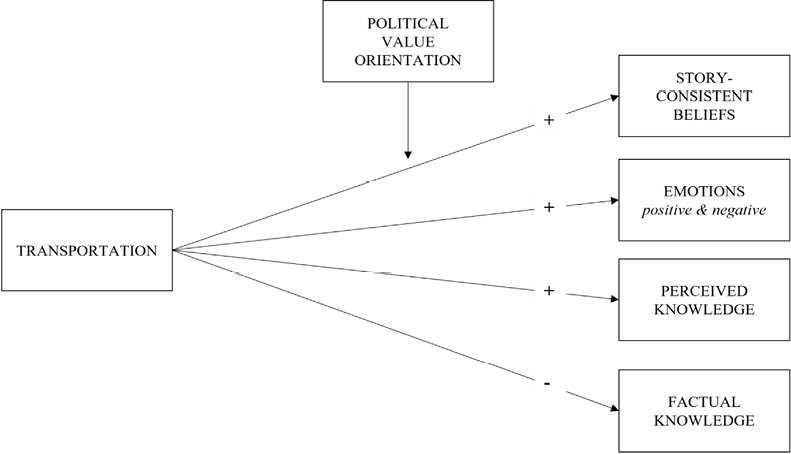
Note: + indicates positive hypothesized relationships, and - indicates negative hypothesized relationships.
3 Method
The study was pre-registered on the platform of the Open Science Framework 1 (OSF). Adjustments from the original registration are further described on OSF, as well as the results of the analysis. The study received approval from the University of Duisburg-Essen’s (Germany) departmental ethics committee (ID: 2206SPMT0604).
3.1 Study Design
3.1.1 Virtual Reality App: Anne Frank House VR
In this study, we used the VR application Anne Frank House VR on Oculus Go, which offers two modes: the tour mode, in which the user can explore the house on their own, and the story mode (see on YouTube 2). We asked participants to use the story mode, which begins in a dark room, where a narrator tells the user about Anne Frank and the people who lived in the annex while floating images and papers from her life are displayed. After the introduction, users can explore the Secret Annex on their own by using the controllers. As they move around each room, they can listen to excerpts of Anne Frank’s diary, which describe her anguish, worries, and fears, as well as her dreams and hopes connected to each room and the belongings it contains. The application can be classified as narrative, especially the initial component of the story mode, which tells the story of the Frank family, as well as the diary entries that adopt Anne Frank’s perspective.
In the beginning, the participants see the pivoting bookcase that disguises the secret entrance to the back house. After entering the latter, different rooms can be visited. One of the rooms served as the Frank family’s living room during the day and Anne Frank’s parents and sister’s bedroom at night. The second room is Anne Frank’s room, which she shared with another person in hiding. There are two other bedrooms for the remaining three people in hiding, as well as the bathroom and the attic.
3.1.2 Procedure
This laboratory study was conducted at the University of Duisburg-Essen in Germany. The participants were first briefed and gave their consent before completing the first questionnaire. This questionnaire included a measure of political value orientation and participants’ subjective assessment of their prior knowledge about Anne Frank. Next, the participants were instructed to use the VR application of the Anne Frank House in its story mode for 10 minutes. After the VR experience, they answered a second survey containing measures of emotional response, transportation, story-consistent beliefs, and perceived and factual knowledge. The VR application was therefore used in a controlled, decontextualized setting without additional pedagogical framing (e.g., lesson plans or workshops), allowing us to isolate its standalone effects.
3.2 Sample
In total, 106 participants aged 18 to 41 years (M = 23.3, SD = 4.2) took part in the experiment. The participants were recruited via different channels (e.g., lectures, flyers, and online advertisements). They were either paid a small amount for their participation (10€) or received course credits for participation when required by their study program. Most of them identified as women (n = 76), had a high school diploma (A-level; 74.5%) or a university degree (17.9%), and were employees (13.2%) or students (84.9%). The participants indicated having a medium level of prior knowledge about Anne Frank (M = 4.3, SD = 2.2).
3.3 Measures
Unless noted otherwise, sum scores were used.
3.3.1 Emotional Responses
Emotional responses were assessed based on the German version of the PANAS (Breyer & Bluemke, 2016), differentiating between five positive adjectives (e.g., active, interested) and negative ones (e.g., confused, upset). The participants rated how they felt after the VR experience on a five-point Likert scale (1 = not at all to 5 = extremely; positive emotions: M = 16.2, SD = 4.0, range = 18; α= .74; negative emotions: M = 14.3, SD = 4.5, range = 19, α = .79).
3.3.2 Transportation
Transportation was assessed based on an adapted German version of the Transportation Scale (Green & Brock, 2000). The 13 items were adjusted to fit the VR application (e.g., “The VR application affected me emotionally.”; “I wanted to know how the VR app ends.”). Based on the results of a reliability analysis, we removed one of the items (“While I was using the VR application, I was aware of the activities in the room around me.”). Consequently, the calculated sum score consists of 12 items. Answers were given on a five-point Likert scale, ranging from 1 = “fully disagree” to 5 = “fully agree” (M = 46.3, SD = 5.8, range = 27, α = .69).
3.3.3 Story-Consistent Beliefs
We measured story-consistent beliefs with five items based on the method proposed by Green and Brock (2000), assessing people’s beliefs regarding solidarity and totalitarianism in line with the story presented in the VR application (e.g., “A society should ensure that all people can live a dignified life.”; “In a society, everyone should be able to feel safe.”). Answers were given on a five-point Likert scale (1 = “fully disagree” to 5 = “fully agree”; M = 23.7, SD = 1.6, range = 10, α = .66).
3.3.4 Political Value Orientation
Political value orientation was assessed using a set of the original items of the Political Value Orientation Scale (POS; Decker et al., 2023). The scale covers five dimensions: (1) sustainability, (2) economic and personal security, (3) morality and tradition, (4) anti-immigration, and (5) equality and solidarity. Participants indicated how much they agreed with each statement on a five-point Likert scale (1 = “fully disagree” to 5 = “fully agree”). Given that the POS was a recently developed tool, we conducted an exploratory factor analysis using SPSS version 29 to confirm the factor structure of the relevant items within our sample. The scree-plot proposed a five-factor solution; however, excluding items with low primary factor loadings (< .4), high alternative factor loadings (>.3), and a high difference of primary and alternative loadings (> .2) led to the exclusion of all items describing solidarity. The dimensions of sustainability, equality and solidarity, and economic and personal security were not used to hypothesize relations due to their topical distance to the VR narrative. Hence, the study’s analysis only includes the dimension of anti-immigration stance (four items, e.g., “All in all, immigration is a burden on the country.”; “People who come here from other countries are a problem for society.”; M = 12.4, SD = 5.2, range = 16, α = .81).
3.3.5 Factual Knowledge
Factual knowledge was assessed using three self-developed items consisting of two true and one false statement based on Frentzel-Beyme et al. (2023); e.g., “Anne was afraid that she and her family would be sent to a forced labor camp if they were discovered,” “The entrance to the Frank family’s hiding place was behind a bookcase”. Participants rated the statements as true or false, and answers were coded as 0 if incorrect and as 1 if correct (M = 2.6, SD = 0.6, range = 2).
3.3.6 Perceived Knowledge
Participants’ perceived knowledge was measured using two self-developed items: “I feel like I know a lot about Anne Frank’s history” and “I feel like I know a lot about the history of Nazism.” Participants rated these statements on a five-point Likert scale (1 = “fully disagree” to 5 = “fully agree”; M = 7.1, SD = 1.5, range = 8, α = .60).
4 Results
We first calculated the relationships between the relevant variables (RQ1). The results of the correlation analysis are presented in Table 1.
Table 1: Correlations between the relevant variables
|
1 |
2 |
3 |
4 |
5 |
6 |
|
|
1 Transportation |
- |
|||||
|
2 Positive emotions |
.41** |
- |
||||
|
3 Negative emotions |
.32** |
-.16 |
- |
|||
|
4 Story-consistent beliefs |
.24* |
.10 |
.13 |
- |
||
|
5 Factual knowledge |
-.09 |
.04 |
-.12 |
.08 |
- |
|
|
6 Perceived knowledge |
.16 |
.19 |
.00 |
.17 |
.20* |
- |
|
7 Anti-immigration |
-.04 |
-.11 |
-.01 |
-.27** |
.01 |
-.20* |
Note: ** p < .01, * p < .05
To test H1 and H2, we calculated a path model using R-Studio (Version 4.2.0). Given the insufficient fit of our original model, we turned to the model fit indices to check for additional paths that were not part of our initial hypotheses. The indicators proposed an increase in the model fit when excluding the prior value variable anti-immigration as a moderator of transportation on the dependent variables. Hence, we explored the influence of anti-immigration values independently of transportation, in line with theoretical work describing elaboration (influenced by existing opinions and values) as a distinct process from evaluations following transportation (Green & Brock, 2002). According to the customary fit indices, the fit of the adjusted model was sufficient: χ2 (4) = 3.96, p = .411, χ2/df = 0.99, CFI = 1.0, TLI = 1.0, RMSEA = .00 (90 % CI from .00 to .13), SRMR = .042 (Hu & Bentler, 1999). Hence, we excluded H2 from this analysis, which assumed a moderating effect of prior anti-immigration values in the effect of transportation, from the path model. Figure 2 shows the results for H1.
Figure 2: Overview of the integrative model results
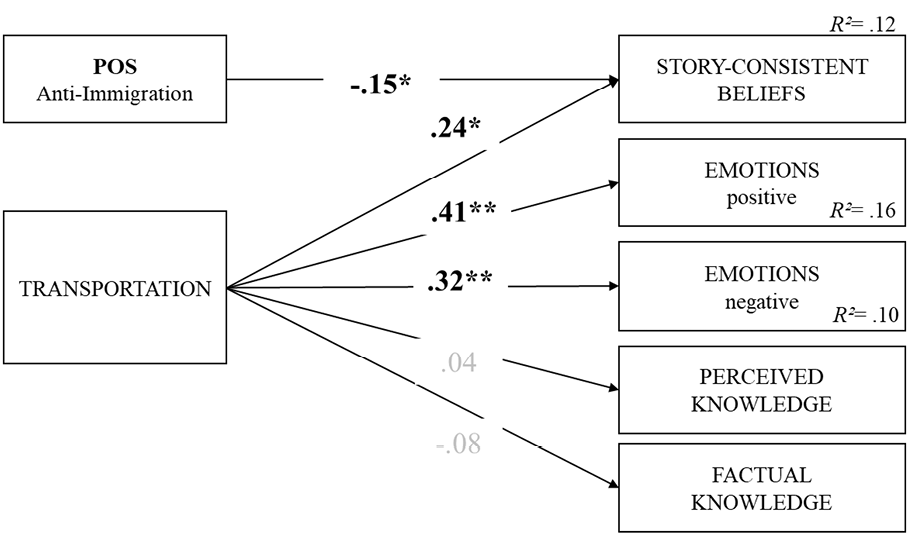
Note: ** p < .001, * p < .05
Regarding the first hypothesis, concerning the association of transportation on story-consistent beliefs (H1a), positive emotions (H1b), negative emotions (H1c), perceived knowledge (H1d), and factual knowledge (H1e), the model points to a positive association of transportation on story-consistent beliefs (H1a; β = .24, p = .007), positive emotions (H1b; β = .41, p < .001), and negative emotions (H1c; β = .32, p < .001) but no association on perceived knowledge (H1d; β = .04, p = .106) or factual knowledge (H1e; β = -.08, p = .339). Consequently, H1a, H1b, and H1c are supported: transportation positively is related to both positive and negative emotions, as well as beliefs consistent with the presented narrative (in this case, Anne Frank’s story). Conversely, H1d and H1e are not supported as there was no significant relationship between the level of transportation and either factual or perceived knowledge.
Regarding H2, we found no moderating association of political value orientation on the relationship between transportation and story-consistent beliefs (see OSF 3). However, we identified a small negative relationship between political value orientation (anti-immigration) and story-consistent beliefs (β = -.15, p = .005). Thus, H2 is rejected.
5 Discussion
The present study analyzes narrative persuasion in immersive media experiences in the educational context. To this end, we investigated whether the transportation experienced by users of Anne Frank House VR was correlated with emotions, knowledge, and story-consistent political beliefs, while also accounting for the impact of existing political value orientations.
Our results reveal that, as hypothesized, transportation was related to story-consistent political beliefs as well as positive and negative emotions. Although persuasion and affective reactions were positively linked to the experience of transportation in VR, neither perceived nor factual knowledge was connected to transportation. Contrary to expectations, however, existing political value orientations did not moderate the relationship between transportation and story-consistent political beliefs. Instead, existing anti-immigration values seemed to be distinctively related to story-consistent beliefs as well as perceived knowledge, independently of recipients’ transportation into the VR’s narrative.
In the following, we simultaneously discuss the theoretical and practical implications of the findings for history education.
5.1 The Transportation-Imagery Model for Virtual Reality
The study demonstrates the existence of the relationships assumed by the transportation-imagery model in the context of VR application (Green & Brock, 2002). Researchers have emphasized that transportation effects can occur as a consequence of any type of media, but little research has been conducted on the specific effects of transportation in immersive media like VR (see Green & Appel, 2024). The present study shows that transportation in history-related VR is correlated with story-consistent political beliefs. In line with previous research (e.g., Frentzel-Beyme & Krämer, 2023), transportation in narrative immersive media is also positively associated with both positive and negative emotional responses. Both findings are consistent with those of previous research on other media formats, such as textual narration. Our findings illustrate the specific transportation effects of history-related immersive media like Anne Frank House VR. Consequently, the findings contribute to the ongoing discussion on the use of VR in history education (e.g., Lewers, 2022; Bunnenberg, 2020; Mulders, 2023). In our study, recipients were more likely to express story-consistent political beliefs when transportation was high. For instance, they more likely agreed that no one should be persecuted based on their religion. Thus, the findings suggest that VR applications addressing historical topics have the potential to affect recipients’ political beliefs (narrative persuasion). Importantly, however, narrative persuasion effects can occur in every direction. Therefore, special attention should be paid to the content presented in VR, especially in educational settings, as it may convey political beliefs that conflict with normative democratic values. Although we focused on democratic beliefs, similar effects may be found for anti-democratic beliefs if they are consistent with the content presented. Future research should include normatively positive political beliefs as well as negatively connoted, anti-democratic beliefs to further shed light on the impact of immersive media on political beliefs and political radicalization.
In summary, the findings imply that the narration presented in a virtual environment can influence recipients’ (political) beliefs. Moreover, the study illustrates the connectedness of transportation and emotions theorized by Green and Brock (2002) and, therefore, the transferability of the transportation-imagery model to VR.
5.2 The Role of Prior Beliefs
These considerations are promoted by the finding that narrative persuasion effects occur independently of the recipients’ prior political value orientation. In line with Green and Brock’s (2000) theoretical assumption that elaboration differs from processes under high transportation, our results reveal that the relationship between existing values and story-consistent political beliefs was not affected by transportation. Hence, in contrast to prior studies that found a decreasing impact of transportation on the expected confirmation effect (Cohen et al., 2015), we found no role of political values in the persuasive impact of transportation. This suggests that the effect of existing belief systems or values on following evaluations is not related to transportation. In addition, our findings support the assumption that high transportation is associated with story-consistent beliefs.
The results also reveal that after the VR experience, participants’ perceived knowledge was negatively correlated with anti-immigration political values: the lower a participant’s subjective knowledge on the issue at hand, the stronger their value of anti-immigration and vice versa. Although the lack of interference of existing political values with opinion formation or knowledge gains in immersive settings may be seen as positive, the detailed relationships underlying the effects of such media experiences on political persuasion in education settings should be further investigated.
5.3 Knowledge
In line with previous research on the effects of immersion in VR in terms of presence (e.g., Makransky & Petersen, 2021), the findings suggest that VR and other highly immersive media could be systematically implemented to motivate students and other learners by activating interest and fostering emotional involvement with a topic. However, transportation was not related to factual knowledge. These findings can be explained based on cognitive load theory (e.g., Sweller, 1988), which states that, when learning with media, recipients’ limited cognitive capacity to process the information they receive may be exhausted by the media’s characteristics (e.g., immersion in VR). The findings of Mulders (2023) lend support to this assumption by showing that learning outcomes in VR depend on users’ cognitive load. Thus, the relationship between immersion in history-related VR applications like Anne Frank House VR may have been mediated by users’ cognitive load. In light of this, the study’s findings imply that narrative immersion may promote affective processes rather than cognitive ones. This is in line with our findings, which show that transportation into the mediated experience was correlated with both positive and negative emotions. Consequently, VR tools hold promise for enhancing engagement and encouraging learners to explore subjects more deeply by promoting emotional involvement in the topics presented, as previously reported by Frentzel-Beyme and Krämer (2023).
However, given that we found no relationship between transportation and (perceived) knowledge, educational programs utilizing immersive media should be carefully integrated into broader learning contexts. Emotional involvement sparked by new media, like VR, could be used as a starting point for successful learning. This integration might include supplementary activities or instructional support to ensure that the heightened engagement translates into knowledge gains (Makransky & Petersen, 2021).
5.4 Limitations and Future Research
This study has several limitations that should be considered. One limitation relates to the measurement and operationalization of constructs. First, the limited number of items used to assess factual knowledge may limit the accuracy and reliability of the observed effects. Second, the conceptualization and measurement of positive emotions focused primarily on interest, which may not fully capture the broader range of positive emotional states, such as joy. Third, the use of political value orientation as an indicator of prior preferences was based on a scale in the early stage of development (Decker et al., 2023). These measurement limitations could affect the interpretation of results, and future research should consider more comprehensive approaches (e.g., physiological measurement; see IJsselsteijn et al., 2000). Fourth, the use of purely quantitative measurement methods may not adequately capture the underlying processes of opinion formation. Thus, future research could gain deeper insights from mixed-method approaches.
In addition, this study, like most existing research, measured the outcomes of narrative persuasion immediately or shortly after exposure, while its longer-term effects remain understudied. Previous studies have found long-term effects on attitudes (e.g., Hormes et al., 2013; Appel & Richter, 2010), and meta-analytic results suggest that narratives are more effective than non-narratives in producing sustained changes in attitudes, intentions, and behaviors over time (Oschatz & Marker, 2020), but the evidence for long-term belief change is less robust. Future research should aim to investigate and verify these long-term effects more comprehensively.
Further, previous research has found that the level of transportation and its persuasive impact are unaffected by the story’s true or fictional nature (Green & Brock, 2000). Hence, as immersive media like VR spreads, the likelihood of people believing untrue stories and adopting story-consistent beliefs without questioning them grows as well. This may be relevant to research on the effects of fast-paced, algorithmically curated social media platforms, such as TikTok, with the potential for immersion or transportation. Given that social media already is associated with threats of dis- and misinformation (e.g., Pérez-Escolar et al., 2023; Kubin & von Sikorski), the impact of immersive content on beliefs or even knowledge deserves attention in future studies.
Finally, the role of emotional flow in narrative persuasion should be investigated. Although recent work (Green & Appel, 2024) emphasizes its importance, a more detailed understanding of how emotional dynamics contribute to narrative effects could deepen insight into the mechanisms of narrative persuasion.
6 Conclusion
This study provides empirical support for the transportation-imagery model in the context of VR application in educational settings. The findings demonstrate that transportation in VR is positively related to emotional engagement and story-consistent political beliefs, illustrating the persuasive potential of immersive media. In this regard, the study highlights the importance of teaching media literacy to encourage learners to engage with emotionally and ideologically loaded media applications critically.
Meanwhile, the lack of relationship between transportation, factual knowledge, and perceived knowledge highlights the limitations of VR as an educational medium. Although it may enrich learning experiences by boosting learners’ engagement with a topic, transportation is not associated with conceptual understanding or factual learning. This finding aligns with broader discussions in digital history and Holocaust education, which emphasize that while immersive media can foster empathy and engagement, they must be carefully embedded in pedagogical frameworks that promote critical reflection and historical contextualization to prevent the uncritical acceptance of simplified narratives.
References
Abs, H. J., Hahn-Laudenberg, K., Deimel, D., & Ziemes, J. F. (Eds.). (2024). ICCS 2022. Schulische Sozialisation und Politische Bildung von 14-Jährigen im internationalen Vergleich. Waxmann. https://doi.org/10.31244/9783830998228
Ahn, S. J., Nowak, K. L., & Bailenson, J. N. (2022). Unintended consequences of spatial presence on learning in virtual reality. Computers & Education, 186, Article 104532. https://doi.org/10.1016/j.compedu.2022.104532
Allcoat, D., & von Mühlenen, A. (2018). Learning in virtual reality: Effects on performance, emotion and engagement. Research in Learning Technology, 26. https://doi.org/10.25304/rlt.v26.2140
Appel, M., & Richter, T. (2010). Transportation and need for affect in narrative persuasion: A mediated moderation model. Media Psychology, 13(2), 101–135. https://doi.org/10.1080/15213261003799847
Ballard, A. M., Davis, A., & Hoffner, C. A. (2021). The impact of health narratives on persuasion in African American women: A systematic review and meta-analysis. Health Communication, 36(5), 560–571. https://doi.org/10.1080/10410236.2020.1731936
Breyer, B., & Bluemke, M. (2016). Deutsche version der positive and negative affect schedule PANAS (GESIS panel). https://doi.org/10.6102/zis242
Bunnenberg, C. (2020). Mittendrin im historischen geschehen? Immersive digitale medien (augmented reality, virtual reality, 360°-film) in der geschichtskultur und perspektiven für den geschichtsunterricht. Geschichte für heute, 13(4), 45–59.
Chen, J., Fu, Z., Liu, H., & Wang, J. (2024). Effectiveness of virtual reality on learning engagement: A meta-analysis. International Journal of Web-Based Learning and Teaching Technologies, 19(1), 1–14. https://doi.org/10.4018/IJWLTT.334849
Cohen, J., Tal-Or, N., & Mazor-Tregerman, M. (2015). The tempering effect of transportation: Exploring the effects of transportation and identification during exposure to controversial two-sided narratives: The tempering effect of transportation. Journal of Communication, 65(2), 237–258. https://doi.org/10.1111/jcom.12144
Costabile, K. A., & Terman, A. W. (2013). Effects of film music on psychological transportation and narrative persuasion. Basic and Applied Social Psychology, 35(3), 316–324. https://psycnet.apa.org/doi/10.1080/01973533.2013.785398
Decker, H., Cetinkaya, N. E., & Krämer, N. (2023). A cross-national evaluation of a value-based measure of political orientation (POS). https://doi.org/10.31234/osf.io/3kacn
Fazio, R. H., & Zanna, M. P. (1981). Direct experience and attitude-behavior consistency. Advances in Experimental Social Psychology, 14, 161–202. https://doi.org/10.1016/S0065-2601(08)60372-X
Frentzel-Beyme, L., Holtze, M., Szczuka, J., & Krämer, N. (2023). Posting from the past: A longitudinal study of the potentials of parasocial interaction with a historical figure for history education. Weizenbaum Journal of the Digital Society, 3(1). https://doi.org/10.34669/WI.WJDS/3.1.3
Frentzel-Beyme, L. & Krämer, N. C. (2020). Back to the past — An experimental investigation of the effects of immersive historical environments on empathy and morality. Presence: Virtual and Augmented Reality 2020, 29, 91–111. https://doi.org/10.1162/pres_a_00357
Frentzel-Beyme, L., & Krämer, N. C. (2023). Historical time machines: Experimentally investigating potentials and impacts of immersion in history-related VR on history education and morality. Technology, Mind, and Behavior, 4(1). https://doi.org/10.1037/tmb0000099
Gouws, B. (2019). Emotions in Holocaust education: The narrative of a history teacher. Yesterday and Today, 21, 47–79. https://doi.org/10.17159/2223-0386/2019/n21a3
Green, M. C., & Appel, M. (2024). Narrative transportation: How stories shape how we see ourselves and the world. Advances in Experimental Social Psychology, 70, 1–82. http://dx.doi.org/10.1016/bs.aesp.2024.03.002
Green, M. C., & Brock, T. C. (2000). The role of transportation in the persuasiveness of public narratives. Journal of Personality and Social Psychology, 79(5), Article 701. https://psycnet.apa.org/doi/10.1037/0022-3514.79.5.701
Green, M. C., & Brock, T. C. (2002). In the mind’s eye: Transportation-imagery model of narrative persuasion. In M. C. Green, J. J. Strange, & T. C. Brock (Eds.), Narrative impact: Social and cognitive foundations (pp. 315–341). Lawrence Erlbaum Associates.
Green, M. C., Kass, S., Carrey, J., Herzig, B., Feeney, R., & Sabini, J. (2008). Transportation across media: Repeated exposure to print and film. Media Psychology, 11(4), 512–539. https://doi.org/10.1080/15213260802492000
Hormes, J. M., Rozin, P., Green, M. C., & Fincher, K. (2013). Reading a book can change your mind, but only some changes last for a year: Food attitude changes in readers of The Omnivore’s Dilemma. Frontiers in Psychology, 4, Article 778. https://doi.org/10.3389/fpsyg.2013.00778
Hu, L. T., & Bentler, P. M. (1999). Cutoff criteria for fit indexes in covariance structure analysis: Conventional criteria versus new alternatives. Structural Equation Modeling: A Multidisciplinary Journal, 6(1), 1–55. https://doi.org/10.1080/10705519909540118
IJsselsteijn, W. A., de Ridder, H., Freeman, J., & Avons, S. E. (2000). Presence: Concept, determinants, and measurement. In B. E. Rogowitz & N. P. Thrasyvoulus (Eds.), Human vision and electronic imaging (pp. 520–529). https://doi.org/10.1117/12.387188
Johnson-Laird, P. N. (1983). Mental models: Towards a cognitive science of language, inference, and consciousness. Harvard University Press.
Kubin, E., & von Sikorski, C. (2021). The role of (social) media in political polarization: A systematic review. Annals of the International Communication Association, 45(3), 188–206. https://doi.org/10.1080/23808985.2021.1976070
Kunda, Z. (1990). The case for motivated reasoning. Psychological Bulletin, 108(3), 480–498. https://doi.org/10.1037/0033-2909.108.3.480
Lee, S., Diehl, T., & Valenzuela, S. (2022). Rethinking the virtuous circle hypothesis on social media: Subjective versus objective knowledge and political participation. Human Communication Research, 48(1), 57–87. https://doi.org/10.1093/hcr/hqab014
Lewers, E., & Frentzel-Beyme, L. (2023). Und was kommt nach der Zeitreise? Eine empirische Untersuchung des „Auftauchens“ aus geschichtsbezogener Virtual Reality. MedienPädagogik: Zeitschrift für Theorie und Praxis der Medienbildung, 51, 402–429. https://doi.org/10.21240/mpaed/51/2023.01.26.X
Lewers, E. (2022). Durch Raum und Zeit? : Medienkritische Auseinandersetzung mit Virtual Reality im Geschichtsunterricht. Medienimpulse, 60(2), 41 Seiten. https://doi.org/10.21243/mi-02-22-20
Manca, S. (2021). Digital memory in the post-witness era: How Holocaust museums use social media as new memory ecologies. Information, 12(1), Article 31. https://doi.org/10.3390/info12010031
Manca, S., Raffaghelli, J. E., & Sangrà, A. (2023). A learning ecology-based approach for enhancing digital Holocaust memory in European cultural heritage education. Heliyon, 9(9), Article e19286. https://doi.org/10.1016/j.heliyon.2023.e19286
Makransky, G., & Lilleholt, L. (2018). A structural equation modeling investigation of the emotional value of immersive virtual reality in education. Educational Technology Research and Development, 66(5), 1141–1164. https://doi.org/10.1007/s11423-018-9581-2
Makransky, G., & Petersen, G. B. (2021). The cognitive affective model of immersive learning (CAMIL): A theoretical research-based model of learning in immersive virtual reality. Educational Psychology Review, 33(3), 937–958. https://psycnet.apa.org/doi/10.1007/s10648-020-09586-2
Mazhar, A. A., & Al Rifaee, M. M. (2023, August). A systematic review of the use of virtual reality in education. In 2023 International Conference on Information Technology (pp. 422–427). IEEE. https://doi.org/10.1109/ICIT58056.2023.10225794
McFerran, B., Dahl, D. W., Gorn, G. J., & Honea, H. (2010). Motivational determinants of transportation into marketing narratives. Journal of Consumer Psychology, 20(3), 306–316. https://doi.org/10.1016/j.jcps.2010.06.017
Meta. (2018, June). Anne Frank House VR [Oculus VR]. https://annefrankhousevr.com/
Mulders, M. (2023, July). Learning about Anne Frank in virtual reality: Investigating the role of cognitive load. In EdMedia+ Innovate Learning (pp. 1034-1040). Association for the Advancement of Computing in Education.
Oschatz, C., & Marker, C. (2020). Long-term persuasive effects in narrative communication research: A meta-analysis. Journal of Communication, 70(4), 473 – 496.
Oschatz, C., Niederdeppe, J., & Liu, J. (2022). The role of prior attitudes in narrative persuasion: Evidence from a cross-national study in Germany and the United States. Communication Monographs, 89(3), 376–395. https://doi.org/10.1080/03637751.2021.2011344
Parong, J., & Mayer, R. E. (2021). Cognitive and affective processes for learning science in immersive virtual reality. Journal of Computer Assisted Learning, 37(1), 226–241. https://psycnet.apa.org/doi/10.1111/jcal.12482
Pérez-Escolar, M., Lilleker, D., & Tapia-Frade, A. (2023). A systematic literature review of the phenomenon of disinformation and misinformation. Media and Communication, 11(2), 76–87. https://doi.org/10.17645/mac.v11i2.6453
Riva, G., Mantovani, F., Capideville, C. S., Preziosa, A., Morganti, F., Villani, D., Gaggioli, A., Botella, C., & Alcaniz, M. (2007). Affective interactions using virtual reality: The link between presence and emotions. Cyberpsychology & Behavior: The Impact of the Internet, Multimedia and Virtual Reality on Behavior and Society, 10(1), 45–56. https://doi.org/10.1089/cpb.2006.9993
Rokeach, M. (1973). The nature of human values. The Free Press.
Sant, E. (2019). Democratic education: A theoretical review (2006–2017). Review of Educational Research, 89(5), 655–696. https://doi.org/10.3102/0034654319862493
Schwartz, S. H., Caprara, G. V., & Vecchione, M. (2010). Basic personal values, core political values, and voting: A longitudinal analysis. Political Psychology, 31(3), 421–452. https://doi.org/10.1111/j.1467-9221.2010.00764.x
Slater, M. (2021). Beyond speculation about the ethics of virtual reality: The need for empirical results. Frontiers in Virtual Reality, 2, Article 687609. https://doi.org/10.3389/frvir.2021.687609
Slater, M., & Wilbur, S. (1997). A framework for immersive virtual environments (FIVE): Speculations on the role of presence in virtual environments. Presence: Teleoperators and Virtual Environments, 6(6), 603–616. https://doi.org/10.1162/pres.1997.6.6.603
Sweller, J. (1988). Cognitive load during problem solving: Effects on learning. Cognitive Science, 12(2), 257–285. https://doi.org/10.1207/s15516709cog1202_4
Sweller, J. (2010). Element interactivity and intrinsic, extraneous, and germane cognitive load. Educational Psychology Review, 22(2), 123–138. https://doi.org/10.1007/s10648-010-9128-5
Sweller, J. (2011). Cognitive load theory. In J. P. Mestre & B. H. Ross (Eds.), Psychology of learning and motivation (vol. 55, pp. 37–76). Academic Press. https://doi.org/10.1016/B978-0-12-387691-1.00002-8
Taber, C. S., & Lodge, M. (2016). The illusion of choice in democratic politics: The unconscious impact of motivated political reasoning. Political Psychology, 37, 61–85. https://doi.org/10.1111/pops.12321
Trofanenko, B. (2014). Affective emotions: The pedagogical challenges of knowing war. Review of Education, Pedagogy, and Cultural Studies, 36(1), 22–39. https://doi.org/10.1080/10714413.2014.866820
Villena-Taranilla, R., & Diago, P. D. (2025). Challenges and implications of virtual reality in history education: A systematic review. Applied Sciences, 15(10), Article 5589. https://doi.org/10.3390/app15105589
Zwaan, R. A., & Radvansky, G. A. (1998). Situation models in language comprehension and memory. Psychological Bulletin, 123(2), 162–185. https://doi.org/10.1037/0033-2909.123.2.162
Acknowledgement
The authors would like to thank Firosa Zargar for her valuable assistance in conducting the laboratory study.
Funding
This project is funded by the German Federal Ministry of Education and Research (no. 01JD1910C). The responsibility for the content of this publication lies with the authors.
Date received: 2 January 2026
Date accepted: 30 June 2026