The Authenticity Challenge
1 Introduction
The deployment of generative AI in journalism and news production offers an array of opportunities and challenges. In this essay, we review these and focus on what we refer to as the “authenticity challenge”. The integration of AI into journalism represents a qualitative shift around how the profession works and how it is perceived.
The arrival of generative AI in the news sector has enabled news organizations to produce more content at higher speed and in more formats than ever before. Routine reporting, such as summaries of companies’ annual reports, sports overviews, and weather updates, can be fully or largely automated. In minutes, stories can be generated in multiple formats (e.g., text, video scripts, animations, social media posts, and newsletters), translated, and localized. Predominantly, these capabilities are framed as ways to free up journalists for more meaningful tasks, rather than to replace them (Cools & Diakopoulos, 2024). Whether this will indeed be the case for an industry long subject to “increasing expectations to do more with less” (Dodds et al., 2026, p. 1) remains to be seen.
In terms of challenges, many issues are at stake: Generative AI is “confident” but error prone; source attribution is improving but still flaky; audiences want AI disclosures but do not attribute value or trust to AI-supported content; and processes of transparency and accountability in reporting have become less clear. Yet the most significant challenge may be epistemic: the growing difficulty, and in some cases even the inability, to distinguish between what is real and what is fake, between authentic and AI-generated content. This fundamental issue touches journalists and audiences alike: While journalism depends on trust and credibility, generative AI introduces new epistemic challenges that may complicate truth-finding and undermine trust in information.
2 Risks and Opportunities of Generative AI in News Production
Before unpacking the authenticity challenge, let us review some of the key changes prompted by generative AI in news production. Generative AI affects all stages of the journalistic value chain, as defined by Cools and Diakopoulos (2024): (1) news gathering, (2) news production, (3) news verification, and (4) news distribution. We have reviewed each of these elsewhere (Mattis & de Vreese, 2025) and will focus here on only the first two.
Generative AI in news gathering: At the news gathering stage, journalists frequently point to generative AI’s ability to make sense of large amounts of data as a key enabler to identify newsworthy stories, for instance through automated content aggregation and trend analysis (Attard et al., 2023; Cools & Diakopoulos, 2024; Shi & Sun, 2024). Some also use it as a sort of sparring partner, for example when preparing for interviews or developing story ideas (Wu, 2026).
Generative AI in news production: Use cases for generative AI during news production include a variety of relatively menial tasks, such as summarization, transcription, translation, news headline optimization, image generation, and data analysis and visualization (Cools & Diakopoulos, 2024; Newman & Cherubini, 2025). However, generative AI also allows journalists to go further by generating plausible news articles from scratch. This marks an important and unprecedented shift from earlier AI applications, which relied on more structured outputs in which facts (such as sports results or earnings calls) were automatically inserted into pre-existing article templates (Caswell, 2024).
These examples illustrate how generative AI tools can deliver research and workflow efficiency improvements (Attard et al., 2023). However, their use in news gathering and production is not without risks. For instance, generative AI has long been known to perpetuate biases in its training data (Bender et al., 2021), while the black-box nature of the models makes it nearly impossible for journalists to understand their inner workings and gauge existing biases – especially in the case of third-party software (Simon, 2024). This introduces risks of reputational damage, especially in the case of automated content creation (Newman & Cherubini, 2025). The use of generative AI in news gathering also introduces a new vulnerability to external manipulation. For instance, automated trend analyses could potentially be susceptible to targeted disinformation campaigns by bad-faith actors. Similarly, the impressive language capabilities of generative AI models that help journalists polish or produce text could be used by others to mimic authentic journalism and misrepresent reality (for instance for financial or political gain).
The authenticity challenge looms across these different dimensions and stages of news production: The rise of generative AI has made synthetic media (text, images, audio, and video) largely indistinguishable from authentic material, at a mass scale. For journalism, this is not just another technological disruption. It strikes at the profession’s very foundation: the ability to establish what is real. If it is no longer possible to reliably tell the difference between genuine reporting and convincing fabrication, audience trust may erode (Coeckelbergh, 2023). This risk applies both to individual pieces of reporting and to the institution of journalism itself. Meeting this authenticity challenge requires the field to rethink verification, transparency, and its relationship with audiences.
3 Verification in a Synthetic Age
Verification has always been central to journalism, but generative AI raises the bar. Traditional journalistic verification methods remain necessary, but they are no longer sufficient. Generative AI can facilitate every stage of news verification and fact-checking, for instance by helping with social-media monitoring, audiovisual content verification, transcription, translation, trend analysis and data summarization, or by supporting the application of open-source intelligence methods for verification purposes (Dierickx et al., 2023; Wolfe & Mitra, 2024). Accordingly, it should come as no surprise that many fact-checking organizations are already using generative AI much like news organizations do and are working toward novel applications such as live fact-checking (Wolfe & Mitra, 2024).
However, several potential issues must be considered. On the one hand, the general drawbacks of using generative AI (e.g., perpetuating biases in training data, spreading misinformation based on model hallucinations, lack of transparency, platform dependence) apply just as much to fact-checking organizations as to news media (Dierickx et al., 2023). Another pressing question is whether audiences accept automated fact-checking. In general, survey research suggests rather critical attitudes toward generative AI in journalism (Fletcher & Kleis-Nielsen, 2024), with AI fact-checking having a particularly negative impact on perceptions of trustworthiness (Mattis et al., 2025). There are also practical challenges, such as knowledge silos that complicate adoption of generative AI tools (Dodds et al., 2026), or technical shortcomings such as low-quality training data, lack of access to real-time information, and an overt focus on fact-checking textual rather than visual content (Dierickx et al., 2023).
One promising response to synthetic media is highlighting provenance: tracking the origin and history of a piece of content. Instead of asking audiences to trust what they see, news organizations can provide verifiable evidence of how that content was created and handled. Technologies such as cryptographic watermarking and content credentials aim to embed metadata into images, videos, and audio files. This metadata can record when and where a file was captured, what device was used, and whether it has been altered. Initiatives such as the Content Authenticity Initiative, relying on C2PA content credentials, are working to standardize these practices across platforms, publishers, and technology companies (Content Authenticity Initiative, 2026).
In journalism, applying such standards could become as routine as citing sources. A photo published by a reputable outlet might come with a verifiable chain of custody, allowing both other journalists and audiences to confirm its authenticity independently. While no system is foolproof, widespread adoption raises the cost of deception and creates a baseline of trust.
4 Transparency as a Competitive Edge
In an era of synthetic media, opacity is a liability. Audiences are increasingly aware that AI can generate convincing content, and suspicion can arise even when material is genuine. Journalism must lean into radical transparency. This includes being explicit about how content is produced. If AI tools are used for transcription, translation, or drafting, news organizations should say so. If a video has been edited, the nature of the edits should be made clear. Transparency does not weaken credibility; it can strengthen it by aligning expectations with reality. However, while audiences claim to want AI disclosures, paradoxically they tend to penalize organizations offering them, reporting lower trust in content after being informed of AI use (Cools et al., 2025; Mattis et al., 2025). In part, this may be due to how AI use is disclosed. Accordingly, news organizations may need to consider more carefully how to disclose not just that AI is being used, but rather how it is being used and how journalistic principles such as accuracy and human oversight are being safeguarded (Zier & Diakopoulos, 2026).
No single newsroom can solve the authenticity challenge alone. Synthetic media spreads across platforms, borders, and languages. Addressing it requires collaboration among journalists, technology companies, and civil society. Platforms play a critical role in labelling or flagging synthetic content, but their incentives do not always align with those of journalism. Partnerships and shared standards can help bridge this gap. For example, if a platform detects that a video is likely AI generated, that signal could be shared with news organizations in real time. Cross-newsroom collaboration is also essential. Investigative networks and fact-checking alliances allow journalists to pool resources and expertise. Organizations such as the International Fact-Checking Network 1 already coordinate efforts to debunk misinformation; their role will only grow as synthetic media becomes more sophisticated.
Even as journalism grapples with these challenges, audiences must also become more discerning consumers of information. This does not mean shifting responsibility away from journalists but simply recognizing that trust is a two-way street. News organizations can help educate audiences on how synthetic media works and how to identify it. Media literacy initiatives, explainer articles, and interactive tools can help audiences understand the risks without becoming cynical. The goal is not to make people distrust everything, but to equip them with tools to ask better questions.
Importantly, this education should avoid alarmism. If audiences come to believe that nothing is real, the result will be not scepticism but disengagement. Journalism must strike a balance: acknowledging the challenges of synthetic media while reaffirming that reliable information is still attainable.
5 Redefining Authenticity
The concept of authenticity itself may need to evolve. In the past, authenticity was often tied to the idea of a direct, unmediated record: a photograph as a snapshot of reality or a recording as a faithful capture of sound, for example. Generative AI disrupts this assumption. Journalism may need to shift from presenting content as inherently trustworthy to demonstrating why it is trustworthy. Authenticity becomes less about the medium and more about the process: the methods used, the standards applied, and the accountability maintained. This shift aligns with journalism’s core values. At its best, journalism has never asked audiences to trust blindly, but to trust based on evidence, transparency, and consistency. Generative AI raises the stakes, but it also clarifies what matters most.
An evolving notion of authenticity also needs to acknowledge that audiences may perceive authenticity differently. In a recent survey (Morosoli et al., 2025), respondents considered human involvement and expression of writers’ character and beliefs to be the most important factors for judging journalistic content as authentic (see Figure 1). While this research by no means captures the full complexity of authenticity judgments, it does indicate that provenance and transparency alone may not be enough for content to be perceived as authentic and trustworthy.
What do you consider authentic journalistic content?
Please rank the following from 1 to 5, where 1 is the least authentic and 5 is most authentic.
Journalistic content…
… that is based on facts and reality
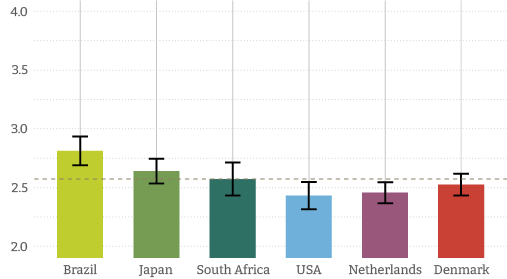
… where it is easy to identify the source of origin
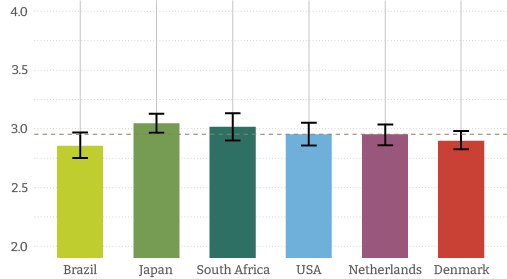
… that follows established journalistic values, such as impartiality or accuracy
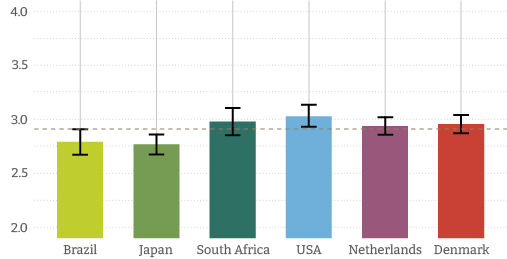
… that is written by a human being
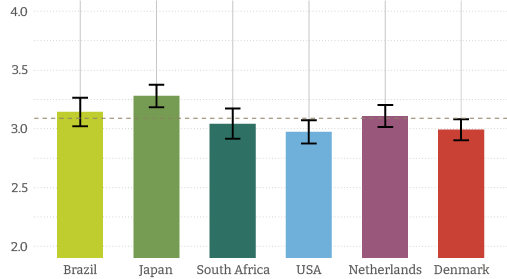
… that expresses the writers´ character or beliefs
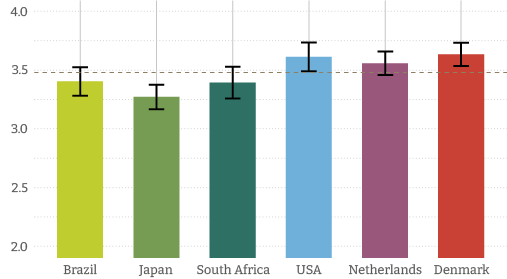
Figure 1: Weighted country means for authenticity rankings, where respondents ranked, in order of importance, elements of journalistic content that may make it seem authentic. Note that higher values correspond to higher rankings. The red dotted line represents the global mean per item. The underlying data (N = 6,961) were collected with the help of local panel companies in each country, stratified by age, gender, education, and geographic region, and weighted to allow for meaningful cross-country comparisons.
Accordingly, journalists might consider revisiting the traditional emphasis on journalistic objectivity and instead place more emphasis on the transparent expression of their journalistic approach and underlying beliefs. This is not to say that journalism should forfeit its ambition to report truthfully. But it might help explain the recent rise of “newsfluencers” at the expense of legacy organisations: As new forms of engaging with journalistic content and its producers emerges, perhaps the locus of trust and authenticity is shifting from well-known brands to more granular units, such as individual journalists or organisations. Generative AI may, in this way, force news organisations to take their “audience turn” more seriously and to rethink how they engage with audiences.
6 Conclusion
The challenge of synthetic media is not merely technical but epistemological, forcing journalism to confront how it knows what it knows, and how it communicates that knowledge to the public. The response must be equally multifaceted: stronger verification practices, robust provenance systems, radical transparency, human editorial oversight, cross-sector collaboration, and audience education. There is no single solution, and no guarantee of success. But the path forward is clear. Journalism must reaffirm its defining principles while adapting its tools and methods to a new reality. In doing so, it can not only withstand the pressures of generative AI but emerge with a stronger, more resilient foundation for safeguarding audience trust.
The authenticity challenge must be met by journalism for IT to remain relevant, trustworthy, and accountable. It is crucial to note that the AI turn in journalism comes not at a moment of financial success and stability for the sector but at a time of interlocking crises on many fronts (Dodds et al., 2026). These include the collapse of traditional business models, plummeting public trust, widespread news avoidance, and the destabilizing influence of platform economies on the distribution and consumption of information (Newman & Cherubini, 2025). It is in this context that answers must be found.
References
Attard, M., Davis, M., & Main, L. (2023). Gen AI and journalism. Centre for Media Transition, University of Technology Sydney. https://figshare.com/articles/online_resource/Gen_AI_and_Journalism/24751881
Bender, E. M., Gebru, T., McMillan-Major, A., & Shmitchell, S. (2021, March). On the dangers of stochastic parrots: Can language models be too big? In Proceedings of the 2021 ACM Conference on Fairness, Accountability, and Transparency (pp. 610–623). Association for Computing Machinery. https://doi.org/10.1145/3442188.3445922
Caswell, D. (2024). Audiences, automation, and AI: From structured news to language models. AI Magazine, 45(2), 174–186. https://doi.org/10.1002/aaai.12168
Coeckelbergh, M. (2023). Democracy, epistemic agency, and AI: Political epistemology in times of artificial intelligence. AI and Ethics, 3(4), 1341–1350. https://doi.org/10.1007/s43681-022-00239-4
Content Authenticity Initiative. (2026, June). Content Authenticity Initiative. https://contentauthenticity.org/
Cools, H., de Vreese, C., El Ali, A., Helberger, N., Prajod, P., Mattis, N., Morosoli, S., Naudts, L., Weikmann, T. (2025, April 22). Tackling the transparency puzzle: Five perspectives from AI disclosure research in news. Generative AI in the Newsroom. https://generative-ai-newsroom.com/tackling-the-transparency-puzzle-0969b3bcc489
Cools, H., & Diakopoulos, N. (2024). Uses of generative AI in the newsroom: Mapping journalists’ perceptions of perils and possibilities. Journalism Practice, 1–19. Advance online publication. https://doi.org/10.1080/17512786.2024.2394558
Dierickx, L., Lindén, C. G., & Opdahl, A. L. (2023). Automated fact-checking to support professional practices: Systematic literature review and meta-analysis. International Journal of Communication, 17, 5170–5190. https://ijoc.org/index.php/ijoc/article/view/21071
Dodds, T., Zamith, R., & Lewis, S. C. (2026). The AI turn in journalism: Disruption, adaptation, and democratic futures. Journalism, 27(3), 530–544. https://doi.org/10.1177/14648849251343518
Fletcher, R., & Kleis-Nielsen, R. (2024). What does the public in six countries think of generative AI in news? Reuters Institute for the Study of Journalism. https://doi.org/10.60625/risj-4zb8-cg87
Mattis, N., & de Vreese, C. (2025). Generative AI and disinformation | Breaking the news? Generative AI’s impact on journalism and its implications for disinformation. International Journal of Communication, 19, 1–24. https://ijoc.org/index.php/ijoc/article/view/25448
Mattis, N., Kieslich, K., de Vreese, C. (forthcoming). Feeling iffy about generative AI: Investigating Audiences’ Trustworthiness Perceptions of Task-Specific AI disclosures. Digital Journalism.
Morosoli, S., Naudts, L., Mattis, N., Helberger, N., Steen-Johnsen, K. & de Vreese, C. (June 2025). Cross-national survey study on AI and journalism. Data set and documentation [unpublished dataset].
Newman, N., & Cherubini, F. (2025). Journalism, media, and technology trends and predictions 2025. Reuters Institute for the Study of Journalism. https://doi.org/10.60625/risj-vte1-x706
Shi, Y., & Sun, L. (2024). How generative AI is transforming journalism: Development, application and ethics. Journalism and Media, 5(2), 582–594. https://doi.org/10.3390/journalmedia5020039
Simon, F. M. (2024). Escape me if you can: How AI reshapes news organisations’ dependency on platform companies. Digital Journalism, 12(2), 149–170. https://doi.org/10.1080/21670811.2023.2287464
Wolfe, R., & Mitra, T. (2024, June). The impact and opportunities of generative AI in fact-checking. In Proceedings of the 2024 ACM Conference on Fairness, Accountability, and Transparency (pp. 1531–1543). Association for Computing Machinery. https://doi.org/10.1145/3630106.3658987
Wu, S. (2026). Journalists as individual users of artificial intelligence: Examining journalists’ “value-motivated use” of ChatGPT and other AI tools within and without the newsroom. Journalism, 27(2), 388–406. https://doi.org/10.1177/14648849241303047
Zier, J., & Diakopoulos, N. (2026). Beyond the byline: Audience expectations for AI disclosure in news media. Digital Journalism, 1–21. https://doi.org/10.1080/21670811.2026.2664428
Date accepted: 4 June 2026