Searching for Structure
The Gender Dimension in HCI
1 Introduction
To this day, technical artefacts (TAs) are predominantly developed by men for men, which results in a lack of accessibility for groups that are not male, white, middle-class, and physically or mentally unrestricted (Bardzell, 2010; Offenwanger et al., 2021; Oudshoorn et al., 2004; Rommes, 2014). At the same time, science and technology studies (STS) have acknowledged that TAs and the sex/gender dimension mutually influence one another, although the specifics of which remain a subject of debate (Reinhardt, 2024). Since the 1980s, feminist scholars have been formulating conceptual frameworks aimed at integrating the sex/gender dimension into the development processes of TAs (Bardzell, 2010; Rode, 2011). A subgroup of these researchers has focused on the field of human–computer interaction (HCI)—the subject of this article. As technology increasingly permeates our daily lives, and as sex/gender and TAs mutually influence each other, Rode (2011) argued that it is crucial to foreground the sex/gender dimension in HCI research. Despite these endeavors, Breslin and Wadhwa (2018) noted that these frameworks have, thus far, provided insufficient guidance on how such a product design can actually be implemented. Furthermore, the precise notion of what it means to implement the sex/gender dimension in an HCI design process remains unclear. This article aims to systematically explore this relatively under-researched field. To this end, it first develops a comprehensive map of existing research clusters. Subsequently, as part of a hermeneutical analysis, three publications are analyzed in terms of the aspects of HCI that the authors consider relevant in the context of gender-sensible design. While still being in relation to the research in which they are presented, these aspects are summed up in elements. These are abstracted into what I call “basic motifs”. To reduce redundancy without losing complexity, the elements are abstracted into facets of the motifs. In so doing, I aim to illuminate the essential factors that can guide the inclusion of the sex/gender dimension in an HCI design process. This allows future recommendations to be based on the logic of the structure without having to rely on and no longer need to rely on specific statements made by authors.
2 Developing a Structure
Despite bearing a considerable economic potential (Stumpf et al., 2020), to this day, feminist perspectives remain notably absent from research on the advancement of HCI (Breslin & Wadhwa, 2018; Stumpf et al., 2020).
To enhance the use of TAs in HCI for all groups of people, a sex/gender-related design of HCIs is necessary (Breslin & Wadhwa, 2018), which I define as any design approach that actively considers the sex/gender dimension. “Feminist theory defines sex only as the biology of a person—whether he or she is anatomically male or female” (Humm, 2022, p. 256), whereas gender is “[a] culturally shaped group of attributes and behaviours given to the female or to the male” (p. 106). Since the early 1990s, gender studies have been able to show that these two dimensions cannot be separated precisely from one another (Butler, 2021). To reflect this interconnection, I adopt the term sex/gender (Duchesne & Kaiser Trujillo, 2021) when discussing the dimension in an abstract way. The majority of studies that have proposed recommendations on the implementation of the sex/gender dimension into an HCI design process use the term gender and are content with its definition as a socially constructed dimension (Bardzell, 2010; Pollitzer, 2021; Szlavi & Guedes, 2023).
When I refer to works that only employ the term gender, I also use gender for precision. In the following, I also mark an analytical difference between gender-aware and gender-inclusive approaches. When speaking of both, I speak of sex/gender-sensitive approaches.
Vorvoreanu et al. (2019) categorized research aimed at enhancing gender-relatedness in HCI into two groups: 1) research that produces demonstration artefacts, and 2) research that develops methods and practices.
The creation of demonstration artifacts involves producing tangible examples of alternative design practices that align with Baker’s (2018, p. 546) assertion that “[...] design [...] should focus on deconstructing and resisting the binaries of sex and gender that manifest themselves in both design discourse and designed objects”.
This focus is crucial, as several studies have indicated that individual preferences regarding the use and design of software are clustered along gender lines (Beckwith et al., 2006; Grigoreanu et al., 2008; Hou et al., 2006; Mendez et al., 2018). Furthermore, Rode and Poole (2018) showed that individuals construct their gender identities in relation to their interactions with technology. Therefore, demonstration artifacts serve as valuable tools to contribute to a design practice offering the potential to transform and redefine gender identities (Vorvoreanu et al., 2019).
In contrast to Vorvoreanu et al. (2019), who differentiated based on outcomes, Breslin and Wadhwa (2018) classified research according to their degree of inclusion: 1) gender-aware work, and 2) gender-inclusive work (Fig. 1)
Figure 1: Differentiation of publications on gender-related design according to their degree of inclusion
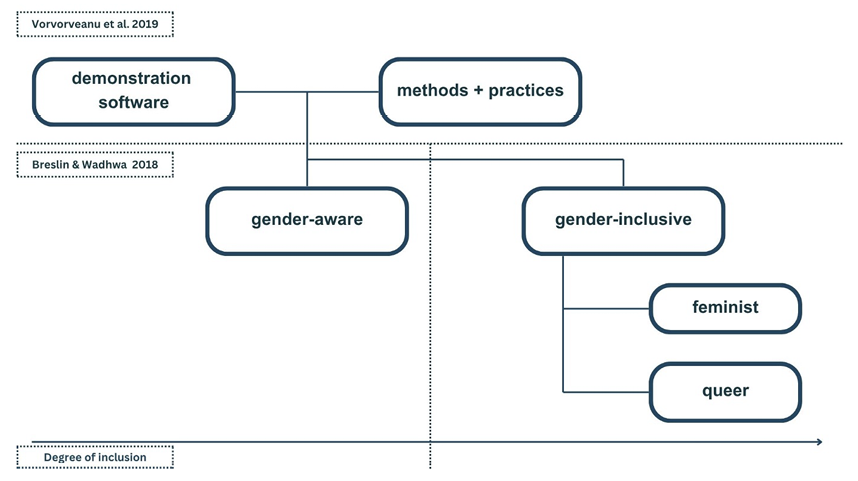
Gender-awareness “reflects on how gender may affect development practices and user interactions, explicitly recognizing the limitations of particular designs in terms of which genders or gendered characteristics are hindered and facilitated” (Breslin & Wadhwa, 2018, p. 73).
Gender-aware designs critically address how gender norms, values, and behaviors influence the production, use, and operation of technologies, and are thus embedded within them (Breslin & Wadhwa, 2018).
Gender inclusion, on the other hand, “[...] actively seeks to include multiple and intersectional genders, and perhaps even future unknown users and characteristics” (Breslin & Wadhwa, 2018, p. 73). Instead of merely acknowledging gender playing a role in the design of TAs, gender-inclusive approaches strive to integrate this dimension into the design process. The authors further delineated between two subgroups based on the way in which they attempt to include the dimension of gender: feminist and queer approaches.
In their understanding, feminist approaches recognize that gender is not a given constant, but a socially constructed phenomenon. As such, feminist approaches assert that it is the designers’ responsibility to counteract marginalizing tendencies in HCIs in order to contribute to a more inclusive society in terms of the co-construction of society and technology. Due to their normative character, this group of works was previously referred to as activist design approaches by the authors (Breslin & Wadhwa, 2014). One possible point of critique toward such approaches is that they risk perpetuating harmful practices by merely addressing pre-existing needs, thereby reinforcing the status quo regarding norms, values, and social relationships (Baker, 2018; Bardzell, 2010).
This problem can be countered by queer approaches. In a general understanding of the term, Queer STS bring together “[…] a longstanding and disaggregated collection of overlapping conversations” (Molldrem & Thakor, 2017, p. 8), focusing on a profound and far-reaching critique of the gender binary and its scientific, normative, and political implications (Anslinger et al., 2014; Gupta & Rubin, 2021). As such, queer approaches are inherently critical of power structures and often transcend the realm of what is typically understood as Feminist STS (FSTS). Both Queer STS and FSTS are inherently future oriented; however, because of their critique of the gender binary in relation to its social structuring qualities, queer approaches in particular entail a creative, utopian dimension and are thus especially future-bound (Tabouratzidis, 2025). Breslin and Wadhwa (2018) employed an understanding of the term queer that has little to do with its usual use. In their understanding, queer approaches strive to remain as open as possible to both current and potential future users and their unique user requirements, rather than establishing strict guidelines on how a TA should be used (Breslin & Wadhwa, 2018, p. 81). Here, users are not solely viewed as users, but also as co-designers.
“Values or norms are therefore unstated, as they are left open for the users to perform and create, or to disrupt and challenge” (Breslin & Wadhwa, 2018, p. 83). 1 Accordingly, feminist and queer approaches offer pivotal potential to subvert both existing power structures and intersectional social inequalities in the field.
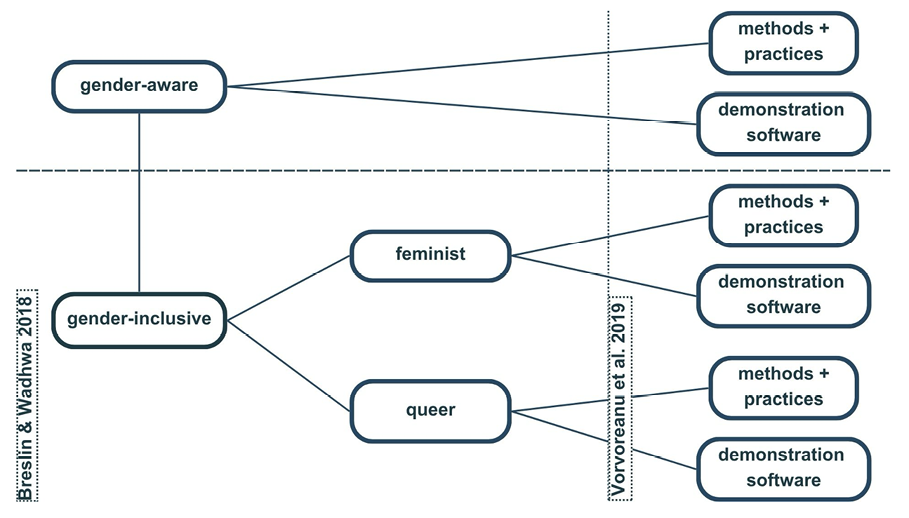
By combining the classifications proposed by Vorvoreanu et al. (2019) with those of Breslin and Wadhwa (2018), I am able to effectively structure the field of research regarding the sex/gender dimension in HCI. This structure differentiates between gender-aware and -inclusive approaches in addressing the sex/gender dimension in this context. The latter category can be further subdivided into feminist and queer approaches. Each of these approaches—gender-aware, feminist, and queer—can result in either demonstration objects or a set of methods and practices (Figure 2).
Having given an overview of a possible classification of relevant works, the following chapter provides information on the actionable recommendations of such works. My thesis posits that these recommendations consistently refer to certain fundamental patterns. Identifying these fundamental patterns (which I term basic motifs), along with their facets, makes it possible to pinpoint factors that require particular attention in sex/gender-sensitive design. A detailed display of said motifs and facets facilitates the development of a resource that effectively encapsulates the sex/gender dimension from multiple perspectives within the design process.
Figure 2: Differentiation of publications on gender-related design according to their outcome
3 Identifying Recommendations for Action
Existing research is rather limited in an international sense (Barros De Amorim et al., 2023; Stumpf et al., 2020). Indeed, articles that provide concrete recommendations on how the sex/gender dimension can be implemented in a design process are rare. In what follows, I examine three publications from the last 15 years for their recommendations for action. The selection of articles was based on content-related reasons. Shaowen Bardzell’s (2010) article, “Feminist HCI: Taking Stock and Outlining an Agenda for Design,” was chosen because it is referred to in almost all published articles on the subject. It can, therefore, be regarded as a central publication. Sarah Homewood et al.’s (2021) publication, “Tracing Conceptions of the Body in HCI: From User to More-Than-Human,” was chosen because it is the only one that deals explicitly and in depth with the topic of bodies in HCI. Pernille Bjørn et al.’s (2023) book, Diversity in Computer Science: Design Artefacts for Equity and Inclusion, was chosen because it deals with recommendations for action that were derived directly from practical experience.
I engage with these publications through a hermeneutical analysis (Betti, 1967; Danner, 2006) to examine which aspects of HCI are considered relevant for sex/gender-sensitive design. A hermeneutical analysis is an interpretative methodology used to uncover latent information in a text. It can take linguistic, structural, and thematic aspects into account, providing a deep understanding of the text and its implications. I began with a comparative reading, searching for similarities and differences between the three publications. Against the backdrop of the findings of general gender studies, FSTS and my own situatedness as a female, White, able-bodied gender researcher with a background in continental philosophy and a research focus on the relation of sex/gender and corporeity, I analyzed the findings of my initial comparison, illuminating different sides of each of these aspects.
Firstly, the publications are presented and briefly summarized, after which their implications are concisely described. These implications are both part of and a first consequence of the hermeneutical analysis, since they are the result of comparative lecture, logical reflection, and the linkage to the research on which they are based.
Subsequently, the explicit and implicit elements of each recommendation are presented. In an inductive process that cannot be displayed here in detail, I grouped the identified elements and summarized them under basic motifs. I then grouped and abstracted the elements into the facets of the motifs to further illustrate different shades of the motifs while reducing redundancy (i.e., different authors discussing the same aspect). In a last step, the motifs’ facets were arranged into the form of reflective questions. These illustrate the facets’ practical use without allowing practical engagement. To be practically applied, more research is needed.
3.1 Shaowen Bardzell’s Six Qualities of Feminist Design
Bardzell (2010, p. 1302) stated that every feminist action—political or scientific—is based on the “central commitments of feminism”: agency, fulfilment, identity and the self, equity, empowerment, and diversity and social justice. Due to the increasingly important role that TAs play in daily life, she argued that HCIs should also be designed in accordance with these central commitments. Her contribution thus aims to strengthen the central commitments of feminism in HCI design processes. If categorized in the above-presented way, this approach could be considered a feminist approach in the sense of Breslin and Wadhwa (2018).
Building on Löwgren and Stoltermann’s (2004) concept of Thoughtful Interaction Design, Bardzell (2010) derived six characteristics that need to be integrated into the design process for it to be considered a feminist HCI design: 1) pluralism, 2) participation, 3) advocacy, 4) ecology, 5) embodiment, and 6) self-disclosure.
The property of pluralism takes up the criticism of feminist standpoint theory, stating that science can never be universal, but must always, to a certain extent, remain partial. 2 According to Bardzell (2010, p. 1305), the characteristic of pluralism is exhibited by TAs “[...] that resist any single, totalizing, or universal point of view.” This results in a retreat from a universalistic design approach and an increased focus on designing TAs for specific groups of people in specific contexts of use. The second characteristic is also derived from this concept of users as people in their specific contexts of use: participation. A TA can be considered participatory if users are involved in the design process. Advocacy, the third characteristic, is also intimately linked to the second. While user requirement analyses provide valuable insights into what users and stakeholders currently need, this practice can result in problems being solved without addressing their root cause or without fundamentally improving the situation. Advocacy refers to the idea of realizing utopias. A TA exhibits this characteristic when political emancipation is emphasized during the development process and when the people involved in the design process are called upon to question their worldview. However, this practice harbors the danger of imposing a specific worldview on a design (Bardzell, 2010).
The fourth characteristic is ecology. Bardzell’s (2010) use of it differs from its common conceptualization. Instead, it refers to the understanding of a TA as an element of its environment. She argues that a TA has an impact on society and the Earth as a habitat. Specifically, this means that a TA should be designed not only in terms of its impact on its users, but also in relation to its consequences for the widest possible interest group in its broadest context.
The fifth characteristic, embodiment, refers to the tendency in HCI development to focus on cognition while neglecting the user’s physicality. Bardzell (2010, p. 1307) stressed the importance “[...] of focalizing the agency of interaction not on the interface or its designer, but the bodies, motivating drives, and primordial urges of users.” In her opinion, research should also pay attention to the differences in perception and interaction between the genders (Bardzell, 2010). Such research harbors the potential to evaluate a TA’s accessibility and make it usable for the future. This accessibility is central to the final characteristic: self-disclosure. This characteristic is rooted in the practice of designers making assumptions about their users, whereby a prototypical user is created, in whom certain characteristics are emphasized while others are excluded. Self-disclosure is taken into account when an HCI artefact discloses the extent to which it produces its user: “Self-disclosure calls users’ awareness to what the software is trying to make of them, and it both introduces a critical distance between users and interactions, and also creates opportunities for users to define themselves for software” (Bardzell, 2010, p. 1307).
This characteristic is based on a techno-feminist humility before the world. While technology in the technical sciences is understood as a mean of using and mastering the world (Haraway, 1995), techno-feminists take the view that technology should be understood as a way to access the world. In this understanding, TAs are both tools for a specific access to the world and independent standpoints that need to be understood and treated with respect (Haraway, 1995). The characteristic of self-disclosure attempts to counter the technoscientific movement of subject construction through emphasis and suppression of specific properties, by pointing out the limitations of a designer’s standpoint and their subjectivity brought into the TA.
3.2 Homewood et al.’s Five Recommendations for Gender-related Design
Homewood et al. (2021) addressed the problem that most HCI research has focused on cognitive representations to the exclusion of other aspects of corporeality. They traced the historical development of HCI in four waves, showing how the body image has shifted in each phase of the transition between the waves. From the analysis of the various body concepts, the authors derived five recommendations for gender-sensitive design: 1) attend to the embodied experience of the user; 2) attend to the importance of clarity to concepts of the body in HCI; 3) cultivate an intersectional sensibility; 4) engage with theorists and practitioners from other fields; and 5) adopt a more-than-human definition of the body in HCI.
The first recommendation is to consider the physical experiences of users. To this end, users must be taken into account as embodied and bodily existing persons. This recommendation is largely based on phenomenologically informed theories referring to the concept of embodiment according to Maurice Merleau-Ponty (1976) and thus indirectly also to those of Helmuth Plessner (1975, 2019). As an embodied human being, an individual comes into contact with their environment as a sensing entity that produces their understanding of the world on the basis of this interaction. In contrast to that the body is the physical body of an individual with which others can interact and which can be the object of an individual’s own reflection (Plessner, 1975; Reinhardt, 2022).
The second recommendation calls designers to be aware of their own body concepts. Specifically, they are called upon to make explicit which bodies they are designing for and which they may exclude with their design decisions (Homewood et al., 2021). The authors distinguish four different body concepts: the performative, the sensing, the datafied, and the intersectional. 3
The performative body is to be understood as the body in the process of a performance. Here, to perform means: “[…] initiating actions, repeating motions, or staging behaviors associated with a certain character, role or situation” (Homewood et al., 2021, p. 4). Approaches that work with this concept can be traced back to Paul Dourish’s (2004) Embodied Interaction Design (EID), characterized by the fact that embodiment “[...] is supported by an ethnographic contextualization of phenomenology, and design knowledge is construed as situated with a focus on the relationship between meaning and action” (Homewood et al., 2021, p. 4).
The sensing body understands the body as a sensing entity; both outwardly in the sense of a sense of touch and inwardly in terms of a sensing entity (Homewood et al., 2021). These approaches are also fundamentally related to EID, but they pay more attention to the physical body. As Kristina Höök (2018, p. xxi) explained: “Embodied interaction did not speak of our muscles, our nervous systems, the ways we can and cannot move, our skeletons, how emotions are processed throughout our brain, releasing hormones, activating muscles, attention and perception, and how those elements would change and be shaped by new interactions.”
While the first two concepts frame the body as a phenomenon, the third body concept, the datafied body, is based on the discovery of individual physical bodies. Here, bodies are discovered as a sales market in which individual bodily functions can be monitored and influenced (Homewood et al., 2021). Bodies are understood as a conglomerate of data that can be collected and adjusted. This reveals a view of humanity that sees people as an improvable or expandable resource.
In contrast, there is the fourth body concept: intersectional bodies, which dates back to Kimberlé Crenshaw (2021 [1989]). Here, various dimensions of identity (gender, ethnicity, sexuality, etc.) are thought of as being intertwined, each resulting in different dispositions of power. 4 Intersectional bodies are bodies where multiple dimensions of identity meet. The concept of intersectional bodies is, therefore, one that considers the diverse dimensions of identity that meet within one person.
This body concept is addressed in the authors’ third recommendation: cultivate an intersectional sensibility. To take intersectional bodies into consideration, designers must be aware that several dimensions interact in one body and that this interaction, in turn, has special consequences that only become apparent in the synergy of certain variables. This is made easier if the designers follow the fourth recommendation: Engage with theorists and practitioners from other fields. This recommendation aims at broadening the perspective on the design process and allows different standpoints to enrich each other.
The fifth recommendation, adopt a more-than-human definition of the body in HCI, aims at embedding the TA in a social system. The authors call on designers to consider people’s surroundings, that is, their environment as well as their social structure, in the design process. This acknowledges the interconnectedness of people with their environment.
The multiple body concepts described by the authors lead to distinct implications for the relationship between technology and society.
The technology using performative body creates an instrumental concept of the user–TA relationship, where the acting body is understood as a highly complex tool that operates TAs. This operation enables ever longer chains of action, leading to a more complex entanglement of bodies and TAs (Rammert & Schubert, 2019). This opens the fundamental questions of what action and interaction are and how they are understood in the context of design.
Based on symbolic interactionism, interaction creates society (Blumer, 1966). Diverging views on the human body—and hence diverging views on its implications for interaction—thus mean that the nature of the relationship between technology and society needs to be considered. The concept of datafied bodies is based on the fundamental idea of an optimizable world and thus expresses the subjugating mindset criticized by Haraway (1988). Accordingly, the reflection on one’s own standpoint demanded by Bardzell (2010) also comes into play here.
It can also be found in Homewood et al.’s (2021) explanations of performance. Although the authors did not directly reference Goffman (2021), the similarity to his role theory cannot be denied. Therefore, it is important to question which roles designers presuppose and which they thus inscribe in a TA.
3.3 Bjørn et al.’s Four Principles of Gender-related Design
Fem-Tech.dk is a project attempting to determine the extent of gender equality’s role in the design and development of digital technologies (Bjørn et al., 2023). Originally founded to investigate why the proportion of women studying computer science in Denmark is so low, the research shifted its focus toward structural issues of the design of HCI:
[FemTech.dk’s] research concern takes its starting point in experienced practice, but the fundamental research interest guiding our work is to explore and unpack the situated fundamental assumptions, values, norms, and background knowledge that serve as the infrastructural sociotechnical foundation shaping the current contextual situations of gender imbalance. (Bjørn et al., 2023, p. 10)
In so doing, FemTech.dk pursues two goals: It seeks to understand the challenges resulting from the gender imbalance in computer science, and it aims to expand computer science so as to allow for diverse agendas (Bjørn et al., 2023). FemTech.dk sees itself as action research (Bjørn et al., 2023). Classifying its research process into the above-provided categories, Bjørn et al. (2023) generated both theoretical insights and feminist TAs.
FemTech.dk formulates four principles for the gender-sensitive design of HCIs: 1) Questioning “taken-for-granted assumptions” about technology; 2) producing alternative narratives of computer science; 3) “design artefacts must embed a story within the design”; and 4) “design artefacts should allow for surprising interactive opportunities” (Bjørn et al., 2023, p. 28).
The first principle involves critically examining unquestioned beliefs about technology, its production, and its use (Bjørn et al., 2023). The approach can take different forms. In its practical actions, FemTech.dk focuses on the subversion of materials classically used in technology, as well as the relationship between computer science and interaction (Bjørn et al., 2023). By choosing “atypical” materials in its practical actions, FemTech.dk was able to shake up supposedly certain knowledge about the materiality of computer science (Bjørn et al., 2023). Moreover, the authors sought to question the assumptions about interaction in the context of computer science. Accordingly, they decided to establish group practices to challenge the image of a scientific field working largely alone (Bjørn et al., 2023). While the first design principle aims at challenging presuppositions, the second calls for alternative narratives to be implemented in TAs (Bjørn et al., 2023). There are many common narratives about computer science, relating to what practices scientists use, how they work, who they work with, who they are, what kind of devices they design, and of what these devices are made (Bjørn et al., 2023).
For FemTech.dk, these narratives are common in computer science, but instead of describing a universal truth about the field, they are, in fact, spatio-temporally situated. For this reason, the second design principle calls for engaging with these narratives by pointing out what is made invisible through them. This formerly absent (or invisible) aspect then becomes the central aspect in the design focus of one of their demonstration software TAs (Bjørn et al., 2023). In other words, in this principle, it becomes relevant to consider who is represented in what way, and this realization then becomes a central requirement in the design process of their demonstration software (Bjørn et al., 2023). According to FemTech.dk, the aspects to be considered in a design process to create alternative narratives are the activity, the technology, the functionality, and the look and feel of the TA (Bjørn et al., 2023).
The third principle is based on the assumption that the contextual nature of a TA depends on the situation in which designers imagine it being used (Bjørn et al., 2023). This means that designers must invent a story in advance about the TA’s context of use. In terms of the second design principle, this story should be adapted to the alternative narrative.
In the fourth design principle, the authors shifted their focus from the TA to the experience of the people included in the design process. Indeed, TAs “[...] should allow for interactive opportunities that trigger curiosity” (Bjørn et al., 2023, p. 27). Those interactive opportunities can concern both the design process and the use of the TA. This way, the first three recommendations can be realized: “[…] it is in the enacting of the design artefacts that the alternative narrative and story emerged together with the participants through their interaction with materials challenging taken-for-granted assumptions” (Bjørn et al., 2023, p. 27). It is important that the interaction possibilities are planned as separate events that are understood as part of the context of use (Bjørn et al., 2023). The authors cited the example that, if collaboration is to become the central design factor, it should also be focused on during the event as an opportunity for interaction. In consequence, a TA’s design in relation to FemTech.dk guidelines is not just about the TA itself but also about the design of the social surroundings.
FemTech.dk’s design recommendations imply aspects that will be relevant in the following. By calling for the questioning of taken-for-granted assumptions, they not only question whether interaction should play a role in Danish computer sciences but also how interaction between people and TAs can be conceptualized. This necessitates the consideration of how interactions between individuals occur and their implications for societal construction through the lens of symbolic interactionism. The second characteristic reveals the normative character of FemTech.dk, as the project seeks to transform computer science in a specific way by actively changing its narratives. By paying attention to the context of use in the third design principle for a more holistic design of TAs, reference is made to the socio-material constitution of social meaning. 5 By assuming a social constitution through bodies and TAs (the material), which, in turn, are always already subject to social norms, the role of materiality for the constitution of society is given a special role (Rammert & Schubert, 2019). Against this backdrop, it becomes all the more obvious why the authors are keen to help shape the environment in the form of events aligned with the fourth design principle.
4 Searching for Structure
In the following, I seek common aspects between the three articles to determine which factors are considered crucial for sex/gender-sensitive design. I begin with a comparative reading of the three articles, extracting general resemblances between the papers. I then break up each recommendation into the elements, as described or implied in the articles. Each motif is then briefly described before being grouped together under a basic motif in the third step. Then, the elements are grouped and abstracted into facets of the motifs. This helps to reduce redundancies while assuring theoretical complexity. Further, I offer exemplary reflective questions that function as a first conceptual step into practical application. The reflective questions are not intended for practical use.
4.1 The Recurring Motifs
During the comparative reading of the three publications, it is noticeable how individual aspects of the various publications are similar. For clarity, the various recommendations are compared in Table 1.
Table 1: Comparison of the three guidelines on gender-inclusive design
|
Six qualities of feminist Design according to Bardzell (2010) |
Five recommendations for gender-related design according to Homewood et al. (2021) |
Four principles of gender-related design according to Bjørn et al. (2023) |
|
Pluralism |
Attend to the embodied experience of the user |
Questioning supposedly self-evident assumptions |
|
Participation |
The importance of clarity to concepts of the body in HCI |
Implementing alternative narratives |
|
Advocacy |
Cultivate an intersectional sensibility |
Conceptualizing the context of use |
Each recommendation comprises elements that I elaborated during the summary and the description of the implications. These implications were both part of and the first result of the hermeneutical analysis. The following three tables summarize the recommendations given in the publications and the corresponding elements.
Table 2: Bardzell’s recommendations and their implications
|
Bardzell |
|
|
Pluralism |
Pluralism as an expression of humility before the user |
|
participation |
Participation as action |
|
Advocacy |
Advocacy as expression of the creation of a utopia |
|
Advocacy as action |
|
|
Ecology |
Ecology as embeddedness into a (social) system |
|
Embodiment |
Body in the context of HCI as a user of technology |
|
Body in the context of HCI as an entity that impacts technology |
|
|
Action as a bodily phenomenon |
|
|
Self-disclosure |
Self-disclosure as reflection of one’s own standpoint and an expression of humility before the world |
Table 3: Homewood et al.’s recommendations and their implications
|
Homewood et al. |
|
|
Attend to the embodied experience of the user |
Body as a sensing entity |
|
Reaching out to the surrounding world by means of interaction |
|
|
The importance of clarity to concepts of the body in HCI |
Clarity to concepts of the body as a reflection on assumptions |
|
Body as carrier of technology |
|
|
Body as the object of technology |
|
|
Body as acting entity |
|
|
Extension of the body qua technology |
|
|
Designing technology against the background of assumptions and conception of humans |
|
|
(re)production of roles |
|
|
Cultivate an intersectional sensibility |
Responsibility for the groups excluded from the design process |
|
Moral demand to take differences of people into account |
|
|
Designing technology against the background of assumptions and conception of humans |
|
|
(re)production of roles |
|
|
Engage with theorists and practitioners from other fields |
|
|
Adopting a more-than-human definition of the body |
Entanglement as embeddedness into a (social) system |
 overcoming the nature/culture dualism
Table 4: Bjørn et al.’s recommendations and their implications
|
Bjørn et al. |
|
|
Questioning supposedly self-evident assumptions |
Reflection on assumptions |
|
Emphasizing the materiality of computer science |
|
|
Implementing alternative narratives |
Design is normative |
|
Conceptualizing the context of use |
Designing the environment |
|
Socio-material constitution of social meaning |
|
|
Pluralism |
Holistic design of a TA by designing its environment |
|
Interaction between individuals |
|
|
Interaction between individuals and TAs |
|
|
Interaction between individuals and TAs |
|
As can be seen, both the recommendations and their elements are tailored differently by the authors. However, a thorough engagement with the texts and the comparison of the content revealed that they are rooted in the same or related assumptions. In an inductive process, I grouped the identified elements and summarized them under basic motifs, these being: 1) A Normative Standpoint, 2) Body, 3) Constitution of the Social and Shaping of the Environment, and 4) Action and Interaction (Table 5).
Table 5: The four basic motifs of gender-inclusive design and their specifics
|
Basic Motif |
Six qualities of feminist Design according to Bardzell (2010) |
Five recommendations for gender-related design according to Homewood et al. (2021) |
Four principles of gender-related design according to Bjørn et al. (2023) |
|
A Normative Standpoint |
Pluralism as an expression of humility before the world |
Clarity to concepts of the body as a reflection on assumptions |
Reflection on assumptions |
|
Advocacy as expression of the creation of a utopia |
Responsibility for the groups excluded from the design process |
Design is normative |
|
|
Self-disclosure as a reflection of one’s own standpoint and an expression of humility before the world |
Moral demand to take differences of people into account |
Designing the environment |
|
|
The Body |
Body in the context of HCI as a user of technology |
Body as a sensing entity |
Emphasizing the materiality of computer science |
|
Body in the context of HCI as an entity that impacts technology |
Body as carrier of technology |
Socio-material constitution of social meaning |
|
|
Body as the object of technology |
|||
|
Extension of the body qua technology |
|||
|
Clarity to concepts of the body as a reflection on assumptions |
|||
|
The Constitution of the Social and Shaping of the Environment |
Ecology as embeddedness into a (social) system |
Entanglement as embeddedness into a (social) system |
Holistic design of a TA by designing its environment |
|
Designing technology against the background of assumptions and conception of humans |
|||
|
(re)production of roles |
|||
|
Action and Interaction |
Participation as action |
Body as acting entity |
Interaction between individuals |
|
Advocacy as action |
Reaching out to the surrounding world by means of interaction |
Interaction between individuals and TAs |
|
|
Action as a bodily phenomenon |
Construction of society by means of interaction ( |
To reduce redundancies without losing complexity, I now summarize similar aspects highlighted by different authors into one facet. These facets function as abstractions from the elements as described by the authors.
4.2 A Normative Standpoint
Table 6: Facets of the motif A Normative Standpoint
|
Clarity to concepts of the body as a reflection on assumptions |
Reflect on the meaning and limitations of one’s own standpoint |
|
Reflection on assumptions |
|
|
Responsibility for the groups excluded from the design process |
|
|
Clarity to concepts of the body as a reflection on assumptions |
Humility before the user |
|
Responsibility for the groups excluded from the design process |
|
|
Self-disclosure as reflection of one’s own standpoint and an expression of humility before the world |
|
|
Pluralism as an expression of humility before the world |
Humility before the user |
|
Pluralism as an expression of humility before the user |
|
|
Advocacy as expression of the creation of a utopia |
|
|
Design is normative |
|
|
Designing the environment |
Feminist Design has a profoundly normative character. Three facets of this normative attitude could be extracted from the publications. First, the demand to reflect on the meaning and limitations of one’s own standpoint. It states that designers should be aware of the normative character inherent in the sex/gender-sensitive design of HCI in the sense of feminist product design. Since adopting one standpoint always means rejecting another, clarifying one’s own standpoint is to clarify one’s own limitations. Questions that can be used to clarify one’s own standpoint are: What are my convictions? And what do I reject?
As an expression of humility before a world that is to be shaped rather than subjugated, this consciousness of limitations should also flow into the design of a TA. To this end, designers could ask themselves: What do I claim to design and why?
The second facet demands humility before the user. As an expression of humility toward future users, the designers must make their assumptions about their users the subject of reflection: Which users, or which characteristics of these users, do I assume? Which characteristics do I subsequently exclude?
These questions should apply to the cognitive and personality-related aspects of future users, as well as to the users’ bodies. Which body concepts do I accept? Which do I exclude? What changes could I make to include a previously excluded group, if that is my aspiration? By making design decisions explicit regarding the assumed and addressed user group, responsibility is taken equally for both the addressed and excluded groups.
The third facet is the demand to enable designing a TA’s environment. FemTech.dk shows that the design of a TA inevitably has an influence on its environment, meaning that this environment should already be considered during the design phase. The underlying normative claim, therefore, is to ask what influence the TA has on the environment and whether this influence is desirable or not. Since the environment is always also one that is inhabited by people, both Bardzell (2010) and FemTech.dk have called for people to be involved in the design. Here, on one hand, the humble attitude toward people and the world reenters play. On the other hand, the risk of reproduction of the ever-same is bypassed, and utopias are made possible. Put simply, one must always ask how people can be included in the design process.
4.3 The Body
Table 7: Facets of the motif The Body
|
Body in the context of HCI as a user of technology |
The Body as the Subject of Technology |
|
Body as a sensing entity |
|
|
Emphasizing the materiality of computer science |
|
|
Socio-material constitution of social meaning |
|
|
Body in the context of HCI as an entity that impacts technology |
|
|
Responsibility for the groups excluded from the design process |
|
|
Body as the object of technology |
The Body as the Object of Technology |
|
Body as carrier of technology |
|
|
Clarity to concepts of the body as a reflection on assumptions |
|
|
Extension of the body qua technology |
The second recurring motif is the body, which, in turn, can be divided into two facets: The first focuses on the body as the subject of technology. Further to a recurring basic normative attitude, the topic of the body is also explicitly or implicitly present in all publications. However, the approaches to the body diverge. On the one hand, the body is thought of as a technology user. When the body uses a TA, it does so as a sensing entity that interacts with a material TA. Designers could thus ask themselves: How do I think about the body as a sensing entity? What aspects do I consider in my design? But also: What importance do I give to the materiality of my TA? Which materials do I choose and why? As the materiality of an object contains preconceptions about it, certain narratives are created through the choice of materials, and social meaning is constituted through the interaction with the body. These questions prompt an additional one: What consequences does this choice of material have for the direct and indirect environment of the TA? This co-constitution of social meaning inevitably leads back to the user’s body. Designers must, therefore, also ask themselves how a TA affects the body using it. Once again, it is important for the designers to be aware of their body concepts, as well as to situate this reflection against the background of an explicit body concept.
The second facet focuses on the body as the object of technology. Thinking of the body as an entity that interacts with technology also means that the body can function as an object of the TA. In this situation, it must be questioned what fundamental image of the human being and the body is taken as the basis for framing the body as the object of a TA. It is also necessary to scrutinize the implications of this, as well as its effects on society and whether and to what extent this is desirable. This is where the different levels begin to interlock, because here too the question must be asked on a normative level as to which bodies may not be able to be considered. A particular form of this way of thinking is to conceptualize TAs as a way of expanding the body. While this is particularly common in medical contexts, advances in the field of augmented and virtual reality also contribute to this.
4.4 The Constitution of the Social and the Shaping of the Environment
Table 8: Facets of the motif The Constitution of the Social and the Shaping of the Environment
|
Ecology as embeddedness into a (social) system |
The Effect on People Using the TA |
|
Entanglement as embeddedness into a (social) system |
|
|
Designing technology against the background of assumptions and conception of humans |
|
|
(re)production of roles |
|
|
Design is normative |
|
|
Ecology as embeddedness into a (social) system |
The Effect on People Not Using the TA |
|
Entanglement as embeddedness into a (social) system |
|
|
Holistic design of a TA by designing its environment |
|
|
Design is normative |
The previous sections have already clarified that the basic motifs can rarely be viewed in isolation. Instead, they are intertwined and mutually dependent.
As people and TAs are in constant dialogue with each other, the design of technology has an influence on the society in which a TA is used. Feminist theorists (Bardzell, 2010; Bjørn et al., 2023; Homewood et al., 2021) have argued in favor of taking this impact seriously and not only asking what effect a TA has on its user group, but also what effect it has in its broadest context for the largest possible interest group. This means that the assumption of responsibility does not end with the observation and explication that certain groups of people are not considered. Instead, they are considered an environment. Questions that arise to meet this basic motif’s expectations would, therefore, include: What effect does the use of my TA have on the people not using it? In which situations could it be used and affect other people? What effect does the TA have on the ecological environment? As the approach to technology design is inherently humble, these questions must always be asked before the fundamental question: Do I consider this desirable? As TAs and users constitute each other, a socio-technical interaction affects both people and, through them, their environment. The assumptions that are thus made in the design of a TA also shape the person and the environment. Against this background, the implicit assumptions and images of people also have a potentially world-shaping effect. Designers must, therefore, ask themselves what effect the assumptions have on people and their environment, and whether this is desirable. Against this background, attention must also be paid to which roles are (re)produced with the help of a TA.
FemTech.dk recommends that, instead of merely reflecting on incidental effects on the environment, the environment should be shaped from the outset in order to shape the world. By actively shaping a TA in its environment, influence can be exerted on the closer environment of a TA, which, in turn, could also change the effect on the more distant environment.
4.5 Action and Interaction
Table 9: Facets of the motif Action and Interaction
|
Interaction between individuals |
Interaction |
|
Interaction between individuals and TAs |
|
|
Reaching out to the surrounding world by means of interaction |
|
|
Construction of society by means of interaction ( |
|
|
Participation as action |
Action |
|
Body as acting entity |
|
|
Advocacy as action |
|
|
Action as a bodily phenomenon |
When a TA and a human form a socio-technical system, they do so by interacting with each other. Interaction is thus a basic motif that must be considered in all HCI designs. The recommendations for action analyzed above provide information on how interaction can be conceived and occur in the context of HCI. To shed more light on the phenomenon of interaction, designers could ask themselves what interaction entails: Do I understand interaction as an action between two or more people? How do I understand interaction between humans and TAs? What role does interaction play in my understanding of how society is organized? Does our society only exist in interactions, or does it exist outside of us? Theories rooted in the philosophies of Merleau-Ponty or Plessner refer to a thinking that constates that the relationship to the environment (and thus the constitution of reality) occurs by means of embodied experiences. Since this relationship to the environment also has consequences for the constitution of the subject, designers should thus ask themselves what effects the interaction has on the individual. Moreover, defined as a social action (Schmidt, 2018), an interaction in its original form is always an action. In this respect, the preceding questions inevitably lead to the following one: Who is acting? Do people operate a passive device, or do I attribute agency to the TA? Which aspects of the human being do I consider relevant for action (cognitive processes, body, emotions)?
In addition to the phenomena of action and interaction in the process of HCI itself, action also comes into play in the instructions for action resulting from the other basic motifs. For example, participation, which is vital to the development process, is also an action that should be considered in the design.
5 Results, Limitations, and Outlook
The primary aim of this article was to analyze existing guidelines on incorporating the sex/gender dimension into design processes within the context of HCI, with a view to examining the underlying patterns. To achieve this, I first undertook a formal structuring of the field, which allowed me to categorize the analyzed works and thereby refine the purpose of the recommendations for action. This foundational step was crucial in establishing a clear framework for understanding how sex/gender considerations can be effectively incorporated into HCI design.
Following this structural analysis, I conducted a hermeneutical analysis of three significant publications that each offered recommendations on how to account for the sex/gender dimension in HCI. Each publication was summarized, with particular attention paid to its theoretical implications. This analysis revealed both the explicitly stated recommendations for action and the underlying, implied aspects that contribute to a more nuanced understanding of sex/gender in design (elements). The inductive character of the hermeneutical analysis allowed me to identify four recurring motifs that emerged across all the three publications: 1) a normative standpoint, 2) the body, 3) the constitution of the social and the shaping of the environment, and 4) action and interaction. I illustrated the motifs by abstracting so-called facets from the elements.
In the final phase, I transformed the facets into reflective questions, which enabled me to comprehensively explore the sex/gender dimension at various levels of organizational structure, facilitating a deeper engagement with the complexities involved in HCI design.
The research field of FSTS, and Feminist HCI in particular, is characterized by its strong heterogeneity and fragmentation. As such, an analysis of the logic of the structure of a selection of guidelines represents a significant step toward a systematic exploration of this diverse field. However, the data corpus of this research was very limited. Accordingly, future research could build upon this foundational work by expanding the scope of this systematization to include additional existing guidelines that were not addressed in this article.
Through this research, I aimed to provide basic information on which future research can build and create truly practical guides on the implementation of the sex/gender dimension. As such, the reflective questions are not practical recommendations, but rather an intermediate step toward them. To truly serve as a practical guide in the future, the reflective questions formulated from this analysis must be expanded, modified, and transferred into real-world design processes. In so doing, we can foster a more inclusive and equitable approach to HCI design, ultimately leading to technological solutions that better serve diverse user groups and reflect a broader spectrum of human experiences.
References
Anslinger, J., Freitag, D., Hofstätter, B., Kink, S., Scheer, L., Schlager, J., Thaler, A., & Wicher, M. (2014, July). Queer Science and Technology Studies – Technik- und Wissenschaftsforschung ‘queer’ betreiben (Working Paper No. 2014-4) Interuniversitäres Forschungszentrum für Technik, Arbeit und Kultur. https://www.researchgate.net/publication/267506612_Queer_Science_and_Technology_Studies_-_Technik-_und_Wissenschaftsforschung_’queer’_betreiben.
Baker, S. E. (2018). Post-work Futures and Full Automation: Towards a Feminist Design Methodology. Open Cultural Studies, 2(1), 540–552. https://doi.org/10.1515/culture-2018-0049
Bardzell, S. (2010). Feminist HCI: taking stock and outlining an agenda for design. In E. D. Mynatt, S. E. Hudson, & G. Fitzpatrick, CHI 2010: We are HCI : conference proceedings, Atlanta, Ga, USA, April 10-15, 2010 (pp. 1301–1310). Association for Computing Machinery.
Barros De Amorim, I. L., Santos Dos Santos, S., Moreira Miranda Da Silva, I., Rios Da Hora Rodrigues, K., & Pereira Mota, M. (2023). Gender Nuances in Human-Computer Interaction Research. Proceedings of the XXII Brazilian Symposium on Human Factors in Computing Systems, 1–12. https://doi.org/10.1145/3638067.3638077
Beckwith, L., Burnett, M., Grigoreanu, V., & Wiedenbeck, S. (2006). Gender HCI: What about the software? Computer, 39(11), 97–101. https://doi.org/10.1109/MC.2006.382
Betti, E. (1967). Allgemeine Auslegungslehre als Methodik der Geisteswissenschaften. Mohr. https://digitale-objekte.hbz-nrw.de/storage2/2024/01/06/file_3/9484273.pdf
Bjørn, P., Menendez-Blanco, M., & Borsotti, V. (2023). Diversity in computer science: Design artefacts for equity and inclusion. Springer.
Blumer, H. (1966). Sociological Implications of the Thought of George Herbert Mead. American Journal of Sociology, 71(5), 535–544.
Bourdieu, P. (2020). Sozialer Sinn: Kritik der theoretischen Vernunft (G. Seib, Trans.; 11. Auflage). Suhrkamp.
Breslin, S., & Wadhwa, B. (2018). Gender and Human‐Computer Interaction. In K. L. Norman & J. Kirakowski (Eds), The Wiley Handbook of Human Computer Interaction (1st edn, pp. 71–87). Wiley. https://doi.org/10.1002/9781118976005.ch4
Butler, J. (2021). Körper von Gewicht: Die diskursiven Grenzen des Geschlechts (K. Wördemann, Trans.; 11. Auflage). Suhrkamp.
Buuren, J. van. (2017). Exzentrizität, Dingstruktur und der Leib als Subjekt und Objekt. In T. Ebke (Ed.), Das Leben im Menschen oder der Mensch im Leben? Deutsch-französische Genealogien zwischen Anthropologie und Anti-Humanismus = La vie dans l’homme ou l’homme dans la vie?: Généalogies franco-allemandes entre anthropologie et anti-humanisme (pp. 419–436). Universitätsverlag Potsdam.
Crenshaw, K. W. (2021). Démarginaliser l’intersection de la race et du sexe: Une critique féministe noire du droit antidiscriminatoire, de la théorie féministe et des politiques de l’antiracisme: (S. Beaulieu, Trans.). Droit et Société, N° 108(2), 465–487. https://doi.org/10.3917/drs1.108.0465
Crutzen, C. K. M. (2013). Nicht-menschlich ist auch Gender. Informatik-Spektrum, 36(3), 309–318. https://doi.org/10.1007/s00287-013-0697-9
Danner, H. (2006). Methoden geisteswissenschaftlicher Pädagogik: Einführung in Hermeneutik, Phänomenologie und Dialektik (5., überarbeitete und erweiterte Auflage). Ernst Reinhardt Verlag. https://doi.org/10.36198/9783838509471
Dourish, P. (2004). Where the action is: The foundations of embodied interaction. MIT Press. https://digitale-objekte.hbz-nrw.de/storage/2010/10/28/file_21/3933956.pdf
Duchesne, A., & Kaiser Trujillo, A. (2021). Reflections on Neurofeminism and Intersectionality Using Insights From Psychology. Frontiers in Human Neuroscience, 15, 684412. https://doi.org/10.3389/fnhum.2021.684412
Goffman, E. (2021). Wir alle spielen Theater: Die Selbstdarstellung im Alltag. Piper.
Grigoreanu, V., Cao, J., Kulesza, T., Bogart, C., Rector, K., Burnett, M., & Wiedenbeck, S. (2008). Can feature design reduce the gender gap in end-user software development environments? 2008 IEEE Symposium on Visual Languages and Human-Centric Computing, 149–156. https://doi.org/10.1109/VLHCC.2008.4639077
Gupta, K., & Rubin, D. (2021). Queer Science Studies/Queer Science. In S. L. Crasnow & K. Intemann (Eds), The Routledge handbook of feminist philosophy of science (pp. 131–143). Routledge, Taylor & Francis group.
Haraway, D. (1988). Situated Knowledges: The Science Question in Feminism and the Privilege of Partial Perspective. Feminist Studies, 14(3), 575–599. Periodicals Archive Online; Periodicals Index Online (1295968804).
Haraway, D. (1995). Situiertes Wissen. Die Wissenschaftsfrage im Feminismus und das Privileg einer partialen Perspektive. In C. Hammer & I. Stieß (Eds), Die Neuerfindung der Natur: Primaten, Cyborgs und Frauen (pp. 73–97). Campus Verlag.
Hartsock, N. C. M. (1998). The feminist standpoint revisited and other essays. Westview Press.
Homewood, S., Hedemyr, M., Fagerberg Ranten, M., & Kozel, S. (2021). Tracing Conceptions of the Body in HCI: From User to More-Than-Human. Proceedings of the 2021 CHI Conference on Human Factors in Computing Systems, 1–12. https://doi.org/10.1145/3411764.3445656
Höök, K. (2018). Designing with the body: Somaesthetic interaction design. The MIT Press. https://digitale-objekte.hbz-nrw.de/storage2/2019/02/06/file_11/8253767.pdf
Hou, W., Kaur, M., Komlodi, A., Lutters, W. G., Boot, L., Cotten, S. R., Morrell, C., Ozok, A. A., & Tufekci, Z. (2006). ‘Girls don’t waste time’: Pre-adolescent attitudes toward ICT. CHI ’06 Extended Abstracts on Human Factors in Computing Systems, CHI EA ’06, 875–880. https://doi.org/10.1145/1125451.1125622
Humm, M. (2022). The Dictionary of Feminist Theory. Edinburgh University Press.
Jaggar, A. M. (2004). Feminist Politics and Epistemology: The Standpoint of Women. In S. Harding (Ed.), The feminist standpoint theory reader: Intellectual and political controversies (pp. 55–66). Routledge.
Lenger, A., & Schneickert, C. (2014). Sozialer Sinn. In G. Fröhlich & B. Rehbein (Eds), Bourdieu-Handbuch: Leben—Werk—Wirkung (Sonderausgabe). Verlag J.B. Metzler. https://doi.org/10.1007/978-3-476-01379-8
Löwgren, J., & Stolterman, E. (2004). Thoughtful interaction design: A design perspective on information technology. MIT Press.
Mendez, C., Padala, H. S., Steine-Hanson, Z., Hildebrand, C., Horvath, A., Hill, C., Simpson, L., Patil, N., Sarma, A., & Burnett, M. (2018). Open Source Barriers to Entry, Revisited: A Sociotechnical Perspective. 2018 IEEE/ACM 40th International Conference on Software Engineering (ICSE), 1004–1015. https://doi.org/10.1145/3180155.3180241
Merleau-Ponty, M. (1976). Die Struktur des Verhaltens (6th edn, Vol. 13). De Gruyter.
Molldrem, S., & Thakor, M. (2017). Genealogies and Futures of Queer STS: Issues in Theory, Method, and Institutionalization. Catalyst: Feminism, Theory, Technoscience, 3(1), 1–15. https://doi.org/10.28968/cftt.v3i1.28795
Offenwanger, A., Milligan, A. J., Chang, M., Bullard, J., & Yoon, D. (2021). Diagnosing Bias in the Gender Representation of HCI Research Participants: How it Happens and Where We Are. Proceedings of the 2021 CHI Conference on Human Factors in Computing Systems, 1–18. https://doi.org/10.1145/3411764.3445383
Oudshoorn, N., Rommes, E., & Stienstra, M. (2004). Configuring the User as Everybody: Gender and Design Cultures in Information and Communication Technologies. Science, Technology, & Human Values, 29(1), 30–63. https://doi.org/10.1177/0162243903259190
Plessner, H. (1975). Die Stufen des Organischen und der Mensch: Einleitung in die philosophische Anthropologie (Dritte, unveränderte Auflage). Walter de Gruyter.
Plessner, H. (2019). Philosophische Anthropologie: Göttinger Vorlesung vom Sommersemester 1961 (J. Gruevska, H.-U. Lessing, & K. Liggieri, Eds; Erste Auflage). Suhrkamp.
Pollitzer, E. (2021). Why gender is relevant to materials science and engineering. MRS Communications, 11(5), 656–661. https://doi.org/10.1557/s43579-021-00093-1
Rammert, W., & Schubert, C. (2019). Technische und menschliche Verkörperungen des Sozialen. In C. Schubert & I. Schulz-Schaeffer (Eds), Berliner Schlüssel zur Techniksoziologie (pp. 105–139). Springer Fachmedien Wiesbaden. https://doi.org/10.1007/978-3-658-22257-4_5
Reinhardt, C. (2022). Der vergeschlechtlichte Mensch: Geschlechterdifferenz aus der Perspektive der Philosophischen Anthropologie Helmuth Plessners. Verlag Traugott Bautz GmbH.
Reinhardt, C. (2024). From Lived Bodies to Inclusive Interfaces. Plessner, Feminist Standpoint Theory, and Gender Inclusive Design Synergies. In Getzinger, Günter, Jahrbacher, Michaela, & Prunč, Roman (Eds), Conference Proceedings of the 22nd STS Conference Graz 2024 (pp. 147–161). Verlag der Technischen Universität Graz. https://openlib.tugraz.at/conference-proceedings-of-the-22nd-sts-conference-graz-2024-2025
Rode, J. A. (2011). A theoretical agenda for feminist HCI. Interacting with Computers, 23(5), 393–400. https://doi.org/10.1016/j.intcom.2011.04.005
Rode, J. A., & Poole, E. S. (2018). Putting the gender back in digital housekeeping. Proceedings of the 4th Conference on Gender & IT, GenderIT ’18, 79–90. https://doi.org/10.1145/3196839.3196845
Rommes, E. (2014). Feminist Interventions in the Design Process. In W. Ernst & I. Horwath (Eds), Gender in science and technology: Interdisciplinary approaches (pp. 41–55). Transcript Verlag.
Schmidt, A. (2018). 2.1. Interaktion und Kommunikation. In D. Hoffmann & R. Winter (Eds), Mediensoziologie (pp. 13–38). Nomos Verlagsgesellschaft mbH & Co. KG. https://doi.org/10.5771/9783845264196-12
Staunœs, D., & Søndergaard, D. M. (2011). Intersectionality: A Theoretical Adjustment. In R. Buikema, G. Griffin, & N. Lykke (Eds), Theories and methodologies in postgraduate feminist research: Researching differently. Routledge.
Stumpf, S., Peters, A., Bardzell, S., Burnett, M., Busse, D., Cauchard, J., & Churchill, E. (2020). Gender-Inclusive HCI Research and Design: A Conceptual Review. Foundations and Trends® in Human–Computer Interaction, 13(1), 1–69. https://doi.org/10.1561/1100000056
Szlavi, A., & Guedes, L. S. (2023). Gender Inclusive Design in Technology: Case Studies and Guidelines. In A. Marcus, E. Rosenzweig, & M. M. Soares (Eds), Design, User Experience, and Usability (Vol. 14030, pp. 343–354). Springer Nature Switzerland. https://doi.org/10.1007/978-3-031-35699-5_25
Tabouratzidis, A. S. (2025). Rethinking Gender in Future Narratives. In V. Nünning & C. Assmann (Eds), The Palgrave Handbook of Feminist, Queer and Trans* Narrative Studies (pp. 361–376). Springer Nature Switzerland. https://doi.org/10.1007/978-3-031-75864-5_21
Vorvoreanu, M., Zhang, L., Huang, Y.-H., Hilderbrand, C., Steine-Hanson, Z., & Burnett, M. (2019). From Gender Biases to Gender-Inclusive Design: An Empirical Investigation. Proceedings of the 2019 CHI Conference on Human Factors in Computing Systems, 1–14. https://doi.org/10.1145/3290605.3300283
Date received: 7 January 2025
Date accepted: 20 April 2026
1 Indeed, Cecile Crutzen (2013) called for the distinction between design and use to be abolished back in 2013. At this point, it is necessary to point out, that the above applied usage of the terms feminist and queer follows Breslin and Wadhwa’s (2018) conceptualization and have little to do with the usual use of these terms. For a better insight on the typical use of the term queer please consider: (Gupta & Rubin, 2021; Mertlitsch, 2019; Nash & Browne, 2016; Perko & Czollek, 2022; Sedgwick, 1993; Tabouratzidis, 2025). For a more in depth discussion of the concept of feminism please consider: (Humm, 2022 pp. 94-95; Müller, 2013; Singer, 2008; Thiessen, 2008; Whelehan, 2022b).
2 See Haraway (1988), Hartsock (1998), and Jaggar (2004). For a short topic-specific introduction, see Reinhardt (2024).
3 On the relationship between Merleau-Ponty and Plessner, see also Buuren (2017).
4 For an introduction, see also (Staunœs & Søndergaard, 2011).
5 Social meaning goes back to Pierre Bourdieu’s work Le sens pratique (Bourdieu, 2020), in which Bourdieu rejects both subjectivist and objectivist positions and develops a theory of practice that allows for experiential knowledge as well as aspects that influence actions that lie outside the subject and to which a subject has no direct access. For an overview, see also: (Lenger & Schneickert, 2014).