Disconnecting in a Digital World
A Practice-based Approach
1 Introduction
Until relatively recently, being unreachable – being digitally disconnected – was the default. In the early days of the internet, going online was a deliberate act. It meant sitting at a desk in front of a computer, actively connecting to the World Wide Web. Today, we are not just connected but immersed and fused with mobile digital technologies (El Sawy, 2003). Smartphones slip in and out of our pockets, delivering notifications from friends, acquaintances, and countless apps; smartwatches rest on our wrists, reminding us to take 10,000 steps a day; and voice assistants await our commands on kitchen counters, ready to set timers, play music, or report the weather. Whether ordering an Uber, swiping through potential partners, or discovering new music, practices of everyday social life are increasingly mediated by technology. This deep mediazation (Hepp, 2020) contributes to the perception of “being permanently online, permanently connected” (Vorderer et al., 2017).
Living in an “always-on” society (Nguyen, 2021) has raised growing concerns about its effects on well-being. For instance, constant connectivity is associated with diminished autonomy due to blurred boundaries between work and personal life (Mazmanian et al., 2013) and reduced well-being (Büchler et al., 2020). In response, the concept of digital well-being has gained traction across disciplines (cf. Vanden Abeele & Nguyen, 2022). With a focus on investigating the relationship between digital technology use and human flourishing, the concept articulates what it means to live well in a digital world (Burr & Floridi, 2020).
A central theme in both academic and public discourse on digital well-being is digital disconnection, understood as a purposeful and time-limited withdrawal from digital media, devices, or features to support well-being (Nassen et al., 2023). Scholars have framed voluntary disconnection as a response to digital saturation (Natale & Treré, 2020) and as a strategy to restore and improve emotional, psychological, and social well-being (Morrison & Gomez, 2014; Nguyen, 2021, 2023; Nassen et al., 2023; Klingelhoefer et al., 2024; Vanden Abeele et al., 2024). Typical disconnective strategies include behavioral approaches, such as scheduling offline time, as well as feature-based interventions, such as muting notifications or deleting apps (Nguyen et al., 2022). While these approaches offer practical interventions (Lyngs et al., 2019; Vanden Abeele et al., 2024), they often foreground agency and intentionality.
However, this is not to say that disconnection is always planned or deliberate. People can find themselves disconnected because a face-to-face conversation becomes more engaging than watching reels, or they accidentally leave their phone in another room. These situational, unplanned occurrences often go unnoticed in the literature. In this paper, we turn our attention to such emergent disconnective practices that unfold in the flow of everyday life.
A second concern in the literature is the tendency to frame disconnection in binary terms: people are either “on” or “off” a platform, device, or app (Nguyen, 2021; Marx et al., 2024, p. 24). However, lived experience suggests a more fluid continuum. Someone might mute social media notifications but still mentally anticipate messages. Can that be considered disconnection?
From an information systems (IS) research perspective, we foreground the sociotechnical nature of digital disconnection (Sarker et al., 2019). Specifically, we adopt the theoretical lens of practice theory, a sociological school of thought that addresses sociotechnical phenomena through how people engage with certain technologies in the course of their daily lives (Orlikowski, 1996; Reckwitz, 2002; Oborn et al., 2011; Barrett et al., 2012). According to practice theory, any phenomenon related to technology is not only a question of its design and engineering, but a question of it interacting with people in routinised practices (Feldman & Orlikowski, 2011; Whittington, 2011).
Drawing on practice theory, we explore how disconnective practices unfold over time, shaped by emotional and cognitive states, tools and objects, technical configurations, and spatial context. This approach captures the everyday complexities of how individuals engage with and disengage from digital technologies, as well as the implications for their well-being. We pose the following research question: How is digital disconnecting from mobile devices enacted in practice by individuals in everyday life?
Our paper makes two conceptual contributions to research on digital disconnection and digital well-being. First, we present a practice-based understanding of digital disconnection by introducing the term digital disconnecting. This foregrounds how disconnecting unfolds contextually and continuously over time, and does not always result from conscious intent. Drawing on 12 interviews and 5 observations, we show how individuals engage in disconnecting through actions that may be planned, habitual, or incidental. Digital disconnecting productively complements the more agentic and strategic concept of deliberately employing “disconnection strategies” (Bossio & Holton, 2021; Nguyen, 2021; Vanden Abeele et al., 2024) by offering a language and lens suitable for those situations where it is hard to draw an exact line between individuals’ strategic intentions and the digital world they must navigate.
Second, we identify and theorize the role of spatiality in digital disconnecting. Through four coding rounds of our empirical material, we found that participants’ ability to disconnect varied depending on their spatial context; that is, the places they were at and the placing of their digital devices. Our findings suggest that this shapes how other dimensions of disconnecting – temporal, mental-emotional, and technical – are configured in everyday practice. We thus propose spatiality as a distinct analytical dimension of digital disconnecting.
This paper is structured as follows: We begin with the conceptual background, followed by the research method. We then report our findings and conclude by discussing their implications, limitations, and directions for further research.
2 Conceptual Background
In this section, we review the literature informing our development of a practice-based approach to digital disconnection. We begin by situating digital disconnection within the context of digital well-being, before turning to a practice-theoretical perspective that foregrounds the interaction and fusion of interrelated dimensions.
2.1 A Brief Introduction to Digital Disconnection
Digital disconnection is a key topic related to research on digital well-being (e.g., Vanden Abeele, 2020; Jorge et al., 2022; Nguyen et al., 2022; Vanden Abeele & Nguyen, 2022). Voluntary digital disconnection has commonly been framed as a means to restore or enhance productivity, attention, a sense of control, privacy, health, social relationships, and overall well-being (see Morrison & Gomez, 2014; Nguyen, 2021, 2023; Nassen et al., 2023; Klingelhoefer et al., 2024; Vanden Abeele et al., 2024). It has been considered as “an antidote to an increasing saturation with digital technologies” (Natale & Treré, 2020, p. 626), “[a] much-discussed solution for undesirable (over-)use of mobile technologies” (Klingelhoefer et al., 2024, p. 1), and a “necessary act of care” to foster well-being (Van Bruyssel et al., 2023). Vanden Abeele (2020) defined digital well-being as “an experiential state of optimal balance between connectivity and dysconnectivity” (Vanden Abeele, 2020, p. 932). The underlying assumption is that digital disconnection strategies help limit digital connectivity, and thus potential or perceived overuse, in order to restore balance, which, in turn, supports overall well-being, particularly digital well-being (Vanden Abeele et al., 2024).
We focus on voluntary digital disconnection, drawing on Nassen et al.’s (2023) definition of it as “a deliberate form of non-use of devices, platforms, features, interactions and/or messages that varies in frequency and duration with the aim of restoring or improving one’s perceived overuse, social interactions, psychological well-being, productivity, privacy and/or perceived usefulness” (p. 1).
Foregrounding deliberation, this definition frames digital disconnection as a reflexive, self-conscious act. Schatzki (2025) distinguished between different forms of acting: intentional acting (aiming to act), purposeful acting (acting in order to achieve something), and self-conscious acting (being aware that one is acting and aiming to act). While intention and purpose need not be consciously held, self-conscious acting necessarily involves such cognitive activities as deliberation, reflection, and planning – in short, reflexivity. While this emphasis on deliberate, and thus self-conscious, action aligns with much of the literature on disconnection strategies, it risks overlooking the extent to which disconnective practices may also emerge incidentally or without self-conscious deliberation, reflection, and planning (a point we will return to later).
The definition also states what individuals “do not use” or disconnect from, namely “devices, platforms, features, interactions and/or messages” (Nassen et al., 2023, p. 1). Nguyen (2021) proposed a typology of disconnection strategies that includes disconnecting from devices, from specific platforms/apps, and from platform/app content, communication, and features. In contrast, related research on digital detoxing suggests that individuals disconnect from devices, applications/tools, and digital/social media (Marx et al., 2024). To further conceptualize and differentiate the levels at which disconnection can occur, we draw on the Hierarchical Computer-Mediated Communication (CMC) Taxonomy by Meier & Reinecke (2021). This framework distinguishes between two overarching conceptual research approaches: the channel-centered approach and the communication-centered approach. The former focuses on the medium itself and identifies four analytical levels: (1) the device (e.g., smartphone, laptop), (2) the type of application (e.g., social media, email), (3), branded applications (e.g., TikTok, Instagram), and (4) specific features (e.g., status updates, reels, notifications). This perspective largely treats communication content as a black box. In contrast, the communication-centered approach shifts the focus from the technical channel to communication as a dynamic and complex social process. Here, the analytical focus lies on: (5) interactions (e.g., degree of user engagement or the directionality of interaction) and (6) messages (e.g., their mode, content, accessibility). A more detailed discussion of the technical aspects of disconnection follows below.
Individuals also determine the “frequency and duration” of their disconnection (Nassen et al., 2023, p. 1); for instance, temporarily (Jorge, 2019; Marx et al., 2024) or more permanently (Šimunjak, 2023, p. 10). Typically, users disconnect to reconnect eventually. We return to the temporality of disconnection in the next section.
Digital disconnection aims to restore or improve such well-being-related aspects as perceived overuse, attention, privacy, and productivity (Nassen et al., 2023, p. 1; see also Morrison & Gomez, 2014; Vanden Abeele, 2020; Nguyen, 2021, 2023; Klingelhoefer et al., 2024). Yet, disconnection, in itself, does not necessarily lead to these outcomes (Radtke et al., 2022; Nguyen & Hargittai, 2023; Vanden Abeele et al., 2024). Returning to Vanden Abeele’s (2020) definition, digital well-being is a matter of dynamic balance between connectivity and dysconnectivity, rather than mere non-use. Accordingly, whether disconnective practices enhance well-being is contingent upon the interplay of different elements, such as device configurations, affective states, and contextual aspects (Vanden Abeele, 2020).
2.2 Toward Understanding Digital Disconnection as a Continuum of Interrelated Dimensions
IS research holds important implications for conceptualizing digital disconnection, as the phenomenon is inherently sociotechnical and the field’s central concern is sociotechnical phenomena (Sarker et al., 2019). El Sawy (2003) outlined three different perspectives through which IS addresses these phenomena: The connection view conceptualizes information technology (IT) as a tool that is conceptually separate from people, requiring them to actively choose whether or not to connect (see Orlikowski & Iacono, 2001; El Sawy, 2003). The immersion view suggests that technology is integrated into social relations through ubiquitous network connectivity, potentially rendering a complete disconnection of humans from technology challenging (Orlikowski & Scott, 2008). Finally, the fused view casts technology as conceptually inseparable from individuals’ professional activities and personal lives (Orlikowski & Scott, 2008; Yoo, 2010).
While these three perspectives have been developed primarily in organizational research (e.g., El Sawy, 2003; Orlikowski & Scott, 2008), we draw on them here to frame sociotechnical entanglements in everyday life more broadly. Nonetheless, work and organizational contexts can significantly shape individuals’ digital disconnection practices. For example, the use of mobile messaging platforms, such as WhatsApp, for both professional and personal communication can blur boundaries between work and leisure, which can complicate efforts to disconnect and give rise to distinct strategies (Mols & Pridmore, 2021). Organizational norms and technological infrastructures may thus structure when and how individuals are expected to be reachable, and how easily they can disengage, which has been shown to diminish one’s sense of autonomy (Mazmanian et al., 2013) and well-being (Büchler et al., 2020).
These three perspectives are particularly useful for conceptualizing digital disconnection because they illuminate different ways of theorizing the human–technology dynamic, each of which foregrounds distinct sociotechnical dynamics that can shape disconnective practices. Much research on voluntary digital disconnection has foregrounded individuals’ agency to deliberately connect and disconnect (see Nassen et al., 2023), implying a conceptual understanding of digital disconnection as a binary state: being either connected (i.e., online, engaged, or simply reachable) or disconnected (i.e., offline, disengaged, or unreachable). This perspective aligns closely with the connection view (El Sawy, 2003).
However, recent IS research has suggested that the immersion and fusion views have gained increasing relevance, as they more accurately reflect our embodied experiences with mobile digital technologies (see Yoo, 2010; Yoo et al., 2024). For instance, Baskerville et al. (2019) highlighted an “ontological reversal,” where the digital world significantly shapes the physical. Which Uber driver we might hire in an unknown city, for example, is managed by algorithms, along with pricing and pick-up times (Möhlmann et al., 2021) – all of which require constant connectivity (El Sawy, 2003). Furthermore, Yoo (2010) emphasized that our everyday lives are deeply entwined with technology, consequently shaping how we experience the world (Lorenz et al., 2024). These conceptual insights are echoed in the notion of a “deep mediatization” of life (Hepp, 2020), entailing “24/7 connectivity” (Vanden Abeele & Nguyen, 2022; Vanden Abeele et al., 2022) and being “permanently online, permanently connected” (Vorderer et al., 2017) in an “always-on” society (Nguyen, 2021). Smartphones have come to be perceived as extensions of ourselves (Park & Kaye, 2019), with various researchers arguing that the vast majority of us are “tethered” to our digital devices to varying degrees (Turkle, 2008; Mihailidis, 2014; Bucher, 2020).
These considerations raise important questions about how digital disconnection is conceptualized. One issue is whether and how a binary distinction between being either connected or disconnected can be further developed. While it may be useful to frame digital disconnection as a binary in certain contexts, such as distinguishing between work and private spheres, our private lives have become increasingly immersed in and fused with digital technologies. This blurs the boundary between “online” and “offline.”
This example points to a broader conceptual challenge: determining precisely when an individual is considered disconnected, which raises a number of questions. For example, does it qualify as disconnection when individuals refrain from glancing at their phones while mentally anticipating notifications? Are people disconnected when they log out of their social media accounts, or does disconnection require full deletion? To what extent can someone be considered disconnected if they carry a smartphone in their pocket, even when it is turned off? In short, what does it mean to be “disconnected” in empirical practice?
One implication of the abovementioned considerations is that it may be helpful to conceptualize digital disconnection as a continuum, wherein the blurring of “connected” and “disconnected” is not a limitation, but a constitutive characteristic of how digital disconnection can be conceptually understood. In this context, the fused view of IS phenomena (El Sawy, 2003) is particularly useful, as it enables us to build on prior research that has investigated various aspects of digital disconnection, such as its temporal (Jorge, 2019; Radtke et al., 2022; Farooq et al., 2023; Šimunjak, 2023; Marx et al., 2024), mental-emotional (e.g., Park & Kaye, 2019; Cai et al., 2020; Gerlach & Cenfetelli, 2020; Vanden Abeele & Nguyen, 2023), and technical aspects (e.g., Lyngs et al., 2019; Meier & Reinecke, 2021; Nguyen, 2021). We conceptualize these aspects as interrelated dimensions that dynamically fuse in empirical practice.
A temporal dimension is inherent in the above-cited definition, as digital disconnection refers to non-use “that varies in frequency and duration” (Nassen et al., 2023, p. 1). Temporary disconnection can involve individuals interrupting ongoing use (i.e., taking a break), imposing usage constraints (i.e., setting a time limit), or defining a clear start and end point for disconnecting (i.e., a disconnection period; Marx et al., 2024). At the other end of this temporal continuum lie more permanent forms of digital disconnection, such as deleting apps or social media accounts (Šimunjak, 2023). More enduring practices are reflected in related concepts, such as social media discontinuation (Farooq et al., 2023) and mobile phone refusal (Rosenberg & Vogelman-Natan, 2022).
The mental-emotional dimension has also been acknowledged in extant research. The aim of digital disconnection is mitigating “perceived overuse” and enhancing “social interactions, psychological well-being, productivity, privacy and/or perceived usefulness” (Nassen et al., 2023, p. 1). This suggests that digital disconnection is not only about (not) using a device but also involves how individuals are cognitively and affectively relating to a device and to the practices of connecting, disconnecting, and reconnecting (Park & Kaye, 2019; Cai et al., 2020; Vanden Abeele & Nguyen, 2023). Emotional and cognitive states can complicate disconnection efforts. For example, the perceived need to stay up to date may lead to constant checking behaviors (Gerlach & Cenfetelli, 2020). While setting screen-time limits may result in temporal non-use, such practices can provoke emotional distress (e.g., fear of missing out), raising questions about what constitutes genuine disconnection. In contrast, going for a hike while carrying a smartphone solely for emergencies, but without checking it once, may represent a meaningful mental-emotional form of disconnection, despite ongoing technical connectivity.
Digital disconnection inherently involves a technical dimension, as individuals make decisions about what exactly to disconnect from – devices, platforms, features, interactions, and/or messages (cf. Meier & Reinecke, 2021; Nguyen, 2021; Nassen et al., 2023; Marx et al., 2024; see the above discussion). These levels, as conceptualized in the Hierarchical CMC Taxonomy, are conceptually distinct, yet often fused in practice. For instance, given that social media use constitutes a large part of mobile digital technology use (Villanti et al., 2017), disconnecting from a platform may simultaneously entail disconnecting from the device. In their experience sampling study, Klingelhoefer et al. (2024) empirically examined 7,360 instances of disconnective behavior among 230 young adults. Their analysis reveals that disconnection was frequently not confined to a single level but instead often overlapped, occurring in 36% of cases at the device level, 46% at the application level, 48% at the feature level, 51% at the interaction level, and 52% at the content level. These findings underscore the layered and overlapping nature of everyday disconnective practices, highlighting that disconnection is rarely a singular or isolated act, but rather a multi-level practice.
Individuals may put their phones aside and temporarily disconnect from selected devices, platforms, features, interactions, and/or messages of their choice. Technically, however, their email accounts, social media profiles, and phone numbers continue to exist and leave associated digital traces. Even while not actively engaging, individuals remain contactable and may be subject to data extraction, which is central to generating customer value for many firms (Yoo et al., 2010; Gregory et al., 2020; Yoo et al., 2024). Even screen-time monitoring apps, marketed as a way to support disconnection, contribute to persistent connectivity: Users may refrain from interacting with their devices and specific applications, yet data collection continues (Jorge et al., 2022). In this context, Bucher (2020) provocatively argued that there is “nothing to disconnect from,” suggesting that full disconnection is, in effect, an illusion due to our constant connection. This view resonates with the fusion perspective, wherein digital technology and humans are increasingly entangled (El Sawy, 2003).
In sum, this section aimed to show that the temporal, mental-emotional, and technical dimensions of digital disconnection fuse in practice, and that this fusion supports conceptualizing digital disconnection as a continuum.
2.3 Approaching the Relations between Different Dimensions of Digital Disconnection from a Practice Lens
To support this conceptualization, we draw on insights from practice theory from sociology. This perspective helps to understand how disconnection plays out in the concrete activities of everyday life. Practice theory attends to the daily doings of people (Feldman & Orlikowski, 2011; Whittington, 2011), offering a lens through which to understand how digital technologies become consequential in daily experience (Yoo, 2010; Vaast & Pinsonneault, 2022). From this viewpoint, digital disconnection can be conceptualized as a practice shaped by the dynamic fusing of the abovementioned dimensions in the concrete activities of individuals. We adopt Reckwitz’s (2002) definition of practices as “a routinized type of behavior which consists of several elements, interconnected to one another: forms of bodily activities, forms of mental activities, ‘things’ and their use, a background knowledge in the form of understanding, know-how, states of emotion and motivational knowledge” (p. 249). There are, arguably, many different definitions of practices in the literature, some attached to significant philosophical underpinnings (Feldman & Orlikowski, 2011; Whittington, 2011; Kautz & Jensen, 2013; Hultin, 2019). A discussion of these far-reaching implications for ontology and epistemology is beyond the scope of our paper, and we particularly adopt Reckwitz’s (2002) definition of practices given its use in IS research to explore individuals’ mental and emotional engagements with digital technology (Wessel et al., 2019; Wessel et al., 2024).
A practice theory approach highlights that things, such as digital technologies, and their use unfold over time (Orlikowski, 1996; Feldman & Orlikowski, 2011; Orlikowski & Scott, 2015). For example, in their study on the use of electronic patient records, Oborn et al. (2011) showed that these records are not isolated tools; rather, their value emerges through situated practices – that is, through doctors’ routine practices, such as discussing, updating, and interpreting patient data in the records. Thereby, the records unfolded only through hospital staff interacting with them over time (see also Lebovitz et al., 2022). This perspective also applies to everyday practices, such as constantly checking mobile devices (Gerlach & Cenfetelli, 2020), relying on smart locating systems to support people with dementia and their caregivers (Wessel et al., 2019), or engaging with artifacts designed for chronic care (Bardhan et al., 2020; Wessel et al., 2024). Similarly, how people engage with or disengage from digital technologies is a continuous and evolving practice.
This section has expanded on our earlier discussion of the dimensions of digital disconnection by grounding the idea of their dynamic, situated fusion in a guiding theoretical framework. We drew on sociological practice theory as this lens allowed us to capture how the dimensions of digital disconnection come together in practice.
3 Methods, Data Collection, and Data Analysis
Our study aims at theoretical generalization (Lee & Baskerville, 2003, 2012), specifically by developing a practice-based understanding of digital disconnection to capture how different dimensions of disconnecting fuse within the concrete, daily activities of individuals. We employed qualitative methods for this purpose, as these are well-suited to developing novel conceptual insights that future research can further explore (Bansal & Corley, 2011).
3.1 Data Collection: Interviews and Observations
We conducted interviews with 12 individuals and shadowed 5 of them (from between a half to a full day). The participants were purposefully sampled (Knott et al., 2022) from within our personal networks. Our goal was to include individuals with varying relationships to their mobile device use, ranging from reporting only minor annoyances (e.g., Luca and Niklas, who mentioned being disturbed by group messages or the phone lighting up without cause) to those describing significant struggles (e.g., Oliver, who referred to his extended periods (weeks and months) of high screen time as “long-term misery” (Oliver, personal communication, December 2022)). Participants were required to own and use a smartphone in their everyday life and be open to discussing their usage practices. Data collection was concluded after 12 interviews and 5 observations, as we began to observe how disconnective practices unfolded and felt confident in our ability to conceptualize them meaningfully.
The interviews were conducted between December 2022 and March 2023, during the COVID-19 pandemic. While no lockdown measures were in place, some interviews were held via video call for practical reasons. The interviews were guided by a broad, open-ended prompt: “Tell me about you and your phone. What do you enjoy and what do you dislike?” This allowed the participants to shape the conversation based on what they found meaningful. The interviewer (one of the authors) asked follow-up questions tailored to the participants’ responses to explore their experiences in more depth. This flexible format aligned with our practice-based lens, which foregrounded lived experiences and the situated nature of action. All interviews were audio-recorded and transcribed. Pseudonyms were used throughout, and an overview of the collected data and study participants is provided in Table 1 below. The interview lengths ranged from 25 minutes to 3.5 hours, reflecting differences in participants’ availability and depth of engagement. Such variation is common in qualitative research and reflects our flexible, participant-centered approach. For instance, the interview with Oliver unfolded as a narrative of his evolving relationship with digital technologies. To protect participant anonymity, given our convenience-based recruitment through personal networks, we include an aggregated summary of participant characteristics here: Participants were aged between 21 and 34 years. Most participants were living in Germany or Spain, except for two residing in South Korea. Seven participants were from Germany, and one each from Spain, the United Kingdom, Iran, Ukraine, and the United States.
Five participants were also shadowed by one researcher for a period ranging from half a day to a full day, with their explicit consent. These participants were recruited based on their willingness to be shadowed. While this introduced some practical constraints, we aimed for variation across age and gender within our sample. The shadowing took place in the participants’ everyday settings, including commutes, workplaces, and leisure environments. For example, Tabea was shadowed after work, during her commute home and while relaxing at home. Luca was shadowed at home on a day off, and Niklas was shadowed after work during his commute, a yoga class, and at home. Simon’s shadowing included working hours, a gym session, and leisure time, and Leonie was observed during a full university day, consisting of time at university and at home. Throughout the observations, the researcher took detailed field notes, capturing both relevant and seemingly unrelated activities, as well as near-verbatim participant quotes. Photographs of participants’ environments were taken selectively, with participants’ explicit consent. This observational data helped enrich our findings and avoid a sole reliance on retrospective self-reports.
Table 1: Overview of Data Collection
|
Interview Duration |
Interview Mode |
Pseudonym |
Gender |
|
3h 29min 23s |
Video call |
Oliver |
Men |
|
1h 13min 33s |
Face-to-face |
Tabea* |
Women |
|
1h 36min 34s |
Video call |
Shadi |
Women |
|
0h 58min 46s |
Face-to-face |
Luca* |
Men |
|
0h 28min 28s |
Video call |
Brian |
Men |
|
1h 24min 44s |
Video call |
Amelie |
Women |
|
0h 46min 46s |
Face-to-face |
Niklas* |
Men |
|
0h 42min 37s |
Face-to-face |
Simon* |
Men |
|
1h 20min 19s |
Face-to-face |
Leonie* |
Women |
|
1h 07min 28s |
Video call |
Paul |
Men |
|
1h 23min 50s |
Video call |
Ulyana |
Women |
|
0h 25min 48s |
Face-to-face |
Enric |
Men |
* Luca, Niklas, Simon, Tabea, and Leonie were each shadowed for half a day to one full day, with their explicit consent.
3.2 Data Analysis
We adopted the data analysis technique employed by Barrett et al. (2012) because it provided us with an established approach for analyzing qualitative data in the context of a study informed by practice theory. Consistent with these authors, we coded our data in four rounds, gradually moving from “local and situated patterns to cross-cutting themes and theoretical insights” (Barrett et al., 2012, p. 1453).
The first round sought to develop descriptive categories that captured the observations in our data. Exemplary codes developed in this first round included “watches Netflix and YouTube on the phone,” “keeps a 1,400-long Snapchat streak,” or “forgets about the present moment due to smartphone use.” The codes resulting from this first round were discussed by two authors to identify emerging commonalities across the participants. A key insight that arose during these discussions was that the location of individuals and where they placed their devices influenced their (dis)engagement with them.
Accordingly, the second round of coding was focused on generating more theoretical themes, particularly around the roles of “places” (where a person or a device was) and “placing” (where a device was placed).
The third round aimed to identify patterns in how places and placement influenced the dimensions of digital disconnecting for the participants. To develop “comparative themes” (Barrett et al., 2012, p. 1454), we drew on prior literature and identified commonly discussed components of digital disconnection, namely temporal, mental-emotional, and technical aspects, which we conceptualized as analytical dimensions (see Section 2.2). We then explored their relationship to “places” and “placing.” The corresponding codings are included in the appendix.
Finally, we wrote analytical summaries of each case that connected codings, emerging theoretical insights, and empirical data (Langley, 1999; Barrett et al., 2012). These summaries appear in the left column of Table A1 in the appendix and served as a basis for conceptualizing the spatial dimension of digital disconnection as a contribution to the literature.
4 Findings: Fusing the Dimensions of Digital Disconnecting in Practice
In this section, we present the cases of Oliver, Leonie, and Luca to explore how digital disconnection is enacted through the fusion of different dimensions in everyday practice. Our analysis focuses on the temporal, mental-emotional, and technical dimensions previously discussed, but also reveals the relevance of spatial configurations. That is, how place and the placement of devices shape disconnection. While we develop the spatial dimension conceptually in the theoretical implications (see Section 5), we introduce it here empirically due to its significance in participants’ lived routines.
This section presents three illustrative cases, as this selective presentation allows us to explore each case in greater depth and to show how different dimensions of disconnecting are entangled in practice. Our intent is to draw on narrative depth to enhance conceptual clarity. To support transparency and traceability, additional excerpts and analytical summaries from all interviews and observations are provided in Table A1 of the appendix.
4.1 Device Placement in Shaping Digital Disconnecting: The Case of Oliver
Reflecting on his past relationship with screens, Oliver described extended periods of high screen time as “long-term misery” (Oliver, personal communication, December 2022), where he felt that his watching of YouTube or pornography slid out of control, with significant negative impacts on his well-being and overall quality of life. In the past, such phases lasted for weeks or even months. At the time of the interview, they occurred roughly once every one or two weeks and typically lasted for only a day or half a day. This shift reflects Oliver’s ongoing efforts to reshape deeply ingrained habits and mechanisms developed over the past 15 years, dating back to childhood. While the emotional burden persisted, he had devised strategies to intervene in these patterns of engagement. Crucially, these were not merely behavior- or feature-based, but included spatial and material arrangements that configured his disconnective practices.
Central to his struggle was a particular social media platform. “YouTube,” he stated, “has been the main problem for most of my life” (Oliver, personal communication, December 2022). From a practice-theoretical perspective, YouTube is not just a branded application but a site of routinized activity in which technological configuration, mental-emotional states, and temporal rhythms converge. As Oliver would occasionally need the platform for work, disconnecting could not involve removing the app entirely; rather, it concerned altering how, when, and where it became part of daily life through changes in spatial and material arrangements.
On the technical level, Oliver blocked YouTube (a branded social media application) on his smartphone (device feature), but could access it on his laptop. There, he disabled autoplay and recommendation algorithms (features) to reduce the algorithmic pull. His occasional need for YouTube for work made a full removal impractical, creating a sense of precariousness: While access was restricted, temptation remained. In response, Oliver also developed spatial routines aimed to limit device access. When not in use, both his laptop and smartphone were stored in a cupboard in the hallway of his flat. If his phone was kept in the room, it had to be connected to the charger in a designated corner. These practices extended spatial organization; instead, they reconfigured bodily orientation and accessibility, subtly reshaping how individuals engage with their devices. As he explained:
So, if I want to go to them, I have to get up, go to the room, open the door, unlock the cupboard – multiple stages along this at which I can change my mind. […] So, the more steps between you and the object, the better (Oliver, personal communication, December 2022).
A depleted battery added another technical-temporal barrier – one more step toward regaining control. The spatial distance introduced friction into routinized engagement with digital devices and opened up moments for reflection and reorientation.
Placing also interacted with Oliver’s bodily experience. At home, he reported enjoying listening to audiobooks or music via his phone, and occasionally receiving a text message, indicated by a buzz. To check or respond to messages, the placement of the phone required him to be physically hunched over the device in an uncomfortable posture. “There can be no comfort while I use it,” he explained. “If I’m comfortable and engaging in the behavior, suddenly I lose control. Discomfort is a disconnector. A thing that separates me from the phone. Discomfort is a way of retaining control” (Oliver, personal communication, December 2022) Similarly, when watching YouTube on his laptop, he would place the device on his desk and sit “painfully upright until the YouTube video is finished” (Oliver, personal communication, December 2022).
In each example, physical posture and movement were not incidental, but a crucial component of the spatial arrangement intended to support emotional and attentional self-regulation. The spatial arrangement of the device placement intersects with embodied experience that shapes the emotional-mental dimension. The discomfort becomes a practice of remaining aware and maintaining agency in moments of vulnerability. Although Oliver was technically connected, his use of physical discomfort as a form of separation reflected a more complex relationship to digital disconnection. If we were to conceptualize disconnection as a continuum, on the mental-emotional dimension, engagement would be deliberately limited compared to moments of being drawn deeply into screens (e.g., watching YouTube videos for hours). This illustrates how disconnection is not binary, but rather involves subtle nuances in how disconnecting is enacted and felt in practice.
Oliver was not always rigid in his routines. Depending on his mental-emotional state, he would occasionally feel comfortable and “pretty safe” (Oliver, personal communication, December 2022) in taking his laptop to bed. With the internet turned off and only a text editor open, he would use it for writing. However, this proximity could become problematic in hindsight. One morning, Oliver woke to find his laptop on the floor beside his bed, left there after a writing session the night before. Its visibility and proximity triggered the thought to “just watch one video” (Oliver, personal communication, December 2022), which cascaded into four hours of uninterrupted YouTube viewing. In this instance, the spatial placement of the device and Oliver’s mental-emotional state fused in practice, re-enacting unwanted patterns of engagement. Disconnection failed due to the specific fusion of spatial, emotional, technical, and temporal elements.
In sum, Oliver’s case highlights how disconnective practices emerge from the situated interplay of spatial, technical, temporal, and emotional dimensions. Through device placement and the experience of embodied discomfort, friction emerged that reconfigured Oliver’s mental-emotional engagement, shaping how the practice unfolded. His experience underscores how spatiality can shape (dis)connective practices.
4.2 Disconnecting at the Edge: The Case of Leonie
On university days, Leonie, who was studying for a master’s degree alongside a part-time job, often moved between working in the library in the morning and at her desk at home in the afternoon. While working on a university assignment at home, she placed her smartphone behind her laptop, as shown in Figure 1.
I prefer having my phone out of my sight. My phone is a metaphor for distraction, fun, and leisure. It’s kind of overwhelming to look at it. If a candle is standing on my desk [she grabs a candle], it’s just this candle that is red and decorative. On my phone, I can check the weather, my emails and messages, Instagram, Vinted, music, and much more. (Leonie, personal communication, January 2023).
Her reflection reveals a mental-emotional association of the phone with overstimulation, distraction, and diversion. In placing the device out of view, she enacted a spatial-material arrangement aimed at supporting focused attention, revealing how emotional-mental and spatial dimensions can come together in the enactment of disconnecting.
However, this placement was not enough to prevent her from using her smartphone. Leonie checked her phone “one more time” to see if “anyone important” had messaged her, then placed it again behind her laptop, out of view, but still within reach (Leonie, personal communication, January 2023). Just six minutes later, she picked it up again, interrupting her university work. This back-and-forth (temporal dimension) continued.
While visually hiding the phone signaled an intention to disengage, the disconnective practice remained partial and unstable, as the mental-emotional and the spatial dimensions remained entangled. Due to the phone’s proximity (spatial dimension), messenger services (communication-centered channel of the technical dimension) remained easily accessible. This, along with a perceived need to stay updated and moments of boredom or frustration (mental-emotional dimension), facilitated her interrupting her work and reaching for the phone. As such, the spatial-material arrangements both supported and undermined her intent.
Disconnecting, in this instance, was not a sustained process, but a temporally fragmented and conflicted practice. Rather than resolving the tension between dimensions, Leonie’s practice brought it into focus. Disconnection here does not take the form of a clear break, but as a continually negotiated practice, at the edge of connecting.
Figure 1: Smartphone (with downward-screen positioning) placed out of Leonie’s sight behind her laptop, while she is sitting at her desk at home (place) to engage with university tasks. Photo taken by Author-1 during fieldwork. Image included with participant’s permission.

4.3 Disconnecting within Constant Connectivity: The Case of Luca
Luca’s smartphone is an almost constant companion. He places it screen-up during gaming sessions to monitor incoming messages, holds it while walking through his flat “just in case” (Luca, personal communication, December 2022) he needs it or someone contacts him, and sets it on the kitchen table to watch videos while eating. His phone appeared to be an integral, unquestioned, and useful element in his daily doings:
Well, I always have it [my mobile phone] with me. So that I can be reached by certain people. And that if I have nothing to do and simply need to wait, for example, and can’t do anything else in the meantime, I can use it as a source of occupation (Luca, personal communication, December 2022).
This statement reflects a habitual intertwining of his smartphone and its digital connectivity with idle moments in everyday life.
One reason for this ever-present proximity lies in how Luca used his phone for entertainment and education. The other reason is his sense of responsibility to remain reachable for friends and family. Luca described a hypothetical situation where a friend might urgently need help. For Luca, being unreachable for even a few hours would feel careless, perhaps even negligent. He valued others’ availability in moments of crisis and wanted to offer the same in return:
You know, something can always happen, and when somebody calls and says, ‘Look, I am having a big problem, can you help me?’ If I am unavailable in that situation, it would not be okay (Luca, personal communication, December 2022).
These mental-emotional expectations shape how spatiality, particularly device proximity, is enacted in practice. By always having his phone physically close, Luca ensured that he could respond when needed.
This was also reflected when taking walks with his dog. Over time, these evening walks “just became” what he calls “smartphone-free time,” despite not leaving his phone behind (Luca, personal communication, December 2022). Instead, he would tuck it away in his jacket pocket, listening to music using Bluetooth earphones (with which he could skip songs or adjust the volume without taking out the phone). He would bring his device with him for two reasons: access to music and remaining reachable by calls “because I want my friends to be able to reach me should there be anything important” (Luca, personal communication, December 2022). He also stated, “it must be okay to not respond for 45 minutes” (Luca, personal communication, December 2022), referring to messaging and social media, thereby drawing a distinction between communication channels. In this way, disconnecting became selective: He maintained (and wanted to maintain) technical connectivity for phone calls while being mental-emotionally detached from messaging and social media apps.
The spatial context of being outside on his walk appeared to facilitate this engagement shift. Unlike at home, where the phone tended to be visually and physically present in his routines, its out-of-sight placement, combined with the movement and familiarity of the walking route, allowed for a disconnective practice to emerge. Spatiality, then, is not simply a backdrop, but shapes how the practice is enacted: The walk emerges as a situation where disconnecting feels legitimate and emotionally untroubling. Luca’s ability to disconnect mentally and emotionally seemed to be enabled by the phone’s latent availability: placed in his pocket, within reach, but neither visible nor actively used.
This case illustrates how spatial arrangement shapes the fusion of technical, mental-emotional, and temporal elements. Technically, the phone remained powered and connected to the network, able to receive calls. The Bluetooth headphones extended its functionality, enabling minimized physical engagement. The placing of the device and the physical setting together created a context in which non-use, aside from the music streaming app navigated via his headphones, became feasible. Mentally and emotionally, Luca could detach because the risk of missing something urgent felt mitigated as a call would immediately reach him. Temporally, the walk became a routinised moment of separation, a recurring practice that “just became” his “smartphone-free time” (Luca, personal communication, December 2022).
5 Theoretical Integration: Digital Disconnecting in Practice
This section presents a theoretical integration of our findings in relation to existing theory. First, we develop a practice-based understanding of digital disconnection (i.e., digital disconnecting) to capture how different dimensions of disconnecting fuse within the concrete activities of individuals. Second, we turn our attention to the spatial context and theorize spatiality as a distinct spatial dimension of digital disconnecting. This theoretical integration lays the groundwork for our conceptual and practical contributions described in the subsequent discussion section.
Given the ubiquity of digital devices in our daily lives (Yoo, 2010; Yoo et al., 2024), we drew on the fusion view of IS (El Sawy, 2003) and explored digital disconnection through a practice-theoretical lens (Reckwitz, 2002; Feldman & Orlikowski, 2011). The vignettes of Oliver, Leonie, and Luca illustrate how disconnective practices unfold in everyday life through the interplay of different dimensions. These dimensions interact and fuse in practice, becoming manifest in concrete actions. Our findings further show that digital disconnection is not always a deliberate act (Nassen et al., 2023), but often emerges as an unfolding and situated practice (Reckwitz, 2002; Oborn et al., 2011; Wessel et al., 2019). For example, one of our participants, Shadi, forgot her phone at home, leading her to disconnect incidentally. For Luca, walking the dog “just became” what he termed his “phone-free time” (Luca, personal communication, December 2022), an emergent routine rather than a planned strategy. To better capture the unfolding nature of practices of technology (non)use, theorists have suggested using continuous terms – practice as ways of “doing” (Schatzki, 1996, p. 90), such as “ways of cooking, of consuming, of working” (Reckwitz, 2002, p. 249) – to emphasize a processual understanding. In line with this, we adopted the term “digital disconnecting” to foreground the continuously evolving and situated ways in which individuals disengage from digital technologies through everyday practices.
Our empirical data analysis revealed that, in addition to temporal, mental-emotional, and technical aspects, spatial context matters for digital disconnecting. We found that places and the placing of digital devices serve as meaningful contexts that shape how disconnecting is enacted. For example, Luca would use social media or messaging apps frequently at home, but would refrain from doing so in the outdoor context of walking his dog.
These examples demonstrate that disconnection is entangled with the experience of place and how individuals relate to their surroundings. To conceptualize this empirically grounded insight, we draw on Gieryn (2000), who framed place as “an agentic player” (p. 466) in social life, shaping and being shaped by human action. Places are more than mere geographic locations; they also comprise material form and symbolic meaning or value (Gieryn, 2000). For instance, “home” may be associated with relaxation and privacy, while the “office” might be associated with productivity and casual interactions, such as conversations with colleagues by the coffee machine. Thereby, each place interacts with the mental-emotional, temporal, and technical dimensions of disconnecting differently, leading to situated practices.
Another key spatial aspect in our participants’ practices was the placement of devices in relation to the body, as this influences how the dimensions of digital disconnection interact and fuse. For Oliver, this placement made a key difference. While charging his phone in a designated corner felt acceptable, leaving his laptop out instead of putting it away in the cupboard carried potential consequences. Moreover, while writing in bed and leaving his laptop on the floor felt fine the night before, it became problematic the next morning, as the laptop’s visible proximity prompted the thought to “just watch one video” (Oliver, personal communication, December 2022), resulting in hours of screen time. Similarly, when working on a university task, Leonie repeatedly engaged with her smartphone, even after deliberately placing it out of sight. Its physical proximity placed it within easy reach, leading to repeated self-interruptions. Whether a phone is physically perceptible in our trousers’ pocket, visible or hidden on our desk during work, or within arm’s reach versus spatially removed, each scenario presents a different spatial situation. As research has shown, the mere visible presence of one’s smartphone can evoke experiences of vigilance and distraction (Johannes et al., 2019), complicating efforts to disconnect, particularly along the mental-emotional dimension. As argued by Merleau-Ponty (2002), spatiality is not merely objective, but also embodied and situational. Accordingly, the spatial dimension of disconnection involves more than geographic coordinates: It encompasses our lived, bodily experiences of places, proximity, and distance, which are intertwined with cognitive and affective states. For Luca, walking with his dog legitimized disconnecting and made it feel emotionally sustainable. For Oliver, spatial routines introduced friction by placing devices out of immediate reach or engaging with them in physically uncomfortable ways.
These insights allow us to theorize spatiality as a distinct dimension of digital disconnecting. The spatial dimension shapes disconnective practices through its interaction with the temporal, mental-emotional, and technical dimensions. While the first three dimensions are informed by existing literature, the spatial dimension emerged inductively from our empirical analysis.
Figure 2: Digital disconnecting as enacted in practice
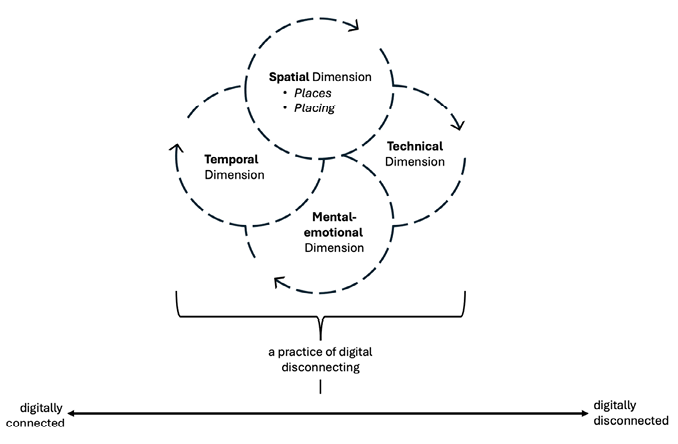
Figure 2 summarizes our findings and puts them into perspective within the broader digital disconnection literature. Our results show that digital disconnecting is enacted in practice through the daily activities in which individuals relate to their devices (Whittington, 2006; see also Feldman & Orlikowski, 2011). Taking a practice-based approach foregrounds the ongoing undertakings through which phenomena, such as using, disconnecting from, or reconnecting to social media, are continuously enacted. The circular arrows in Figure 2 represent that everyday doings shape the dimensions of digital disconnecting. The dimensions mutually configure each other (illustrated by their overlaps) and fuse in practice (indicated by the dashed lines), forming practices of digital disconnecting. A given practice can be located along a continuum between being “digitally connected” and “digitally disconnected.”
6 Discussion
We now turn to our discussion of our study’s conceptual contributions, theoretical and practical implications, limitations, and directions for future research.
6.1 Contributions to Research
Amid mounting concerns over digital well-being, and the topic of digital disconnection becoming a “much-discussed solution” to the downsides of mobile technology use (cf. Klingelhoefer et al., 2024), this study has explored how disconnective practices are lived and experienced, as their impact on well-being depends on more than the act of disconnection itself. Our study makes two conceptual contributions to research on digital disconnection and well-being in the context of everyday mobile technology use. First, we conceptualize digital disconnecting through a practice-based lens as an emergent, ongoing practice rather than a singular act, unfolding both deliberately and incidentally. How disconnective practices relate to digital well-being depends on how temporal, mental-emotional, technical, and spatial dimensions are enacted in specific situations. Second, we theorize spatiality as a distinct and relevant dimension of digital disconnecting, encompassing both the notion of place and the placing of devices.
Drawing on the fusion view in IS research (El Sawy, 2003) and on practice theory, our first contribution is to conceptualize digital disconnection not as a deliberate act (Nassen et al., 2023), but as an unfolding and situated practice (Reckwitz, 2002; Oborn et al., 2011; Wessel et al., 2019), captured by the continuous term “digital disconnecting.” This is particularly useful for unpacking how people engage in digital disconnecting over time. This alternative conceptualization matters, as individuals often face challenges disconnecting from devices and platforms (Nguyen, 2023), underscoring the need for further nuanced insights into how such struggles play out in everyday life. Earlier work has meaningfully explored temporal (e.g., Jorge, 2019; Rosenberg & Vogelman-Natan, 2022; Farooq et al., 2023; Šimunjak, 2023; Marx et al., 2024), mental-emotional (e.g., Park & Kaye, 2019; Cai et al., 2020; Gerlach & Cenfetelli, 2020; Vanden Abeele & Nguyen, 2023), and technical aspects (e.g., Lyngs et al., 2019; Meier & Reinecke, 2021; Nguyen, 2021) of deliberate digital disconnection. Our study demonstrates the value of conceptualizing these aspects as interrelated dimensions that dynamically fuse in practice (El Sawy, 2003). This provides us with a conceptual language and analytical lens to understand how the deep embedding of digital devices into everyday life and their reciprocal shaping of it unfold in practice (Yoo, 2010; Baskerville et al., 2019; Yoo et al., 2024), and why this entanglement poses a struggle for many individuals wishing to disconnect. These dimensions form a continuum that moves beyond binary notions of being online or offline, connected or disconnected. Conceptualizing digital disconnecting as a continuous practice enables a nuanced understanding of how disconnective practices unfold in situ, embedded in the context of everyday life.
Prior research has often framed digital disconnection as the temporary and deliberate non-use of devices, platforms, features, and/or contents (Nassen et al., 2023), such as reducing screentime duration or frequency of smartphone use with the help of device settings or by adhering to rules (Vanden Abeele et al., 2024, p. 24). Such deliberation, as our study shows, also emerges in practice. Individuals like Oliver might employ known disconnection strategies, such as intending to limit screen time; however, their enactment is key to whether these strategies can be effective. This is why a practice-based approach complements earlier literature that conceptualizes digital disconnection as a strategic action by instead foregrounding digital disconnecting as an emergent, dynamic practice shaped by the continual configuring and reconfiguring of its underlying dimensions. Moreover, our findings show that disconnective practices may involve deliberate intent, though it does not have to per se. Intent is only one pathway; disconnecting can also emerge incidentally, as a by-product of doing other things, often tied to certain places.
The second contribution of our study centers on how we conceptualize the dimensions of digital disconnecting, with particular emphasis on theorizing the spatial dimension as meaningful and distinct. When digital disconnecting is enacted in practice, it becomes tangible that the bodily experience of the spatial context shapes how the temporal, mental-emotional, and technical dimensions are configured and fused. So far, spatiality has remained underacknowledged in prior research. For instance, while Vanden Abeele et al. (2024) highlighted the importance of “environment-fit” in their framework of digital disconnection, this aspect remains under-theorized. By employing a practice theory perspective, we identify the importance of the spatial context and contribute to the literature by framing it as a distinct dimension of digital disconnecting.
Taken together, these insights point toward a more holistic and situated conceptualization of digital disconnecting, understood as comprising a temporal, mental-emotional, technical, and spatial dimension whose dynamic interplay shapes disconnective practices. By conceptualizing disconnecting as an emergent, spatially embedded practice, our findings contribute to a richer understanding of how attaining digital well-being – defined as a dynamic “experiential state of optimal balance between connectivity and dysconnectivity” (Vanden Abeele, 2020, p. 932) – involves navigating complex, embodied, and situated engagements with technology in everyday life.
6.2 Practical Implications
Our findings offer two practical implications for engaging in disconnective practices that restore and enhance digital well-being. First, that individuals often disconnect as a by-product of engaging in other activities, often tied to different places, suggests that digital well-being efforts could benefit from supporting these everyday practices, rather than relying solely on adherence to behavioral guidelines or feature-based interventions (Nguyen, 2021). Second, device placement emerged as a low-effort yet influential practice that shapes how individuals engage with or disconnect from their devices. Placing devices not only out of sight but assigning them a specific location in the home to increase physical distance may help foster habitual engagement in disconnective practices and disrupt connective routines. These implications highlight the value of considering the spatial context of everyday life in the design of digital well-being interventions.
6.3 Limitations and Future Research
While our qualitative approach offers rich insights into everyday disconnective practices, it also comes with certain limitations. As with all qualitative research, our findings aim to contribute to conceptual, not statistical, generalization (Lee & Baskerville, 2003, 2012) by unpacking how digital disconnecting is enacted in everyday life through practice. This theoretical contribution was prioritized over representativeness.
Second, our sample presents certain limitations. Our study was based on a relatively small sample size comprising 12 interviews and 5 observations. Participants were between the ages of 21 and 34 and living in Germany or Spain, except for two individuals residing in South Korea. While four participants originated from outside Germany or Spain (the United Kingdom, Iran, Ukraine, and the United States), the overall cultural diversity was limited. This may constrain the transferability of our findings to older age groups, other world regions, or individuals with limited access to digital technologies.
Thirdly, regarding modality, half of the interviews were conducted via video calls, which can lead to shorter or less in-depth conversations compared to in-person formats (Irvine, 2011). However, interview durations and the richness of participant responses suggest that the video medium did not significantly compromise our data quality. Conducted in late 2022 and early 2023 during the COVID-19 pandemic, the interviews may reflect pandemic-related shifts in how participants engaged with and disconnected from digital technologies.
Fourthly, our reliance on retrospective self-reports represents a methodological limitation, as with many interview-based qualitative studies (Jerolmack & Khan, 2014). Although this approach is widely used in digital disconnection research (e.g., Floros et al., 2021; Nguyen, 2021, 2023; Agai & Agai, 2022), self-reporting may invite biased or incomplete representations, especially on topics shaped by social norms. For instance, mobile technology use may be framed as aspirational by research participants. Despite this, we found that the participants were often self-reflective and critical of their own behavior.
Future research could further explore the role of place and placement in shaping disconnective practices, including the development of distinct spatial strategies and their effectiveness. Given that mobile media use is not bound to specific locations, to what extent and under what conditions place configures disconnective practices remain open questions. It may also be valuable to further examine how concrete spatial aspects, such as proximity, positioning, visibility, physical perceptibility, and the presence of physical boundaries, shape everyday (dis)engagement with devices. While we included embodied aspects within spatiality, we did not analyze embodiment as a separate dimension; future research could further develop this perspective. Future work could also assess the relative effectiveness of spatial strategies compared to more established approaches (e.g., Nguyen, 2021; Vanden Abeele et al., 2024) and explore how these effects generalize across diverse populations and situational contexts.
7 Conclusion
With growing concern over the impact of constant connectivity, individuals and institutions alike are seeking ways to disconnect from digital technologies to foster well-being in a digital world. Our study contributes to this discussion by shifting the focus from disconnection as a strategic act to disconnecting as a situated practice that can happen both deliberately and incidentally, shaped by the varying fusion of mental-emotional, technical, and spatial dimensions over time. In particular, we foregrounded the role of place and placement for practices of disconnecting. The findings from our practice theory-based study open new avenues for theorizing, practically engaging in, and designing for disconnective practices.
Acknowledgement
We thank our editor Dr. Hannes-Vincent Krause and the three anonymous reviewers for their support and thoughtful feedback during the review process.
References
Agai, M. S., & Agai, M. S. (2022). Disconnectivity synced with identity cultivation: Adolescent narratives of digital disconnection. Journal of Computer-Mediated Communication, 27(6). https://doi.org/10.1093/jcmc/zmac025
Bansal, P. (Tima), & Corley, K. (2011). The coming of age for qualitative research: Embracing the diversity of qualitative methods. Academy of Management Journal, 54(2), 233 – 237. https://doi.org/10.5465/amj.2011.60262792
Bardhan, I., Chen, H., & Karahanna, E. (2020). Connecting systems, data, and people: A multidisciplinary research roadmap for chronic disease management. Management Information Systems Quarterly, 44(1), 185 – 200
Barrett, M. et al. (2012). Reconfiguring boundary relations: Robotic innovations in pharmacy work. Organization Science, 23(5), 1448 – 1466. https://doi.org/doi:10.1287/orsc.1100.0639
Baskerville, R L., Myers, M. D., & Yoo, Y. (2019). Digital First: The Ontological Reversal and New Challenges for Information Systems Research. MIS Quarterly, 44(2), 509 – 23. https://doi.org/10.25300/MISQ/2020/14418
Bossio, D., & Holton, A. E. (2021). Burning out and turning off: Journalists’ disconnection strategies on social media. Journalism, 22(10), 2475 – 2492. https://doi.org/10.1177/1464884919872076
Bucher, T. (2020). Nothing to disconnect from? Being singular plural in an age of machine learning. Media, Culture & Society, 42(4), 610 – 617. https://doi.org/10.1177/0163443720914028
Büchler, N., Ter Hoeven, C. L., & Van Zoonen, W. (2020). Understanding constant connectivity to work: How and for whom is constant connectivity related to employee well-being?. Information and Organization, 30(3), 100302. https://doi.org/10.1016/j.infoandorg.2020.100302
Burr, C., & Floridi, L. (2020). Ethics of digital well-being: A multidisciplinary approach. Springer.
Cai, W., McKenna, B., & Waizenegger, L. (2020). Turning it off: Emotions in digital-free travel. Journal of Travel Research, 59(5), 909 – 927. https://doi.org/10.1177/0047287519868314
El Sawy, O. A. (2003). The IS core IX: The 3 faces of IS identity: Connection, immersion, and fusion. Communications of the Association for Information Systems, 12. https://doi.org/10.17705/1CAIS.01239
Farooq, A., Dahabiyeh, L., & Maier, C. (2023). Social media discontinuation: A systematic literature review on drivers and inhibitors. Telematics and Informatics, 77, 101924. https://doi.org/10.1016/j.tele.2022.101924
Feldman, M. S., & Orlikowski, W. J. (2011). Theorizing Practice and Practicing Theory. Organization Science, 22(5), 1240 – 53. https://doi.org/10.1287/orsc.1100.0612
Floros, C. et al. (2021). Imagine being off-the-grid: Millennials’ perceptions of digital-free travel. Journal of Sustainable Tourism, 29(5), 751 – 766. https://doi.org/10.1080/09669582.2019.1675676
Gerlach, J. P., & Cenfetelli, R. T. (2020). Constant checking is not addiction: A grounded theory of IT-mediated state-tracking’, MIS Quarterly, 44(4), 1705 – 1732. https://doi.org/10.25300/MISQ/2020/15685
Gieryn, T. F. (2000). A space for place in sociology. Annual Review of Sociology, 26(1), 463 – 496. https://doi.org/10.1146/annurev.soc.26.1.463
Gregory, R. W. et al. (2020). The Role of Artificial Intelligence and Data Network Effects for Creating User Value. Academy of Management Review, 46(3), 534 – 51. https://doi.org/10.5465/amr.2019.0178
Hepp, A. (2020). Deep mediatization. Routledge.
Hultin, L. (2019). On Becoming a Sociomaterial Researcher: Exploring Epistemological Practices Grounded in a Relational, Performative Ontology. Information and Organization, 29(2), 91 – 104. https://doi.org/10.1016/j.infoandorg.2019.04.004
Irvine, A. (2011). Duration, dominance and depth in telephone and face-to-face interviews: A comparative exploration. International Journal of Qualitative Methods, 10(3), 202 – 220. https://doi.org/10.1177/160940691101000302
Jerolmack, C., & Khan, S. (2014). Talk is cheap: Ethnography and the attitudinal fallacy. Sociological Methods & Research, 43(2), 178 – 209. https://doi.org/10.1177/0049124114523396
Johannes, N. et al. (2019). Hard to resist?: The effect of smartphone visibility and notifications on response inhibition. Journal of Media Psychology, 31(4). 214 – 225. https://doi.org/10.1027/1864-1105/a000248
Jorge, A. (2019). Social media, interrupted: Users recounting temporary disconnection on Instagram. Social Media + Society, 5(4), 2056305119881691. https://doi.org/10.1177/2056305119881691
Jorge, A., Amaral, I., & de Matos Alves, A. (2022). “Time well spent”: The ideology of temporal disconnection as a means for digital well-being. International Journal of Communication, 16, 1551 – 1572
Kautz, K., & Jensen, T. B. (2013). Sociomateriality at the royal court of IS. A jester’s monologue. Information and Organization, 23(1). https://doi.org/10.1016/j.infoandorg.2013.01.001
Klingelhoefer, J., Gilbert, A., & Meier, A. (2024). Momentary motivations for digital disconnection: An experience sampling study. Journal of Computer-Mediated Communication, 29(5), 13. https://doi.org/10.1093/jcmc/zmae013
Knott, E. et al. (2022). Interviews in the social sciences. Nature Reviews Methods Primers, 2(1), 73. https://doi.org/10.1038/s43586-022-00150-6
Langley, A. (1999). Strategies for theorizing from process data. Academy of Management Review, 24(4), 691 – 710.
Lebovitz, S., Lifshitz-Assaf, H., & Levina, N. (2022). To engage or not to engage with AI for critical judgments: How professionals deal with opacity when using AI for medical diagnosis. Organization Science, 33(1), 126 – 148. https://doi.org/10.1287/orsc.2021.1549
Lee, A. S., & Baskerville, R. L. (2003). Generalizing Generalizability in information systems research. Information Systems Research, 14(3), 221 – 243. https://doi.org/10.1287/isre.14.3.221.16560
Lee, A. S, & Baskerville, R. L. (2012). Conceptualizing generalizability: New contributions and a reply. MIS Quarterly, 36(3), 749. https://doi.org/10.2307/41703479
Lorenz, J., Kruse, L. C., & Recker, J. (2024). Creating and capturing value with physical-digital experiential consumer offerings. Journal of Management Information Systems, 41(3), 779 – 811. https://doi.org/10.1080/07421222.2024.2376386
Lyngs, U. et al. (2019). Self-control in cyberspace: Applying dual systems theory to a review of digital self-control tools. In Proceedings of the 2019 CHI Conference on Human Factors in Computing Systems. ACM, pp. 1 – 18. https://doi.org/10.1145/3290605.3300361
Marx, J., Mirbabaie, M., & Turel, O. (2024). Digital detox: A theoretical framework and future research directions for information systems. Information & Management, 104068. https://doi.org/10.1016/j.im.2024.104068
Mazmanian, M., Orlikowski, W. J., & Yates, J. (2013). The autonomy paradox: The implications of mobile email devices for knowledge professionals. Organization Science, 24(5), 1337 – 1357. https://doi.org/10.1287/orsc.1120.0806
Meier, A., & Reinecke, L. (2021). Computer-mediated communication, social media, and mental health: A conceptual and empirical meta-review. Communication Research, 48(8), 1182 – 1209. https://doi.org/10.1177/0093650220958224
Merleau-Ponty, M. (2002). Phenomenology of perception: An introduction. Routledge.
Mihailidis, P. (2014). A tethered generation: Exploring the role of mobile phones in the daily life of young people. Mobile Media & Communication, 2(1), 58 – 72. https://doi.org/10.1177/2050157913505558
Möhlmann, M. et al. (2021). Algorithmic management of work on online labour platform: When matching meets control’, MIS Quarterly: Management Information Systems, 45(4)
Mols, A., & Pridmore, J. (2021). Always available via WhatsApp: Mapping everyday boundary work practices and privacy negotiations. Mobile Media & Communication, 9(3), 422 – 440. https://doi.org/10.1177/2050157920970582
Morrison, S L., & Gomez, R. (2014). Pushback: Expressions of Resistance to the “Evertime” of Constant Online Connectivity. First Monday, 19(8). https://doi.org/10.5210/fm.v19i8.4902
Nassen, L.-M. et al. (2023). Opt-out, abstain, unplug. A systematic review of the voluntary digital disconnection literature. Telematics and Informatics, 81, 101980. https://doi.org/10.1016/j.tele.2023.101980
Natale, S., & Treré, E. (2020). Vinyl won’t save us: Reframing disconnection as engagement. Media, Culture & Society, 42(4), 626 – 633. https://doi.org/10.1177/0163443720914027
Nguyen, M. H. (2021). Managing social media use in an “always-on” society: Exploring digital wellbeing strategies that people use to disconnect. Mass Communication and Society, 24(6), 795 – 817. https://doi.org/10.1080/15205436.2021.1979045
Nguyen, M. H. (2023). “Maybe I should get rid of it for a while…”: Examining motivations and challenges for social media disconnection. The Communication Review, 26(2), 125 – 150. https://doi.org/10.1080/10714421.2023.2195795
Nguyen, M. H., Büchi, M., & Geber, S. (2022). Everyday disconnection experiences: Exploring people’s understanding of digital well-being and management of digital media use. New Media & Society, 146144482211054. https://doi.org/10.1177/14614448221105428
Nguyen, M. H., & Hargittai, E. (2023). Digital disconnection, digital inequality, and subjective well-being: a mobile experience sampling study. Journal of Computer-Mediated Communication, 29(1), 44. https://doi.org/10.1093/jcmc/zmad044
Oborn, E., Barrett, M., & Davidson, E. (2011). Unity in diversity: Electronic patient record use in multidisciplinary practice. Information Systems Research, 22(3), 547 – 564. https://doi.org/doi:10.1287/isre.1110.0372
Orlikowski, W. J. (1996). Improvising organizational transformation over time: A situated change perspective. Information Systems Research, 7(1), 63 – 92. https://doi.org/10.2307/23010790
Orlikowski, W. J., & Iacono, C. S. (2001). Research commentary: Desperately seeking the “IT” in IT research – A call to theorizing the IT artifact. Information Systems Research, 12(2), 121 – 134. https://doi.org/DOI%252010.1287/isre.12.2.121.9700
Orlikowski, W. J., & Scott, S. V. (2008). Sociomateriality: Challenging the separation of technology, work and organization. Academy of Management Annals, 2(1), 433 – 474. https://doi.org/10.5465/19416520802211644
Orlikowski, W. J., & Scott, S. V. (2015). The algorithm and the crowd: Considering the materiality of service innovation. MIS Quarterly, 39(1), 201 – 216. https://doi.org/10.25300/MISQ/2015/39.1.09
Park, C. S., & Kaye, B. K. (2019). Smartphone and self-extension: Functionally, anthropomorphically, and ontologically extending self via the smartphone. Mobile Media & Communication, 7(2), 215 – 231. https://doi.org/10.1177/2050157918808327
Radtke, T. et al. (2022). Digital detox: An effective solution in the smartphone era? A systematic literature review. Mobile Media & Communication, 10(2), 190 – 215. https://doi.org/10.1177/20501579211028647
Reckwitz, A. (2002). Toward a theory of social practices: A development in culturalist theorizing. European Journal of Social Theory, 5(2), 243 – 263. https://doi.org/10.1177/13684310222225432
Rosenberg, H., & Vogelman-Natan, K. (2022). The (other) two percent also matter: The construction of mobile phone refusers. Mobile Media & Communication, 10(2), 216 – 234. https://doi.org/10.1177/20501579211033885
Sarker, S. et al. (2019). The sociotechnical axis of cohesion for the IS discipline: Its historical legacy and its continued relevance. MIS Quarterly: Management Information Systems, 43(3). https://doi.org/10.25300/MISQ/2019/13747
Schatzki, T. R. (1996). Social practices: A Wittgensteinian approach to human activity and the social. Cambridge University Press. https://doi.org/10.1017/CBO9780511527470
Schatzki, T. R. (2025). Agency. Information and Organization, 35(1), 100553. https://doi.org/10.1016/j.infoandorg.2024.100553
Šimunjak, M. (2023). “You have to do that for your own sanity”: Digital disconnection as journalists’ coping and preventive strategy in managing work and well-being. Digital Journalism, 0(0), 1 – 20. https://doi.org/10.1080/21670811.2022.2153711
Turkle, S. (2008). Always-on/always-on-you: The tethered self. In J. E. Katz (Ed.), Handbook of mobile communication studies (pp. 121 – 138). The MIT Press. https://doi.org/10.7551/mitpress/9780262113120.003.0010
Vaast, E., & Pinsonneault, A. (2022). Dealing with the social media polycontextuality of work. Information Systems Research, 33(4). https://doi.org/10.1287/isre.2022.1103
Van Bruyssel, S., De Wolf, R., & Vanden Abeele, M. (2023). Who cares about digital disconnection? Exploring commodified digital disconnection discourse through a relational lens. Convergence: The International Journal of Research into New Media Technologies, 13548565231206504. https://doi.org/10.1177/13548565231206504
Vanden Abeele, M. M. (2020). Digital wellbeing as a dynamic construct. Communication Theory, 31(4), 932 – 955. https://doi.org/10.1093/ct/qtaa024
Vanden Abeele, M.M.P. and Nguyen, M.H. (2022). Digital well-being in an age of mobile connectivity: An introduction to the Special Issue. Mobile Media & Communication, 10(2), 174 – 189. https://doi.org/10.1177/20501579221080899
Vanden Abeele, M. M., & Nguyen, M. H. (2023). Digital media as ambiguous goods: Examining the digital well-being experiences and disconnection practices of Belgian adults. European Journal of Communication, 02673231231201487. https://doi.org/10.1177/02673231231201487
Vanden Abeele, M. M. et al. (2024). Why, how, when, and for whom does digital disconnection work? A process-based framework of digital disconnection. Communication Theory, 34(1), 3 – 17. https://doi.org/10.1093/ct/qtad016
Vanden Abeele, M. M., Halfmann, A., & Lee, E. W. J. (2022). Drug, demon, or donut? Theorizing the relationship between social media use, digital well-being and digital disconnection. Current Opinion in Psychology, 45, 101295. https://doi.org/10.1016/j.copsyc.2021.12.007
Villanti, A.C. et al. (2017). Social media use and access to digital technology in US young adults in 2016. Journal of Medical Internet Research, 19(6), e196. https://doi.org/10.2196/jmir.7303
Vorderer, P. et al. (Eds.) (2017). Permanently online, permanently connected: Living and communicating in a POPC world. Routledge. https://doi.org/10.4324/9781315276472
Wessel, L., Davidson, E. J., et al. (2019). Configuration in smart service systems: A practice-based inquiry. Information Systems Journal, 29(6), 1256 – 1281. https://doi.org/10.1111/isj.12268
Wessel, L. et al. (2024). Designing as trading-off: A practice-based view on smart service systems. European Journal of Information Systems, 1 – 26. https://doi.org/10.1080/0960085X.2024.2308541
Whittington, R. (2006). Completing the practice turn in strategy research. Organization Studies, 27(5), 613 – 634. https://doi.org/10.1177/0170840606064101
Whittington, R. (2011). The practice turn in organization research: Towards a disciplined transdisciplinarity. Accounting, Organizations and Society, 36(3), 183 – 186. https://doi.org/10.1016/J.AOS.2011.04.003
Yoo, Y. (2010). Computing in everyday life: A call for research on experiential computing. MIS Quarterly, 34(2), 213. https://doi.org/10.2307/20721425
Yoo, Y. et al. (2024). The next frontiers of digital innovation research. Information Systems Research, 35(4). https://doi.org/10.1287/isre.2024.editorial.v35.n4
Yoo, Y., Henfridsson, O., & Lyytinen, K. (2010). Research commentary – The new organizing logic of digital innovation: An agenda for information systems research. Information Systems Research, 21(4), 724 – 735. https://doi.org/10.1287/isre.1100.0322
Appendix
Table A1: Illustrative Data and Practice Theory-informed Analysis
|
Analytical Summaries |
Excerpts from Interviews |
|
Informant: Paul |
|
|
In Paul’s account, digital disconnecting emerges as an unfolding across technical, temporal, and mental-emotional dimensions. The temporary absence of a SIM-card (technical) left him “offline-offline” for ten days (temporal). At first, the feeling of “missing out” lingered on him (mental-emotional) due to being offline. He temporarily reconnected via Wi-Fi of the supermarket downstairs (“Edeka”; spatial: place) when “loaf[ing] around” during opening hours (temporal), which underscores the technical infrastructural nature of connectivity, this time bound to a physical place (Quote 1). Further, when he was offline (technical) and his smartphone (technical: device) wasn’t nearby (“not around me”; Quote 2), he described heightened cognitive activity, deliberately searching how he’s going to spend his time “productively” (Quote 2). He spent more time outside of his flat (spatial: place) and took interest in reading a book at home (mental-emotional; Quote 3). In contrast, if he has his mobile phone (technical: device) around him and it’s connected to the internet (technical), his mind becomes “quite quickly” distracted by it, diverting his attention (mental-emotional; Quote 3). |
“[…] previously, in my current flat, I didn’t have Wi-Fi, no internet connection, and I was only reachable via mobile data to do the bare minimum, WhatsApp etc. But then I got myself a new [internet] contract. Yes, and then the SIM card was sent to my address in Bonn and my current SIM card had been cancelled already and I was offline for ten days - offline-offline. I could only loaf around the WLAN in the Edeka downstairs when it was open. And at the beginning it was kind of... well, difficult would be too much to say, but you get the feeling you’re missing out on something.” (Interview mit Paul) “[...] at the beginning of December, I was offline for ten days and, I don’t know, that was the first time I really thought to myself: What am I going to do with my time? And then I started reading a book. And - what I notice with my mobile phone - is that when I don’t have it around me, I have to think a lot more about how I can occupy myself productively.” (Interview with Paul) “So it’s actually easier for me to do something productive without my mobile phone, to find a productive task, because the mobile phone distracts me quite quickly, of course. [...] So when I’m not online, I’m more forced to actively engage with myself and perhaps actively say: Paul, that didn’t go so well. [...] I then have more in the back of my mind: OK, I could still do this, I could still do this, the laundry here. It’s just a bit easier for me without my mobile phone, because then I have these things a bit more present in my brain, that I still have to do it.” (Interview with Paul; emphasis in italics reflects the interviewee’s intonation) |
|
Informant: Amelie |
|
|
For Amelie, there was a noticeable connection between place, technical, emotional and mental dimensions of disconnecting when spending time with other people, for instance when eating out (spatial: place). Specifically, depending on where she placed her smartphone (technical: device), she felt distracted due to physically sensing the phone in her hand or in her trousers (mental-emotional), even when it was set to mute (technical: feature). For Amelie, her phone’s physical presence generates a subtle (“a bit”) yet persistent distraction (“it’s distracting”) whether she was receiving a message or merely anticipating one (mental-emotional). To avoid this, she placed the phone somewhere she could no longer feel its presence (e.g., in her jacket pocket where “I don’t notice it”), supporting her to avoid being “rude” (emotional) in a conversation by not being “distracted” (mental). |
“So actually, as a standard, I would say I don’t really like having my mobile phone with me, so to speak, close to hand or in my trouser pocket or something, when I’m out with other people or out to eat or something like that with real people. Because then I just know that it’s distracting and I think it’s a bit rude. I talk to the person and then I’m always a bit distracted because I realise I’m getting a message or maybe I think I’m getting a message or something. In other words, I try to avoid that. I’m okay, I have my mobile phone with me, but it’s somewhere in my jacket pocket. I don’t notice it. It’s silent.” (Interview with Amelie) |
|
Informant: Luca |
|
|
Luca’s walking routine (spatial: place) with his dog exemplified a form of digital disconnecting where technical connectivity was maintained but mental-emotional attention was redirected from the smartphone (technical: device) and social media (technical: type of application). During the walk, he placed the smartphone in his jacket pocket, interacting with a music streaming app (technical: type of application) only through tapping on his earphones (technical: device) connected to this phone via Bluetooth (technical: feature). Placed in his jacket pocket, his phone remains easily accessible (spatial: placement) and connected to the internet (technical) in case someone reaches out for him by calling. During this “smartphone-free time” (mental-emotional) he actively avoids engaging with any other applications, features, interactions, or messages apart from listening to music. This illustrates a selective mode of disconnection in which technical connectivity coexists with deliberate mental and emotional distancing supported by the spatial arrangement and minimal interaction thanks to additional devices (e.g. Bluetooth earphones). |
As Luca steps outside with his dog, the evening air is crisp, and the streetlights have already turned on, casting spots of light over the pavement. At his side, his dog trots along as they follow their usual route. During this time, it’s just him, his dog, and the music playing through his earphones from his smartphone. A gentle tap on his earphone skips a song, avoiding the need to pull out his phone. To him, this walk is “smartphone-free time” – an intentional break from replying to messages, engaging with social media, reading news, or playing mobile games. However, he carries his phone with him, not only for music but also to remain reachable in case of emergency. He keeps his phone tucked away, only reaching for it if a call comes in. (Vignette based on interview and fieldnotes of shadowing Luca) |
|
Informant: Niklas |
|
|
For Niklas, it’s not the interruption caused by a message that he finds most frustrating, but the moment his attention (mental-emotional) is drawn to his phone (technical: device) simply because it lights up “even though nothing is happening” as he hasn’t received any notification (technical: communication-centred). To avoid this, he flips the phone, so that the screen faces down (spatial: positioning). In doing so, he doesn’t remove the phone’s presence altogether but eliminates the possibility of the screen lighting up (technical: feature) and thereby capturing his attention (mental-emotional). Niklas describes how two distinct places - the office and his home-office - facilitate different practices of disconnecting from his smartphone. In the office, spatial separation enables incidental forgetting. Because he frequently moves around rather than sitting at his desk, where the phone remains placed (spatial: placement), it can happen that hours pass without him thinking about the device (“it can happen that […] I haven’t thought about it [my phone] at all”; mental-emotional). Reconnection occurs if a call comes in, signalled by the ring tone (technical: feature) (Quote 1). In contrast, when working from home (spatial: place), Niklas keeps his phone (technical: device) within arm’s reach and in his visual field with its screen facing upward (spatial: positioning) and with vibration alerts (technical: feature) enabled. While this proximity ensures availability for important work-related calls or messages (technical: communication-centred), it also allows |
“That I think to myself I’m not doing anything [with the mobile phone], there’s no message and [it] lights up and I... my attention is briefly drawn to [the mobile phone] even though nothing is happening. That’s even more pointless than when something happens. If something happens, I can at least pick it up somehow and say a message from XYZ, fine, then I can put it down again. Is it important now? But the fact that [the mobile phone] just lights up without anything happening is somehow the most annoying interruption ever. But that, I don’t know, it’s relatively easy to eliminate in this way (he turns the mobile phone over in his hand so that the screen is facing the floor and the phone case is facing upwards). Which is relatively often the case with me.” (Interview with Niklas) When Niklas is working in the office, he is not sitting at his desk all day but also moving around the office, interacting with his colleagues while his phone stays in the same place: “I rarely have it in my pocket when I’m staying somewhere for a long time. It’s usually lying around somewhere... At work, it can really happen that my mobile phone is lying around at my desk for six hours and I (incomprehensibly) haven’t thought about it at all, which I think is super nice because then it’s just lying around so stupidly and if it should ring, I notice it.” (Interview with Niklas) When Niklas is working from home, water and a coffee mug are placed on the right side of his laptop so that he can reach them more easily since he is right-handed. He places his smartphone left to his laptop on the desk: [Vibration is on] to hear the notifications. |
|
him to assess whether any other incoming messages require an immediate response. He thus maintains a lighter mode of connection by monitoring and evaluating the urgency of incoming messages without necessarily unlocking the screen to respond to the sender (mental-emotional). |
[...] Mainly because my boss is calling. So I have to be available for that. And then I have to reply relatively quickly and things like that. That’s why it’s always down to vibration. Yes. That’s the main reason. [...] especially throughout the day when I’m working [...] I don’t unlock it. I usually look at the lock screen to see who has written something and then it’s just to-do lists or |
|
priorities like that. Then there are just two people who I know or where I’m expecting a reply somehow and then I have to look in and then I want to reply and everything else is just kind of nice to know, we’ll do it later. [...] If I then open it, then I’m out of my job. Because then it’s just this active what did the person write, okay what did I write - so sometimes it’s also a bit like thinking about what did I write before, what topic is it about, sometimes it’s not so obvious because it’s somehow also an answer and then I have to think about it and then I’m already relatively alienated again and somehow quite deep in the matter. And that’s not where I want to go.” (Interview with Niklas) |
|
|
Informant: Enric |
|
|
Enric’s account illustrates how proximity and visibility (spatial: placement) of his smartphone (technical: device) can trigger a shift in practice, even when another media practice - watching anime (technical: content) on his laptop (technical: device) - is ongoing. While taking a break (temporal) to go to the bathroom (spatial: place), seeing the phone and picking it up on the way leads him from replying to messages to scrolling social media (technical: communication-centred), which ultimately disrupts his intention to sleep (mental-emotional). Here, the bathroom becomes a transition point: a place where he momentarily disconnects from one screen-based practice (anime viewing on his laptop) but reconnects with another (social media and messenger use on his smartphone), illustrating how spatial transitions can both interrupt and enable shifting digital practices. |
“I keep the phone always close to me, even when I’m sleeping. And what this makes is that whenever I want to go to sleep, I keep the phone, and I keep like looking on social networks, for example. And I lose a lot of time. […] it happened yesterday. So, I wanted to go to sleep but at 12. I stayed working until 12.30am or 1.30am. And I wanted to go to at least get some hours of sleep, not seven but six. And I ended up like scrolling out on my social network. Just looking about things and answering people on WhatsApp and it made me lose maybe half an hour or one hour of sleeping time. […] I was working on my laptop, which I spent a lot of hours like in front of, apart from my working hours, just watching TV series, TV shows, Animes sometimes. And I was watching an Anime to going to get to sleep, and to just like getting up to date with all of the ones that I’m watching. And I had my phone over there. And I just - it was like a natural reaction. I went to the bathroom and I took it. And I started replying over there.” (Interview with Enric) |
|
Informant: Ulyana |
|
|
Ulyana’s experience highlights the complexity of the mental-emotional dimension of digital disconnecting, in this situation shaped by availability expectations and technical infrastructure. Prior to a trip in the mountains, she embraced the idea of being offline due to a lack of signal (technical); disconnecting not only from her device, applications and features (technical: channel-centred), but also from digital interactions and messages (technical: communication-centred). She mentally and emotionally prepared for this situation and informed everyone that she would not be available. When arriving in the mountains, the unexpected availability of Wi-Fi transformed non-availability from technical circumstances into a deliberate choice, introducing tension (mental-emotional). The technical possibility of connection brought her anxiety about “missing something or not knowing something” (mental-emotional) to the foreground. |
“We were in the mountains in Poland two months ago and were told there was no reception. So we have to let everyone know. We’re going to be without reception for a few days now so that nobody worries. Of course I told everyone okay, I won’t have reception now. And I was so disappointed when there was Wi-Fi. Because I was so, so prepared for it: Okay, I’m not going to read any messages, I’m not going to make any phone calls and I’m not going to be on Instagram and so on. I have three days off my mobile phone now. And there was Wi-Fi. And of course I switched on the Wi-Fi. I still tried to use it as little as possible because everyone knew I wasn’t available. But I sent messages anyway. And sometimes I replied directly and my plan fell through. [...] because I still knew that something would arrive. It will. Yes, I have to check a few more messages now and it just makes me anxious that I’m missing something or not knowing something.” (Interview with Ulyana) |
|
Informant: Shadi |
|
|
Due to being in a hurry (mental-emotional), Shadi forgot to take her phone (technical: device) with her, resulting in spatial separation. Though her phone was technically connected at home (spatial: place), it was inaccessible to Shadi due to the physical distance of her being outside (spatial: place). Shadi experiences group chats and the high volume of incoming messages (technical: communication-centred) as a source of distraction (mental-emotional). In order to relax or spend quality time with friends (mental-emotional), she likes to intentionally leave her phone at home (spatial: place), thereby creating spatial separation. |
“I do it [leave my phone at home intentionally] actually regularly because like, I have so many groups, like different groups for different activities and sometimes people are so chatty, so many messages come up and times I want to relax, like go for a walk or just be with friends that I just want to be with them and I don’t want any distraction. I just leave my phone. And I just take my credit card with me and I go. Maybe the last time was maybe two days ago, I went for a walk with my friends around the lake and went to a café, and we were spending a very lovely time, quality time. So I didn’t take my phone.” (Interview with Shadi) |
|
When Shadi feels emotionally and mentally overwhelmed (“when I get lost and I feel shit”), spatial separation from her phone offers relief. Putting her phone away and stepping into the shower (spatial: place) that helps her reconnect with her sensory experience, providing comfort and calming her mind (mental-emotional). For Shadi, spatial separation from her smartphone enables “a sort of feeling of freedom” (mental-emotional). Merely turning it off (technical) while carrying her smartphone (technical: device) with her doesn’t evoke the same sense of freedom and doesn’t fully allow her “to be with [her]self,” to be “separated from the [digital] world.” In her experience, the spatial separation to her device shapes her mental-emotional state in ways that technical disconnection alone can’t evoke. |
“And the interesting thing is when I spend too much screen time - not only on my phone, even in my computer but mostly on my phone - when I get lost and I feel shit, I go take a shower. I don’t know why it helps but somehow I feel it helps. […] then there’s something like taking me out of that and give me that comfort in different way, I don’t know. But I do that all the time when my mind is so busy. I just feel like I need to take a shower so.” (Interview with Shadi) “I kind of feel like if I don’t have it with me, it means no one can find me. So it gives me a sort of feeling of freedom. That doesn’t make sense because as you’re right, you can turn it off and have it with you for an emergency situation, which is way more like smarter, actually. But I don’t know, I kind of feel like I don’t want anything.” (Interview with Shadi) “For example, I went for a temple stay and I had my phone with me, of course. But the whole process of going out of the room for meditations, for the walk, for the hike, I left my phone in the room because it kind of gave me the sense of... I’m separated from the world. To be with myself. And if I have any sort of device that does not allow me to be with myself, even though that’s not true, you can turn it off, you know?” (Interview with Shadi) |
|
Informant: Amelie |
|
|
Technical disconnection (lack of signal in the train when underground) doesn’t automatically create disconnection on a mental-emotional dimension which doesn’t even need to be conscious but can also happen unconsciously. On the train, Amelie noticed that she has been pulling out her smartphone (technical: device) “two or three times” (temporal) despite not wanting to change the music or do something else, and not having signal (technical) to receive messages (technical: communication-centred). Amelie’s account underscores that technical disconnection (in this case, the absence of signal while travelling through underground train stations) does not automatically produce disconnection on a mental-emotional level. |
“I had an appointment with someone in the city centre and... Um, it’s just the railway line that I have to take. There were really only four stations and they go there - but two of them are underground, where there’s hardly any network. And I always listen to music on the train. Let’s put on some list where it doesn’t matter whether I have a network or not, because it’s downloaded. That means I don’t have to worry about that. And I didn’t actually expect any messages, because I had a date with the person, but I still had enough time. I also knew where we were meeting and everything was secure [...] And although I knew that I was in this tunnel and didn’t actually have a network, I checked my mobile phone. But I had no |
|
Despite being fully aware that she could not receive messages and had no functional need to adjust her music (which had been downloaded in advance), she still found herself pulling out her phone “two or three times” (temporal) “without much sense.” This situation demonstrates how mental-emotional engagement with the device persist at an unconscious level even when technical connectivity is temporarily suspended. In contrast, when her battery later ran out entirely on a different day, she described feeling “just fine,” highlighting how perceived interaction potential due to technical unavailability of the screen shapes disconnection as a mental-emotional state. Instead of reaching out for her phone, she observed her surroundings more closely (e.g. staring out of the window). |
other reason to do so. Because, as I said, I knew where I was going. I didn’t get a message because I couldn’t get a message. I had my music selection... was set, I didn’t have to switch or anything. And still I looked at my mobile phone. Probably two or three times without much sense.” (Interview with Amelie) “Oh, no message. Oh yes, no network. And by the third time at the latest, if - because I’ve seen it happen to me before - I just take out my mobile phone. Like this: Now you’ve taken out your mobile phone again (laughs). So it usually only comes somehow... after the third or fourth time, this thought that I then really consciously notice how often I’ve now reached for my mobile phone.” (Interview with Amelie) When Amelie’s mobile phone battery ran out on another day, she describes the following: “I couldn’t listen to music or do anything on the bus, I just stared out of the window or watched something, and it was just fine” (Interview with Amelie) |
|
Informant: Tabea |
|
|
Spatial dimension: Tabea is at home (spatial: place), in a private and familiar setting opens up space for relaxation and passive digital engagement. Her phone is physically present and within reach throughout the day, facilitating repeated return to the device (spatial: placement). In terms of the temporal dimensions, Tabea glides in an out of digitally (dis)connecting from the social media apps TikTok and Instagram, mostly watching videos passively. In total, she spent about five hours on social media, though in several sessions. |
It’s a slow Sunday morning for Tabea. She is at home, having breakfast, while scrolling through TikTok on her smartphone. Video after video draws her in. When she realises that much of the content shown to her doesn’t interest her anymore, she puts her phone away and turns to practical tasks, like cleaning and laundry. Despite just having put her phone away, she feels the itch to pick it up again. With nothing planned for the day and not being in the mood to do anything, she finds herself unsure of what to do with herself. Rather than letting herself experience the discomfort she senses, she looks for a distraction and turns to the colourful flow of videos curated for her on her TikTok app again and again. |
|
Mental-emotional dimension: Tabea moves between boredom, low motivation, and a vague sense of inner restlessness. She recognises that the content no longer interests her but still finds herself reaching for the device — an “itch” she tries to relieve with curated distraction. Emotional discomfort, uncertainty about what to do, and a desire to avoid that discomfort lead to compulsive re-engagement. The end of the day brings reflection and regret, as she contrasts her screen time with the sense of things left undone. Technical dimension: The never-ending algorithmically curated content provided by TikTok and Instagram (technical: branded applications) and available through constant internet connection (feature) of her smartphone (device) facilitates passive consumption and offers little friction to re-engagement (mental-emotional) once Tabea picks up her phone again to open the app. Though Tabea carries her smartphone (technical: device) with when she’s working or travelling (spatial: place), she is not drawn to using (mental-emotional) the social media platforms (technical: type of application) TikTok and Instagram (technical: branded applications). Instead, she is occupied with working, or impressions of being on the go (spatial: place), engaging in place-based activities. Therefore, she neither has time nor feels a desire to use (mental-emotional) social media (technical: type of application). Disconnecting from social media emerges incidentally, due to engaging in other place-based activities, configuring her thoughts and emotions. |
By the end of the day, she has spent four hours and nine minutes on TikTok, and 45 minutes on Instagram. A sense of regret settles in. All she did, basically, was watch TikTok reels. There are so many other things could have done – things that mattered, things that moved her forward. But now, the day is over. The night has arrived and it’s time to sleep. (Vignette of Tabea based on the interview) “When I have a lot to do, I don’t really have time to be on TikTok or Instagram. I also notice that in phases when I’m simply working a lot or travelling a lot, I don’t feel like being on social media at all.” (Interview with Tabea) |
|
Informant: Simon |
|
|
Simon is sitting on the sofa in the living room of his home (spatial: place). He wants to occupy himself, and as his smartphone (technical: device) is within reach in his trouser’s pocket (spatial: placement), he pulls it out. He opens a second-hand online marketplace app (technical: type of application) called Wollapop (technical: branded application) to browse through the cars on offer (technical: content) without an intention to buy any. Instead, he simply fantasising about buying or owning a vehicle (mental-emotional). The device’s proximity fused with the mental-emotional search for diversion from his present thoughts and emotions. Yet, the practice leaves him emotionally unchanged or slightly more discontent when he puts down the phone after a while. Then, disconnection emerged without thinking rather than deliberate intent. |
At home, Simon tends to use his phone when he wants to do something but, at the same time, does not feel like doing anything. He sits on the sofa in the living room and pulls out his phone from his pocket because doing so seems like the easiest and quickest way to occupy himself. When he has received a new message he replies to it and opens the App Wallapop (like eBay) on his smartphone. He does not only look at Vans he might want to buy but also at other cars like Audi A6 Avant or 6er BMW without any intention to buy them. He’s interested in what he sees on the screen and enjoys fantasising about buying or owning a van or car. When he closes the app and puts his smartphone on the sofa or in his pocket, he does not feel much different than before. His body feels more rested yet his mind is still bored and slightly more discontent then before. (Vignette based on an observation of Simon) |
|
Informant: Oliver |
|
|
When Oliver is at home (spatial: place) and his smartphone (technical: device) is not stored in the cupboard where it usually goes (spatial: placement), it is connected to the charger with music or an audiobook playing via a streaming application (technical: type of application). Thereby, his device is within reach but not within immediate reach as physical steps are required to reach it (spatial). When Oliver wants to check his phone or respond to a message, the placement of the device requires him to be hunched over it, creating physical discomfort on a bodily level. His embodied discomfort serves as a mental-emotional disconnector as he can maintain control over his doings. In contrast, if he experiences physical relaxation and comfort, he might lose control. On a technical level, he is engaging with a device. On a mental-emotional level, how deeply he is entangled is shaped by the dimensions, particularly by the spatial dimension that configures his bodily experience, thoughts and emotions. |
“I often have audiobooks playing. So, or music on, so I have my phone charging in the corner, it stays- if it’s in the room - and okay again, this [interview call] is a special situation - but if it’s in my room, it’s connected to the charger. That’s the rule. If it’s off the charger, then it goes into foyer. Because that’s too close, too dangerous. So, I have to sit uncomfortably close to it, hunched over, if I want to text someone, I want to reply. If I want to do anything like that, I’m hunched. There’s no comfort - there can be no comfort while I use it. If I’m comfortable, and engaging in the behaviour, suddenly I lose control. Discomfort is a disconnector. A thing that separates me from the phone. Discomfort is a way of retaining control.” (Interview with Oliver) |
|
While YouTube (technical: branded application) is permanently (temporal) blocked (technical: feature) on his phone (technical: device), the social media platform (technical: type of application) remains accessible on his computer (technical: device) because he sometimes needs it for work, making a blockage impractical (mental-emotional). When watching a YouTube video, his laptop is placed on his desk (spatial: placement) and he sits “painfully upright” (spatial: bodily experience of the placement; mental-emotional) until the video (technical: content) is finished (temporal). Oliver experiences a fear of failure (“Sometimes I fail […] and then the day can be gone.”; mental-emotional) but is motivated to try to enact practices that are helpful to him (“what I always strive for”; mental-emotional). He rejects algorithms, (“I do not allow any algorithm in my life”) and has configured the settings to that YouTube’s interface has the search function available, but video suggestions turned off (technical: features), though the YouTube algorithm (technical) is still in place in the background as it cannot be disabled (lack of technical: feature). If not in use, Oliver stores his laptop and smartphone (technical: devices) in the cupboard (spatial: placement) in his flat’s foyer (spatial: place). This creates physical distance between him and the devices – he would have to take several physical steps (spatial) to access them (e.g., walk to the room, open the door, unlock the cupboard, |
“YouTube has been the main problem for most of my life. This [YouTube] is blocked on my phone. And I have it [YouTube] on my computer because sometimes I do need it. But again, if I watch YouTube, I sit at my desk, painfully upright until the YouTube video is finished, if I want to watch anything, I have to search it. There’s no algorithm for Oliver, I do not allow any algorithm in my life. Again, this is like what I always strive for. Sometimes I fail, sometimes my computer makes it to bed and then the day can be gone.” (Interview with Oliver) “And the other thing is, I keep my laptop and my phone in the foyer behind the door. That’s where they live. So if I want to go to them, I have to go open the door, get them out of the cupboard - multiple stages along this at which I can change my mind. The more places at which you have the opportunity to change your mind before engaging in a habit, the more natural control you have over it. Because if it’s one, two, pocket, phone, you only need to make one decision as anyone. But if it’s get up, go to the room, open the door, unlock the cupboard, that’s one, two, three, four things separating you from it. That’s a huge amount more distance, and you’re way less likely to engage in that behaviour. It’s four steps away. So the more steps between you and the object, the better. If it’s off as well, even better, that’s five steps. If it’s out of battery, six steps, you know, the more steps, the more control.” (Interview with Oliver) |
|
grab the device, push the power button). Due to the prolonged temporal process before being able to engage with a device, there is more time to potentially changing his mind (mental-emotional). Thereby, placing and place are not just geographic coordinates but configure thoughts, emotions and movement in space differently compared to placing a smartphone (technical: device) in one’s pocket where access is much more immediate (temporal) |
|
|
Informant: Brian |
|
|
Brian is at home (spatial: place) switching between different screens and their contents. He does not only has his phone in use, but also his computer and tablet (technical: devices) combining them altogether (“combining all my screens together”), switching between screens and different contents (e.g., watching videos and checking emails). While absorbed, he reports feeling “sucked into them” (mental-emotional), unaware of how the spatial setup configures both his posture and immobility (“my body hasn’t moved for a long time”). Over time, bodily discomfort and the realisation of “killing time” trigger a shift in awareness (mental-emotional), prompting a reconfiguration of the practice (e.g., wanting to do something (mental-emotional) that does not involve a screen (technical: device) and move his body (spatial)). This case demonstrates how the fusion of spatial, technical, temporal, and mental-emotional dimensions unfolds and transforms in the course of action. |
“[…] I kind of had a week or two ago that moment where I was like: Man, I’m really - and it wasn’t just my phone, but my computer, my laptop, my tablet, I mean, I’ve got a lot of different screens. So, I realised like combining all my screens together, I’m just spending too much time in front of a screen and I need to read books or go outside or do activities that don’t involve a screen.” (Interview with Brian) “A lot of times, I’m like on multiple screens at the same time. I’m doing- seriously, I got like three screens going on, because I got my computer with a different monitor. So I can like watch a video, check my email, check my phone. And I’ve got like multiple screens going on. And I just realised that I was kind of killing time and not really doing something productive so much. I didn’t really need- there wasn’t an urgent messages that I needed to do. And I’m like, oh. And I realise for me, it feels like if I’m over snacking. And I just started to be like: Ugh, this doesn’t feel great. If I’m too much on my screen, just sitting, my body hasn’t moved for a long time. I’m just kind of like huh, usually not great posture, because I’m not aware. I’m just like sucked into this. And I just started, I realised, oh, man, I gotta move. I gotta do something. So that that was yesterday. And that’s a really common occurrence, especially if I’m inside for a while.” (Interview with Brian) |
|
Informant: Leonie |
|
|
During her commute (temporal) on the subway (spatial: place), Leonie enjoys having music playing through headphones (technical: device) from a music streaming app (technical: type of application) running on her smartphone (technical: device) that is within reach (“in my pocket”; spatial: placement). Especially when the subway it full, her mind is at ease with not having to do anything else than listening to the music and paying attention to not missing the station where she needs to get off (spatial: place; changing over time). In this situation, disconnecting from Instagram (technical: branded application) emerges incidentally due to the spatial and temporal arrangement of the subway being full with people and the destination station only being a few stops away, since it would be more likely for her to engage with the platform if she is on a longer commute and the train is less full. Leonie is sitting down at her desk at home (place), with her laptop (technical: device) placed in front of her, including external keyboard and mouse (technical: devices) connected to it via Bluetooth (technical: |
“So, I’m on the metro and I travel three stops on the U5 [subway] and then I take the U6. And the U5 is only very short, and I don’t want to distract myself in any way, because otherwise I’ll miss the fact that I have to get off and I only ever listen to music. And then the U6, that’s like, I don’t know, 15 minutes or something, I think I’d rather look at Instagram. But especially when it’s full and stuff, I’m actually really happy when I just have my mobile phone in my pocket and my music on. And don’t have to do anything. Well, or want to do. Because it’s just full and I just want to wind down. So downtown-like, um, commuting as relaxation.” (Interview with Leonie) Leonie gets back home from having lunch at the university canteen. She puts on some sweatpants and sits down at her desk. Before she turns back to her university assignment, the grabs a candle that is standing on the small shelf next to her desk and smells it. After she put it down again she says ‘I’ll go on my phone one more time to see if any important people have messaged me before I put my phone away again.’ |
|
feature). Her smartphone (technical: device) is placed behind her laptop, out of her field of vision (spatial: placement). She focuses on her university tasks on her computer until thoughts come to her mind on what other tasks she still needs to do (e.g., asking a friend about meeting later) or when she wonders if someone has messaged her (technical: communication-centred), interrupting herself by reaching for her phone (spatial). The engages with it until she places it again behind der laptop out of sight (spatial: placement). Although she cannot see her smartphone, the mental-emotional aspect of (dis)connecting is salient. She continues to switch between engaging with her smartphone laptop to write messages (technical: interaction and content) and laptop to work on a university assignment (technical: content). |
Six minutes later, after having responded to a few messaged she places her phone behind her notebook and turns to her university assignment. A few minutes later, she turns her gaze away and starts tidying up her desk by moving the charger, planner, pencils case, keys, and her water bottle on the file cabinet next to the desk. ‘I just like to clear my desk; it distracts me when things are in view,’ she comments. Now, only a notepad, a lamp, her laptop (placed on a thick dictionary), keyboard, computer mouse, and her phone (behind der notebook) remain on the table. Her computer screen shows a text file (in Full Screen Mode) with the assignment she is working on. She engages with the task for a few minutes until she reaches for her phone behind her laptop. |
|
‘I’ll quickly message a friend to ask if we want to meet later on to watch the movie together,’ she says while holding her phone with both hands, typing. She has crossed her legs underneath the table and slightly bobs up and down with her knee while types work her right thumb and left index finger. Once she is finished, she puts down her phone again behind her laptop with the screen facing downwards. (Composite narrative based on the interview with and observation of Leonie) |
|
Date received: 20 December 2024
Date accepted: 1 October 2025